That is true, the initial Bonds from the 80s are about to start maturing. The notes from the 200s and all the borrowing the republicans did are also about to Mature. Give it a few years and if countries wanted to sell their bonds the US will be in deep shit. As in, the US will collapse, deep shit.
I'm not advocating constantly borrowing ammounts of money we can't pay back. I do advocate borrowing and running defeceits NOW, and then making sure we have surpluses after the recession and its effects fade, and the economy begins expanding (I have to take Intermediate Macro and study more economics to learn if we should stop expansionary policies now, or later, due to the recession recently ending, but unemployment still high). And the US bonds will always be very be appealing, because we have such a long history of NEVER DEFAULTING (again, Greece NEEDS to pay its debts, in order to prevent loss of all credibilitiy), and don't have the risk of wars, rebelions, RIOTS, MASS-PROTEST (god dammit Greeks >.<).
And we should have capital inflows, for the very reason that we have such a trade and Current Account defeceit. People will lend us money... provided we are able to pay it back, and/or expected to pay it back.
See you are not getting my point. If people wanted their money back in a few years, shit can really go down hill. Even if people want half of the debt back, things will get ugly. That's about 6 trillion out of the economy, hell even a quarter of 3 trillion will be very devastating. The US won't default, but it will get very miserable.
See you are not getting my point. If people wanted their money back in a few years, shit can really go down hill. Even if people want half of the debt back, things will get ugly. That's about 6 trillion out of the economy, hell even a quarter of 3 trillion will be very devastating. The US won't default, but it will get very miserable.
Bonds don't work that way.
Yes they do. Once the maturity, usually 30 years, is reached you can get your money back whenever. Guess what, 30 years are about to be up from the shitstorm that was the 80s. Another thing to keep in mind, the Public debt is only a bit more than half of the gross debt of the US, and the private debts are nowhere near as well protected as bonds are by the maturity gap.
Also I can't help but laugh at your solution. You are basically saying "yeah the US will be fine, when we have to pay off this credit card we'll just charge it on another credit card." I mean, did you seriously suggest that?
Also I can't help but laugh at your solution. You are basically saying "yeah the US will be fine, when we have to pay off this credit card we'll just charge it on another credit card." I mean, did you seriously suggest that?
That is actually the mentallity of the American people. Just cover your old debt with new debt.
Hope that you get lucky and keep that going until you hit your lucky break or finally declared bankrupt.
mrstickball said: Yes, crap would hit the fan if there was a run on the banks. But in Greece even, that hasn't happened yet. It would take an incredible catastrophe for every nation to ask for its money back.
No one ever said what the US was doing was good. I'm against deficit spending more than anyone. Its a very bad thing to do.
However, the alternatives are horrible. The opposite (communism) calls for the destruction of private entities, which has always led to horrible results.
In fact, I'd argue that the US going halfway, into a socialist system like we have is the cause. Its not capitalisms fault. Its the establishment of various types of government programs that cannot be funded that are causing the problems. Capitalism would want free markets that put the responsibility for most services on the people, and not the government....What we have is the opposite in many countries.
So in fact, the problems the US, Greece and others is too much socialism.
I cannot clearly remember the problems back in the 80s, but as an educated guess I doubt that it was the socialistic programs that caused the problems back then, especially since the majority of the Baby Boom population was actually funding the programs, not draining them. Furthermore, it was Capitalism that fucked the US back in '29 and it's rampant capitalism and lack of regulation that fucked the world this time around as well.On the other hand, the Russian economy fell under for many reasons, one big one being too much regulation. Both systems are utter trash.
I actually just recently learned who Kaynes was, but apparently I have been his diehard fan for a long time now. He is absolutely correct in what he said, when it comes to the economy as a large, capitalism fails miserably. The reason is simple, people are greedy fuckers and bastards, and you need to whip them into shape so that the economy in general doesn't go to shit. The crisis that jsut hit now is a perfect example of what happens when you have free greedy people and let them run free.
Capitalism sounds just as good as Communism does on paper, and it's about as effective too. I can't think of any world economy crisis ocurring because of regulated businesses.
So, explain to me exactly how capitalist, free-market changes to America during the late 20s and early 30s caused the great depression. Go on, I have the time to wait.
My American Hisotry is a little rusty so bear with me. If I can remember one factor was the simple fact that more goods were produced than people could buy. All the money was kept at the top and since the top people are so few in number and don't need everything produced they didn't buy anymore, meanwhile the lower classes just didn't ave the money and then the businesses didn't get their money back so they became poor too.Regulation could have prevented this.
Then this is the big one that I can remember, the margin requirement for investment was just 10%. For every 1$ I invested, brokers would just give me 9$ as a loan and voila. Huge amounts of people bought huge amounts of stock, and the moment all the brokers wanted their money when things got dicey, the other people couldn't pay. This led to the huge bank runs and the stock market crash. If there was more regulation such would also not happen. It was caused purely by the greed of the people.
All this is also ignoring the fact of how the current mess of things happened, which is directly linked to unregulated greed of businesses. People are bastards and assholes, they don't give a shit and hence to prevent a widescale tragedy regulation is needed.
Wrong, wrong, and more wrong.
I'd reccomend reading up on the depression, and looking at metrics such as GDP growth/contraction as well as unemployment, and how such changes correlate to actions taken by businesses and government and see which one made the worse mess of things.
Lets start out with this, which we can all agree on:
The depression officially 'started' on October 29th, 1929 during the stock market crash. We can all agree on that, yes?
But the critical thing is what policies took place after the stock market crash - as the major indicators of wealth and productivity (GDP, unemployment, industrial output) did not take a sharp downturn in 1929...They took place in mid 1930, which is when the real crap hit the perverbial fan.
Here are a few charts to note this:
Now, we can note when October 29 was...There was a slight uptick in unemployment.
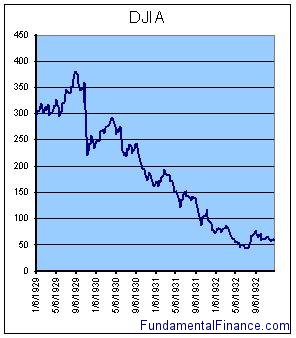
Also, lets note the severity of the crash:
Lets note a few factors about this:
The market crashed 17% in a month during October
There was a 15% increase between the crash, and the first few months of 1930
It began a horrendous decline in May of 1930, which saw it lose about 80% of its value in 1 year and 6 months...Which correlated with us going into the real horrors of the Great Depression
So lets think about it:
Was the crash of '29 what caused the Depression?
Although we can all agree that is when it started, there isn't enough evidence to state that the Depression was entirely caused by the stock market alone.
Why? That was not the last time the stock market crashed in American history.
When else has it crashed? There are a few recent examples:
Crash of 1987 (S&P lost 20% in a matter of days) aka 'Black Monday':
(For reference, the DJIA shed a much larger percentage in 1987 than it did during the crash in 1929)
Crash of 2008 (Lost 45% of its peak value in just over a year):
So then, we have to look at other correlative factors after the crash that also helped cause the great depression. I will not argue that the crash caused problems, because it obviously did. However, there are many other factors that we can look at including the Dust Bowl of 1930-1936 and other economic policy changes after the crash of 1929 that had dire effects on economic output.
First off, one can look at the Dust Bowl as causing major problems. It caused economic activity in hundreds of thousands of square miles of farmland to wither and die for years, hurting our food supply, and bankrupting many farmers. A Wikipedia search, or any study of the Dust Bowl will give pretty clear-cut answers on why it happened - over-farming. So if over-farming was the cause, why was there an accute problem in the 30's which caused the Dust Bowl?
There is a pretty straight forward answer to that. Americans were given land by the government to farm there. It was called the Enlarged Homestead Act of 1909, which gave anyone that wanted it, 320 acres of land, if they would settle it and use it for farmland. As this program built up unsustainable land, ground was stripped of its grassland, and replaced with dirt farms, which changed the ecology of the area...Ensuring that if there was to be a drought (which was in 1930), that it would be magnified due to the over-farming. This major issue can be pinned on government intervention, as they subsidized the farming in these locations - it wasn't capitalism, or a free market, it was government initiative that caused the dustbowl, as it sought to hyper-farm bad land.
Now to the next problem which also sprung up in 1930 - The Smoot-Hawley Tariff Act of 1930. It was the 2nd heaviest tariff in American history. A protectionist program which was put into place by Hoover, and signed into law....Guess when? May 1930. The same month that the DJIA dropped again, never to recover.
Looking at Wikipedia, you can see what the act did:
Imports dropped by 66% between 1929 and 1933 (due to retaliation from many countries abroad)
Exports dropped by 61% between 1929 and 1933
Some economists argue that the act actually helped cause the crash of 1929
Now, thats not to say that Smoot-Hawley caused the depression in and of itself, either. But it was (again) a government intervention into the free market, which, overall, casused major problems to help take America into the depression even further. The tariff was repealed in 1944-1945 due to the need of many imports to Europe after WW2, which caused America's huge jump into a superpower. So we can see in a 10 year span, a pretty strong correlation between problems of government tariffs, and problems, as well as their repeal and benefit for America.
So again, I have to ask: where were the grandoise reduction of regulations, and pro-capitalist changes that caused the economy to contract so severely? What I see from all the research I've done is that government intervention during the dust bowl, and government intervention in international trade helped exacerbate the problem, making it far worse than it was.
There are many other views on other aspects of the depression - there is indeed the Keynesian theory that the government spent a lot, and it helped recover the economy. However, in Keynes' view, there wasn't enough done, especially in the area of farm subisdies to get the economy back to pre-depression levels. My contention is that had the government not of meddled in environmental affairs by subsidizing the land, you would not of needed to subsidize the farms during FDR's term, either...Keynes puts the cart before the ox on that. Furthermore, the problem wasn't solved until WW2, which put everyone to work and also set America up for being able to pay off the debts.The problem with Kenyesian economics is that it always assumes that there will be a recovery that will magically allow us to pay off everything, and go on our merry way. Yet we're seeing now that some countries took on Keynes view that the government should spend a lot during bad times, yet doesn't have a recovery, and has to default, or go through a double-dip recession, because the underlying problems were never fixed.
Hopefully that explains my view and understanding of the Great Depression. Although that we can probably agree that spending money got us out of the depression (due to WW2) fixed the depression, the cause was intrisically tied to government meddling in the free enterprise system. Yes, the greedy banks may have caused problems that started the depression due to poor bank practices, but had the government not meddled (through Smoot-Hawley, Hoover's 60% tax rate on the rich, the Enhanced Homestead Act, and so on), it would have simply been a recession like we have had many other times since instead of the worst economic decade of our country's history.
Here are a few YT videos on the Great Depression by my favorite economist, Milton Friedman:
Hope this helps explain some of the reasons why government interventionism is not a good thing - both for wars, social mores, and economics.
mrstickball said: Yes, crap would hit the fan if there was a run on the banks. But in Greece even, that hasn't happened yet. It would take an incredible catastrophe for every nation to ask for its money back.
No one ever said what the US was doing was good. I'm against deficit spending more than anyone. Its a very bad thing to do.
However, the alternatives are horrible. The opposite (communism) calls for the destruction of private entities, which has always led to horrible results.
In fact, I'd argue that the US going halfway, into a socialist system like we have is the cause. Its not capitalisms fault. Its the establishment of various types of government programs that cannot be funded that are causing the problems. Capitalism would want free markets that put the responsibility for most services on the people, and not the government....What we have is the opposite in many countries.
So in fact, the problems the US, Greece and others is too much socialism.
I cannot clearly remember the problems back in the 80s, but as an educated guess I doubt that it was the socialistic programs that caused the problems back then, especially since the majority of the Baby Boom population was actually funding the programs, not draining them. Furthermore, it was Capitalism that fucked the US back in '29 and it's rampant capitalism and lack of regulation that fucked the world this time around as well.On the other hand, the Russian economy fell under for many reasons, one big one being too much regulation. Both systems are utter trash.
I actually just recently learned who Kaynes was, but apparently I have been his diehard fan for a long time now. He is absolutely correct in what he said, when it comes to the economy as a large, capitalism fails miserably. The reason is simple, people are greedy fuckers and bastards, and you need to whip them into shape so that the economy in general doesn't go to shit. The crisis that jsut hit now is a perfect example of what happens when you have free greedy people and let them run free.
Capitalism sounds just as good as Communism does on paper, and it's about as effective too. I can't think of any world economy crisis ocurring because of regulated businesses.
So, explain to me exactly how capitalist, free-market changes to America during the late 20s and early 30s caused the great depression. Go on, I have the time to wait.
My American Hisotry is a little rusty so bear with me. If I can remember one factor was the simple fact that more goods were produced than people could buy. All the money was kept at the top and since the top people are so few in number and don't need everything produced they didn't buy anymore, meanwhile the lower classes just didn't ave the money and then the businesses didn't get their money back so they became poor too.Regulation could have prevented this.
Then this is the big one that I can remember, the margin requirement for investment was just 10%. For every 1$ I invested, brokers would just give me 9$ as a loan and voila. Huge amounts of people bought huge amounts of stock, and the moment all the brokers wanted their money when things got dicey, the other people couldn't pay. This led to the huge bank runs and the stock market crash. If there was more regulation such would also not happen. It was caused purely by the greed of the people.
All this is also ignoring the fact of how the current mess of things happened, which is directly linked to unregulated greed of businesses. People are bastards and assholes, they don't give a shit and hence to prevent a widescale tragedy regulation is needed.
Sorry for the quick response, eve of a few finals so I can't formulate my thoughts staright but this is what I am getting. You are saying that the government intervention only made the normal recession into a depression. I agree. First off, for 1987, and all of the 80s actually, you have a graph like this:
The heavy recession in the 80s was solely saved because of government spending, for one cause or another. Reagan built nukes and Bush went to war. Both Bushes actually. Just about every major stock crash has been fixed by going to war, or more specifically, the increase in spending that is associated by going to war, which is in itself a big government intervention.
Another thing I would like to point out, there are really shitty things governments can do. Just because a government fucked up once, does not mean regulation as a whole is bad. It just means the decisions made were just bad. As an example, COmmunism failed due to horrible regulation and just too much regulation.
If there was a regulation back in '29 that stated that had the marginal cost at say, 50% instead of 10%, the crash would have been much milder and the bad decisions made afterward would not have needed to be made in the first place. It's a chicken-egg sort of problem. The same applies for today's problems. If there were regulations on speculation and banks were kept in rein, there wouldn't have been such a bust a year ago, I guess nearing two soon.
Obama is now spending a ton of money, and while I don't agree with it, he is basically doing what everyone else did before him to fix a drop like the one last year. The only reason I can see why he gets bashed is because it's not for a war, but something quite a lot less meaningless (war to me is absolutely meaningless and a waste of money as I see it, just to clarify). Yes the reasons are questionable but it's not as bad as war. He is literally doing what has worked for the previous stock crashes.
Lastly I want to address youe Keynesian attack. Again, I jsut learned about Kaynes just a month or so ago, but from what I get he never said that someone should just spend and not fix underlying problems and the causes that caused the crash in the first place. Problems need to be fixed, one of which is human nature and only regulations can fix that, and then you should spend. Correct government decisions with measured spending will allow an economy to recover, and put it in the position to start reducing its debt.
This is as far as I go tonight, I have to get in enough REM cycles to remember everything I learned. Hopefully it won't be about economics.
During the crash of 1987, no additional money was hedged as a protection against further recessions. According to Keynesian ideals , the government should have given out much more than they were in response to the crash. That didn't happen in 1987. In fact, your graph proves the opposite - expenditures as a percentage of GDP grew much slower in 1987-1991 than they did during the 8 years prior. Also, there have been many more recessions in the past 100 years than the 3 stock crashes I showed you. I used the stock crashes as an illustration that they in and of themselves didn't cause the Great Depression.
In fact, we've had 22 recessions since the start of the 1900s.
I am going to quantify this in the morning by building a spreadsheet to explain how it doesn't work that government spending has removed us from many recessions. There were major, yet short, recessions during many periods after the great depression that were met with no government spending, and we recovered easily from.
See you are not getting my point. If people wanted their money back in a few years, shit can really go down hill. Even if people want half of the debt back, things will get ugly. That's about 6 trillion out of the economy, hell even a quarter of 3 trillion will be very devastating. The US won't default, but it will get very miserable.
Bonds don't work that way.
Yes they do. Once the maturity, usually 30 years, is reached you can get your money back whenever. Guess what, 30 years are about to be up from the shitstorm that was the 80s. Another thing to keep in mind, the Public debt is only a bit more than half of the gross debt of the US, and the private debts are nowhere near as well protected as bonds are by the maturity gap.
Also I can't help but laugh at your solution. You are basically saying "yeah the US will be fine, when we have to pay off this credit card we'll just charge it on another credit card." I mean, did you seriously suggest that?
Mmmm, it seems to me in your post that you're implying people have a choice when they want their loans back. That's not how bonds work, as you said, it's at a set time. I don't know how you calculated it, but I'm sure our government is not totally incompetent to have 6 trillion or 3 trillion dollars due on the exact same time.
My solution is to use expansionary policies to prevent liquidation of capitals, prevent deflation, and to expediate the process of renewing consumer confidence. Yes, we have to borrow money and engage in defeceits. We cannot be like Hoover now, in the long run we will be fucking dead, and we will drag the world down with it.
It's sad, it's tough, but I'll rather have the weaker poison of the two.
mrstickball said: Yes, crap would hit the fan if there was a run on the banks. But in Greece even, that hasn't happened yet. It would take an incredible catastrophe for every nation to ask for its money back.
No one ever said what the US was doing was good. I'm against deficit spending more than anyone. Its a very bad thing to do.
However, the alternatives are horrible. The opposite (communism) calls for the destruction of private entities, which has always led to horrible results.
In fact, I'd argue that the US going halfway, into a socialist system like we have is the cause. Its not capitalisms fault. Its the establishment of various types of government programs that cannot be funded that are causing the problems. Capitalism would want free markets that put the responsibility for most services on the people, and not the government....What we have is the opposite in many countries.
So in fact, the problems the US, Greece and others is too much socialism.
I cannot clearly remember the problems back in the 80s, but as an educated guess I doubt that it was the socialistic programs that caused the problems back then, especially since the majority of the Baby Boom population was actually funding the programs, not draining them. Furthermore, it was Capitalism that fucked the US back in '29 and it's rampant capitalism and lack of regulation that fucked the world this time around as well.On the other hand, the Russian economy fell under for many reasons, one big one being too much regulation. Both systems are utter trash.
I actually just recently learned who Kaynes was, but apparently I have been his diehard fan for a long time now. He is absolutely correct in what he said, when it comes to the economy as a large, capitalism fails miserably. The reason is simple, people are greedy fuckers and bastards, and you need to whip them into shape so that the economy in general doesn't go to shit. The crisis that jsut hit now is a perfect example of what happens when you have free greedy people and let them run free.
Capitalism sounds just as good as Communism does on paper, and it's about as effective too. I can't think of any world economy crisis ocurring because of regulated businesses.
So, explain to me exactly how capitalist, free-market changes to America during the late 20s and early 30s caused the great depression. Go on, I have the time to wait.
My American Hisotry is a little rusty so bear with me. If I can remember one factor was the simple fact that more goods were produced than people could buy. All the money was kept at the top and since the top people are so few in number and don't need everything produced they didn't buy anymore, meanwhile the lower classes just didn't ave the money and then the businesses didn't get their money back so they became poor too.Regulation could have prevented this.
Then this is the big one that I can remember, the margin requirement for investment was just 10%. For every 1$ I invested, brokers would just give me 9$ as a loan and voila. Huge amounts of people bought huge amounts of stock, and the moment all the brokers wanted their money when things got dicey, the other people couldn't pay. This led to the huge bank runs and the stock market crash. If there was more regulation such would also not happen. It was caused purely by the greed of the people.
All this is also ignoring the fact of how the current mess of things happened, which is directly linked to unregulated greed of businesses. People are bastards and assholes, they don't give a shit and hence to prevent a widescale tragedy regulation is needed.
Wrong, wrong, and more wrong.
I'd reccomend reading up on the depression, and looking at metrics such as GDP growth/contraction as well as unemployment, and how such changes correlate to actions taken by businesses and government and see which one made the worse mess of things.
Lets start out with this, which we can all agree on:
The depression officially 'started' on October 29th, 1929 during the stock market crash. We can all agree on that, yes?
But the critical thing is what policies took place after the stock market crash - as the major indicators of wealth and productivity (GDP, unemployment, industrial output) did not take a sharp downturn in 1929...They took place in mid 1930, which is when the real crap hit the perverbial fan.
Here are a few charts to note this:
Now, we can note when October 29 was...There was a slight uptick in unemployment.
Also, lets note the severity of the crash:
Lets note a few factors about this:
The market crashed 17% in a month during October
There was a 15% increase between the crash, and the first few months of 1930
It began a horrendous decline in May of 1930, which saw it lose about 80% of its value in 1 year and 6 months...Which correlated with us going into the real horrors of the Great Depression
So lets think about it:
Was the crash of '29 what caused the Depression?
Although we can all agree that is when it started, there isn't enough evidence to state that the Depression was entirely caused by the stock market alone.
Why? That was not the last time the stock market crashed in American history.
When else has it crashed? There are a few recent examples:
Crash of 1987 (S&P lost 20% in a matter of days) aka 'Black Monday':
(For reference, the DJIA shed a much larger percentage in 1987 than it did during the crash in 1929)
Crash of 2008 (Lost 45% of its peak value in just over a year):
So then, we have to look at other correlative factors after the crash that also helped cause the great depression. I will not argue that the crash caused problems, because it obviously did. However, there are many other factors that we can look at including the Dust Bowl of 1930-1936 and other economic policy changes after the crash of 1929 that had dire effects on economic output.
First off, one can look at the Dust Bowl as causing major problems. It caused economic activity in hundreds of thousands of square miles of farmland to wither and die for years, hurting our food supply, and bankrupting many farmers. A Wikipedia search, or any study of the Dust Bowl will give pretty clear-cut answers on why it happened - over-farming. So if over-farming was the cause, why was there an accute problem in the 30's which caused the Dust Bowl?
There is a pretty straight forward answer to that. Americans were given land by the government to farm there. It was called the Enlarged Homestead Act of 1909, which gave anyone that wanted it, 320 acres of land, if they would settle it and use it for farmland. As this program built up unsustainable land, ground was stripped of its grassland, and replaced with dirt farms, which changed the ecology of the area...Ensuring that if there was to be a drought (which was in 1930), that it would be magnified due to the over-farming. This major issue can be pinned on government intervention, as they subsidized the farming in these locations - it wasn't capitalism, or a free market, it was government initiative that caused the dustbowl, as it sought to hyper-farm bad land.
Now to the next problem which also sprung up in 1930 - The Smoot-Hawley Tariff Act of 1930. It was the 2nd heaviest tariff in American history. A protectionist program which was put into place by Hoover, and signed into law....Guess when? May 1930. The same month that the DJIA dropped again, never to recover.
Looking at Wikipedia, you can see what the act did:
Imports dropped by 66% between 1929 and 1933 (due to retaliation from many countries abroad)
Exports dropped by 61% between 1929 and 1933
Some economists argue that the act actually helped cause the crash of 1929
Now, thats not to say that Smoot-Hawley caused the depression in and of itself, either. But it was (again) a government intervention into the free market, which, overall, casused major problems to help take America into the depression even further. The tariff was repealed in 1944-1945 due to the need of many imports to Europe after WW2, which caused America's huge jump into a superpower. So we can see in a 10 year span, a pretty strong correlation between problems of government tariffs, and problems, as well as their repeal and benefit for America.
So again, I have to ask: where were the grandoise reduction of regulations, and pro-capitalist changes that caused the economy to contract so severely? What I see from all the research I've done is that government intervention during the dust bowl, and government intervention in international trade helped exacerbate the problem, making it far worse than it was.
There are many other views on other aspects of the depression - there is indeed the Keynesian theory that the government spent a lot, and it helped recover the economy. However, in Keynes' view, there wasn't enough done, especially in the area of farm subisdies to get the economy back to pre-depression levels. My contention is that had the government not of meddled in environmental affairs by subsidizing the land, you would not of needed to subsidize the farms during FDR's term, either...Keynes puts the cart before the ox on that. Furthermore, the problem wasn't solved until WW2, which put everyone to work and also set America up for being able to pay off the debts.The problem with Kenyesian economics is that it always assumes that there will be a recovery that will magically allow us to pay off everything, and go on our merry way. Yet we're seeing now that some countries took on Keynes view that the government should spend a lot during bad times, yet doesn't have a recovery, and has to default, or go through a double-dip recession, because the underlying problems were never fixed.
Hopefully that explains my view and understanding of the Great Depression. Although that we can probably agree that spending money got us out of the depression (due to WW2) fixed the depression, the cause was intrisically tied to government meddling in the free enterprise system. Yes, the greedy banks may have caused problems that started the depression due to poor bank practices, but had the government not meddled (through Smoot-Hawley, Hoover's 60% tax rate on the rich, the Enhanced Homestead Act, and so on), it would have simply been a recession like we have had many other times since instead of the worst economic decade of our country's history.
Here are a few YT videos on the Great Depression by my favorite economist, Milton Friedman:
Hope this helps explain some of the reasons why government interventionism is not a good thing - both for wars, social mores, and economics.
My Macroeconomic teacher stated that the second recession was caused due to FDR wanting to listen to the Classical economists, and balancing the budget that time, cutting back government spending, engaging in contractionary policy.
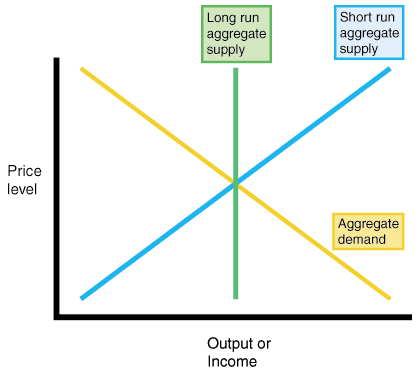
Also World War II in itself, was a natural Keynesian policy. It was simply a natural way, of increasing C+I+Nx+G
And it's hard to use monetary policy for expansionary policy when the interest rates are near 0.
But, I need to study more, if I'm going to advocate to cut back on the expansionary policies now (now that the recession ended), keep it (because unemployment is still up), or to gradually cut back on it (as AD shifts right due to C, cut back on G)
During the crash of 1987, no additional money was hedged as a protection against further recessions. According to Keynesian ideals , the government should have given out much more than they were in response to the crash. That didn't happen in 1987. In fact, your graph proves the opposite - expenditures as a percentage of GDP grew much slower in 1987-1991 than they did during the 8 years prior. Also, there have been many more recessions in the past 100 years than the 3 stock crashes I showed you. I used the stock crashes as an illustration that they in and of themselves didn't cause the Great Depression.
In fact, we've had 22 recessions since the start of the 1900s.
I am going to quantify this in the morning by building a spreadsheet to explain how it doesn't work that government spending has removed us from many recessions. There were major, yet short, recessions during many periods after the great depression that were met with no government spending, and we recovered easily from.
Government spending isn't the only way, you can and should use monetary policy as the first step. Government spending should only be used as a last resort, when monetary policy is infeasible.