By using this site, you agree to our Privacy Policy and our Terms of Use. Close

Forums - Gaming - Roger Ebert says video games can never be art

Grahamhsu said:
Kasz216 said:
Metallicube said:
Khuutra said:
Metallicube said:

Like I said, there could be art IN games, but the games themselves are not art. It is never the primary focus of games. Games are related more closely to math and physics than art, in that they are based around rules and specific mechanics. The "art" in games is just the exterior. Monopoly may have an artistic message as you say, but it is not the central focus of the game. People play monopoly to have fun and use their mind to make decisions themselves, not to be moved emotionally or get political messages.

Art and games serve different purposes. Art is meant to "do all the work" for the person experiencing it so to speak. It is meant to move people emotionally, to send a message, comment on society, or wow people visually. Games are meant to entertain people through interaction, and to make the user be maker of the outcome. They give the user an array of options and let the user logically and strategically select from these options what they think is the best outcome to "win" the game. You cannot "win" art.

In a sense, games are really the anti art. Games give an array of options and lets the user provide their own course and experience, art provides it for them.

Art need not be the primary focus of a work for that work to be art, sir. I would argue that Miyamoto creates art all the time, but he intends nothing of the sort at any point, ever.

The problem is that you think of games as jus being sets of rules like perspective and the ability to move and speed and laws put in place, but it's the crafting and application of these laws that make games fun, and fun is one of those experience that can make a game into art if it is very well-made.

Art is not meant to be passive. Not at all. That's needlessly restrictive and too reductive to be representative of the artistic scene on the whole. Interactivity does not preclude art.

Whether or not it is intened to be the primary focus, I think many devs get the impression that it should be. This is why I think it is so important to establish that games are NOT art, because then you get these game developers who get the idea in their head that put the art before the gameplay and making the gameplay suffer as a result of focusing too much on the exterior. 

I don't think people played Pacman and pong because they were art, and I don't think anything has changed since then. Just the technology has changed. But art should be timeless shouldn't it? So how could games be art NOW, but not in the days of Pacman?

When Shakespeare was writing his plays... people did not go see them because they were art.

They went to see them because it was something to do and entertaining to watch.

Honestly, a lot of what makes shakespeare art now, is that nobody gets all the dirty jokes.

If Shakespeare were alive today, he'd rather watch an Adam Sandler movie then a silent film.

Storytelling has always been an artform, it stimulates the ear, and in the form of a play it stimulates the eyes. When you are reading shakespeare do you not see the characters form in your mind (this is why I say there are 7 senses in art). The second the characters are re-created in your mind to your standards you have played with aesthetics in sight.

Shakespeare was not written to be read.

Additionally, not every story is art.  In fact.. very few are, under the Ebert definition... he even talks about how the majority of books are not art.


Around the Network
Metallicube said:
Khuutra said:

You haven't actually said why games are not art, outside of "games are not art". That's not actually reasoning for the point.

I agree that cetain directors need to be broken of this mentality, not beause gams aren't art but beause trying to mimic art from other media makes games less fun, which ruins the whole point of the art in the first place.

Nobody plays games because they are art - few people do anything solely for the sake of experiencing art. But they do do things - including meaningfully consume art - for the sake of experience. Therein lies the important thing: Pac-Man is still art because the essential experience of it has not changed and has not been diluted over time.

Games are not art.. because games are games. I know that sounds simplified but I really don't know how to explain it beyond that. You can INCORPORATE art INTO games, but games themselves are not art.

I guess what it boils down to, it just depends on your perspective of the very definition of art, and that is something that cannot be definitly answered.. But art from my view cannot BE games. Only used IN games. It's like saying porn is art. I suppose you can say you can make "artul" porn, or incoroprate artistic features into porn, but I think we can agree porn itself is not art, and its primary purpose is not to be art.

I think if you start blending the term art with games, it begins to be a slippery slope, because then nearly everything could be considered a form of art. I think you have to draw the boundaries somewhere, or the term art loses all its meaning and its value.

It's fine that you think that, as long as you acknowledge that it's not an argument and cannot be the backbone for discourse concerning the subject.

Sex has been used as performance art before, actually! It's funny you say that.

Here is the thing: you are commiting two problems here.

1. You are transforming "art" into some kind of sacred cow which cannot be touched. It isn't. Art comes from everywhere and can belong to anybody. You know Shakespeare's plays weren't art back then, right? They were derided for being full of nothing but murder and dick jokes. Now he's considered the bacbone of the entire canon of English literature. Art is changing, ever changing, based on what people find appealing and meaningful.

2. You are saying games cannot be good enough to be art. This is fallacious ou of reflex, and I dismiss it ou of hand: games have always been better at illiciting emotion for me personally than cinema, and that says a lot. In terms of conveying experience, the very itneractivity which you decry is what makes games so powerful. Yes, they are games, but games are never "just" games, even when fun is the only stated design goal of said games.



Grahamhsu said:
Khuutra said:
Metallicube said:

Like I said, there could be art IN games, but the games themselves are not art. It is never the primary focus of games. Games are related more closely to math and physics than art, in that they are based around rules and specific mechanics. The "art" in games is just the exterior. Monopoly may have an artistic message as you say, but it is not the central focus of the game. People play monopoly to have fun and use their mind to make decisions themselves, not to be moved emotionally or get political messages.

Art and games serve different purposes. Art is meant to "do all the work" for the person experiencing it so to speak. It is meant to move people emotionally, to send a message, comment on society, or wow people visually. Games are meant to entertain people through interaction, and to make the user be maker of the outcome. They give the user an array of options and let the user logically and strategically select from these options what they think is the best outcome to "win" the game. You cannot "win" art.

In a sense, games are really the anti art. Games give an array of options and lets the user provide their own course and experience, art provides it for them.

Art need not be the primary focus of a work for that work to be art, sir. I would argue that Miyamoto creates art all the time, but he intends nothing of the sort at any point, ever.

The problem is that you think of games as jus being sets of rules like perspective and the ability to move and speed and laws put in place, but it's the crafting and application of these laws that make games fun, and fun is one of those experience that can make a game into art if it is very well-made.

Art is not meant to be passive. Not at all. That's needlessly restrictive and too reductive to be representative of the artistic scene on the whole. Interactivity does not preclude art.

I don't think you quite understand metallicube's perspective, for me and metallicube it's not that games are a set of rules, it's that gameplay is a set of rules. For metallicube and I, everything non-essential to game function is stripped off. For example, you can play Mario Brothers while muted, but than you're missing out on the artistic music, but you're still essentially able to play the game correct? For MGS4 you can play without watching any cutscenes, or reading any of the text, (as I said story is an artform) but essentially you're still able to play the game right? Now take LBP, if I were to make a completely blank canvas world, could you play LBP in it? Yes you could, would it be enjoyable? Probably not. Is there art still involved, yes there's art in the graphics of the sackboy. From our perspective a game isn't the culmination of all these items, but rather these items are added on for additional enjoyment of the game.

Bingo..

The biggest problem I have with people saying "games ARE art!" is that it implies the art in games is the primary focus and very REASON for the game, and if the art is primary, that means the gameplay is secondary. The focus of games, or the "reason" games exist if you will, is to entertain users by letting the user interact with the medium, over a set of given rules. Art does not serve this purpose.

Let's turn this around, and say that "art ARE games." Now is that statement true? Most artists would take offense to that, because art is it's own entity, with its own purpose. Art are not games, and games are not art. Games are centered around user created fun based on a set of rules, giving the user interactivity. Anything else is exterior.


Metallicube said:

Bingo..

The biggest problem I have with people saying "games ARE art!" is that it implies the art in games is the primary focus and very REASON for the game, and if the art is primary, that means the gameplay is secondary. The focus of games, or the "reason" games exist if you will, is to entertain users by letting the user interact with the medium, over a set of given rules. Art does not serve this purpose.

Let's turn this around, and say that "art ARE games." Now is that statement true? Most artists would take offense to that, because art is it's own entity, with its own purpose. Art are not games, and games are not art. Games are centered around user created fun based on a set of rules, giving the user interactivity. Anything else is exterior.

Art need not be the primary focus for a work to be art. I said that some time ago: believe me, I got your point from the start, and already addressed it specifically.

Art can exist just to entertain! That's all Shakespeare was.

Also, that's immensely ridiculous. Let me draw you an analogy.

"Humans are mammals!" is true.

"Mammals are humans!" is not true. Do you see?

Games and art are not mutually exclusive.


Khuutra said:
Metallicube said:
Khuutra said:

You haven't actually said why games are not art, outside of "games are not art". That's not actually reasoning for the point.

I agree that cetain directors need to be broken of this mentality, not beause gams aren't art but beause trying to mimic art from other media makes games less fun, which ruins the whole point of the art in the first place.

Nobody plays games because they are art - few people do anything solely for the sake of experiencing art. But they do do things - including meaningfully consume art - for the sake of experience. Therein lies the important thing: Pac-Man is still art because the essential experience of it has not changed and has not been diluted over time.

Games are not art.. because games are games. I know that sounds simplified but I really don't know how to explain it beyond that. You can INCORPORATE art INTO games, but games themselves are not art.

I guess what it boils down to, it just depends on your perspective of the very definition of art, and that is something that cannot be definitly answered.. But art from my view cannot BE games. Only used IN games. It's like saying porn is art. I suppose you can say you can make "artul" porn, or incoroprate artistic features into porn, but I think we can agree porn itself is not art, and its primary purpose is not to be art.

I think if you start blending the term art with games, it begins to be a slippery slope, because then nearly everything could be considered a form of art. I think you have to draw the boundaries somewhere, or the term art loses all its meaning and its value.

It's fine that you think that, as long as you acknowledge that it's not an argument and cannot be the backbone for discourse concerning the subject.

Sex has been used as performance art before, actually! It's funny you say that.

Here is the thing: you are commiting two problems here.

1. You are transforming "art" into some kind of sacred cow which cannot be touched. It isn't. Art comes from everywhere and can belong to anybody. You know Shakespeare's plays weren't art back then, right? They were derided for being full of nothing but murder and dick jokes. Now he's considered the bacbone of the entire canon of English literature. Art is changing, ever changing, based on what people find appealing and meaningful.

2. You are saying games cannot be good enough to be art. This is fallacious ou of reflex, and I dismiss it ou of hand: games have always been better at illiciting emotion for me personally than cinema, and that says a lot. In terms of conveying experience, the very itneractivity which you decry is what makes games so powerful. Yes, they are games, but games are never "just" games, even when fun is the only stated design goal of said games.

I understand that the term art is loosely defined and somewhat relative. But then what ISN'T art, by your description? At that point art ceases to lose all its meaning, and where then is the value of art, if merely anything can be interpruted as art? At what point does the term "art" become so diluted that it loses all power and value in society?

I'm not saying games are not good enough to be art, I'm simply saying they are separate entities, thus games are not art. Games are games.


Around the Network
Metallicube said:
Khuutra said:

It's fine that you think that, as long as you acknowledge that it's not an argument and cannot be the backbone for discourse concerning the subject.

Sex has been used as performance art before, actually! It's funny you say that.

Here is the thing: you are commiting two problems here.

1. You are transforming "art" into some kind of sacred cow which cannot be touched. It isn't. Art comes from everywhere and can belong to anybody. You know Shakespeare's plays weren't art back then, right? They were derided for being full of nothing but murder and dick jokes. Now he's considered the bacbone of the entire canon of English literature. Art is changing, ever changing, based on what people find appealing and meaningful.

2. You are saying games cannot be good enough to be art. This is fallacious ou of reflex, and I dismiss it ou of hand: games have always been better at illiciting emotion for me personally than cinema, and that says a lot. In terms of conveying experience, the very itneractivity which you decry is what makes games so powerful. Yes, they are games, but games are never "just" games, even when fun is the only stated design goal of said games.

I understand that the term art is loosely defined and somewhat relative. But then what ISN'T art, by your description? At that point art ceases to lose all its meaning, and where then is the value of art, if merely anything can be interpruted as art? At what point does the term "art" become so diluted that it loses all power and value in society?

I'm not saying games are not good enough to be art, I'm simply saying they are separate entities, thus games are not art. Games are games.
You haven't qualified why games are separate entities: I urge you to come up with a why before you make that assertion again.

Where does art stop and begin, to me? It doesn't matter. Rather, what I think doesn't matter: like you said abov, art is relative, art is subjective, and I'm not going to give a crap about the things that the academia thinks right now when I know that perspective changes with time, and some art is only recognized long after the fact. Some people see cat shit smeared on canvas by a lunatic as art: I see hitting a block with your head and eating a mushroom to turn into a giant as art.

That's all there is.


Khuutra said:
Grahamhsu said:

I don't think you quite understand metallicube's perspective, for me and metallicube it's not that games are a set of rules, it's that gameplay is a set of rules. For metallicube and I, everything non-essential to game function is stripped off. For example, you can play Mario Brothers while muted, but than you're missing out on the artistic music, but you're still essentially able to play the game correct? For MGS4 you can play without watching any cutscenes, or reading any of the text, (as I said story is an artform) but essentially you're still able to play the game right? Now take LBP, if I were to make a completely blank canvas world, could you play LBP in it? Yes you could, would it be enjoyable? Probably not. Is there art still involved, yes there's art in the graphics of the sackboy. From our perspective a game isn't the culmination of all these items, but rather these items are added on for additional enjoyment of the game.

You can, of course, experience cinema while removing either the sound or the visuals and still enjoy it perfectly well. I've seen a project where a blind person is playing through Wind Waker based on nothing but sound and memory. I don't see the point you're making here.

Gameplay does not preclude art, which seems to be your primary point. "Games cannot be art" is specious because it is needlessly reductive concerning what art is.

Obvious that you don't see the point I'm making, because without sound or visuals it's still a story, and any story is visually stimulating whether that story be played out in real life or not. The project with windwaker, how is that related? I'm trying to say a game can exist without those functions and as such means they are expendable. Not preclude, expendable. I'm getting tired of this arguement, I have orchestral auditions for jobs coming up and don't have time for this, all I can say is I never read Ebert's definition, I don't give a rat's ass about it, but if I were to entrust you with violin students using your definition of art I know they would only become musically confused. My perspective is as valid and needed as yours depending on the situation, although my occupation forces me to accept said perspective. Our perspectives differ because we will never agree on the definition of art and as Metallicube said if I let anything be art than it would be slippery slope, and my job as a musician would be a lot more difficult.
@kasz Ok I'll say Ebert is an elitist dick in that case. I haven't read the article at all, my view still doesn't change however for it to be art there must a set of rules it must follow, most importantly it must stimulate senses. Culinary, painter, musician, graphic designer, fashion, writers, etc all these people are artists in my definition and view because they use a medium that directly stimulates senses. 


-=Dew the disco dancing fo da Unco Graham=-

Grahamhsu said:
Khuutra said:

You can, of course, experience cinema while removing either the sound or the visuals and still enjoy it perfectly well. I've seen a project where a blind person is playing through Wind Waker based on nothing but sound and memory. I don't see the point you're making here.

Gameplay does not preclude art, which seems to be your primary point. "Games cannot be art" is specious because it is needlessly reductive concerning what art is.

Obvious that you don't see the point I'm making, because without sound or visuals it's still a story, and any story is visually stimulating whether that story be played out in real life or not. The project with windwaker, how is that related? I'm trying to say a game can exist without those functions and as such means they are expendable. Not preclude, expendable. I'm getting tired of this arguement, I have orchestral auditions for jobs coming up and don't have time for this, all I can say is I never read Ebert's definition, I don't give a rat's ass about it, but if I were to entrust you with violin students using your definition of art I know they would only become musically confused. My perspective is as valid and needed as yours depending on the situation, although my occupation forces me to accept said perspective. Our perspectives differ in our definition of art and as Metallicube said if I let anything be art than it would be slippery slope, and my job as a musician would be a lot more difficult.

@kasz Ok I'll say Ebert is an elitist dick in that case. I haven't read the article at all, my view still doesn't change however for it to be art there must a set of rules it must follow, most importantly it must stimulate senses. Culinary, painter, musician, graphic designer, fashion, writers, etc all these people are artists in my definition and view because they use a medium that directly stimulates senses. 

It is impossible for a story to be visually stimulating without visuals. Or, if you prefer, to the blind. Any one aspet is always expendable, it just means that art is experience differently by different people.

And your perspective is a valid one, sure, but it's still needlessly narrow. My view of art comes from art in literature, and similarly I would not leave a bunch of literature students in the hands of someone whose entire concept of art is based around the whole of sensory inputs.


Just because something is interactive doesn't mean it's a game.

Heavy Rain is more of a film than a game.
SimCity is more of a toy than a game.
Call of Duty is more of a sport than a game.
Jam Sessions is more of a virtual instrument than a game.
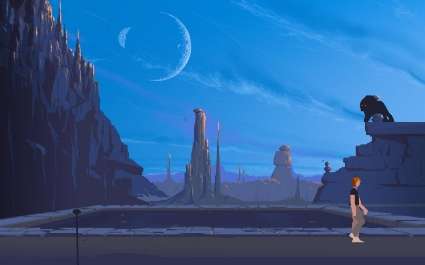
Out of This World is more interactive art than game. IMHO anyway, I never really played it for fun. I play it every once in a while because I think it's great art. And me, just one guy on the internet, playing it for art... that means it's art.


Khuutra said:
Grahamhsu said:
Khuutra said:

You can, of course, experience cinema while removing either the sound or the visuals and still enjoy it perfectly well. I've seen a project where a blind person is playing through Wind Waker based on nothing but sound and memory. I don't see the point you're making here.

Gameplay does not preclude art, which seems to be your primary point. "Games cannot be art" is specious because it is needlessly reductive concerning what art is.

Obvious that you don't see the point I'm making, because without sound or visuals it's still a story, and any story is visually stimulating whether that story be played out in real life or not. The project with windwaker, how is that related? I'm trying to say a game can exist without those functions and as such means they are expendable. Not preclude, expendable. I'm getting tired of this arguement, I have orchestral auditions for jobs coming up and don't have time for this, all I can say is I never read Ebert's definition, I don't give a rat's ass about it, but if I were to entrust you with violin students using your definition of art I know they would only become musically confused. My perspective is as valid and needed as yours depending on the situation, although my occupation forces me to accept said perspective. Our perspectives differ in our definition of art and as Metallicube said if I let anything be art than it would be slippery slope, and my job as a musician would be a lot more difficult.

@kasz Ok I'll say Ebert is an elitist dick in that case. I haven't read the article at all, my view still doesn't change however for it to be art there must a set of rules it must follow, most importantly it must stimulate senses. Culinary, painter, musician, graphic designer, fashion, writers, etc all these people are artists in my definition and view because they use a medium that directly stimulates senses. 

It is impossible for a story to be visually stimulating without visuals. Or, if you prefer, to the blind. Any one aspet is always expendable, it just means that art is experience differently by different people.

And your perspective is a valid one, sure, but it's still needlessly narrow. My view of art comes from art in literature, and similarly I would not leave a bunch of literature students in the hands of someone whose entire concept of art is based around the whole of sensory inputs.

Jeesus I'm not trying to pick a fight with you khuutra I'll agree if you placed your lit students in my hands they would have no hope of pursuing their literary dreams. I am merely trying to say both our viewpoints are needed for our roles. As for visually stimulating without visuals, to me the second you imagine anything, whether you imagine a sound, picture, etc. your sensory inputs are stimulated, IE anything that occurs in our imagination is actually semi-real. Musicians before we play any piece of music must already know what the sound is in our head, which is why I say it need not exist in reality but only in our mind to already be stimulating. Same concept of getting a song stuck in our head except we mold the song in our head before we bring it to the physical realm.


-=Dew the disco dancing fo da Unco Graham=-