
By using this site, you agree to our Privacy Policy and our Terms of Use. Close

Forums - General - Re-educating prisoners

kowenicki said:
Well isnt the flaw in your OP that the killer of James Bulger had all of this to help him and when he was released he immeditaely commited more disgsting crimes, ending with him back in prison within a short period.

And this isnt only with this piece of shit... the re-offending rate is massive, seems to me our method of rehabilitation doesnt work.

So how about making it a hell-hole and actually provide a detterent... I know... wacky idea isnt it.. so leftfield......

I came across this report from the social exclusion unit (source) looking at Reducing re-offending by ex-prisoners in the UK. It recognises that re-offending is a large problem. However, it states that the best results for reducing re-offending is education.


"(We have)invested in prison education to double the number of educational qualifications achieved by prisoners by the end of next year. And this effort is starting to pay off. Crime is down 21 per cent since 1997. Reconviction rates for juveniles serving community sentences are down 14 per cent. But we know there is still a long way to go...

...People who have been in prison account for one in five of all crimes. Nearly three in five prisoners are re-convicted within two years of leaving prison. Offending by ex-prisoners costs society at least £11 billion a year. This all tells us we are failing to capitalise on the opportunity prison provides to stop people offending for good.

We need to make sure that a prison sentence punishes the offender, but also provides the maximum opportunity for reducing the likelihood of re-offending."


In short, the UK prison system recognises the problem of re-offenders and they have tried to combat it by trying to achieve a balance between punishment and education. And offering education to prisoners has significantly reduced re-offending rates. The system isn't foolproof, but education does offer good results.



Around the Network

Curse you highwaystar how dare you make what I said seem simplistic! You back it up with hard cold evidence how could you!??! You totally one upped me!


PSN ID: KingFate_

Actually, here's another extract from that report I posted in my rebuttal for Kowenecki that's interesting...

"Many prisoners’ basic skills are very poor. 80 per cent have the writing skills, 65 per cent the
numeracy skills and 50 per cent the reading skills at or below the level of an 11-year-old child.
60 to 70 per cent of prisoners were using drugs before imprisonment. Over 70 per cent
suffer from at least two mental disorders. And 20 per cent of male and 37 per cent of female
sentenced prisoners have attempted suicide in the past. The position is often even worse for
18–20-year-olds, whose basic skills, unemployment rate and school exclusion background are
all over a third worse than those of older prisoners."


highwaystar101 said:
kowenicki said:
Well isnt the flaw in your OP that the killer of James Bulger had all of this to help him and when he was released he immeditaely commited more disgsting crimes, ending with him back in prison within a short period.

And this isnt only with this piece of shit... the re-offending rate is massive, seems to me our method of rehabilitation doesnt work.

So how about making it a hell-hole and actually provide a detterent... I know... wacky idea isnt it.. so leftfield......

I came across this report from the social exclusion unit (source) looking at Reducing re-offending by ex-prisoners in the UK. It recognises that re-offending is a large problem. However, it states that the best results for reducing re-offending is education.


"(We have)invested in prison education to double the number of educational qualifications achieved by prisoners by the end of next year. And this effort is starting to pay off. Crime is down 21 per cent since 1997. Reconviction rates for juveniles serving community sentences are down 14 per cent. But we know there is still a long way to go...

...People who have been in prison account for one in five of all crimes. Nearly three in five prisoners are re-convicted within two years of leaving prison. Offending by ex-prisoners costs society at least £11 billion a year. This all tells us we are failing to capitalise on the opportunity prison provides to stop people offending for good.

We need to make sure that a prison sentence punishes the offender, but also provides the maximum opportunity for reducing the likelihood of re-offending."


In short, the UK prison system recognises the problem of re-offenders and they have tried to combat it by trying to achieve a balance between punishment and education. And offering education to prisoners has significantly reduced re-offending rates. The system isn't foolproof, but education does offer good results.

I could be wrong but I suspect that if you looked deeper into recidivism based on certain crimes that you would find that education was highly effective with certain crimes and completely ineffective with others. People who’re committing (what could be called) an "Economic Crime" would probably be far less likely to re-commit a crime if they’re trained in a field which offers greater economic opportunity; while someone who has committed a violent or sexual crime will see little/no impact from this kind of training.


HappySqurriel said:
highwaystar101 said:
kowenicki said:
Well isnt the flaw in your OP that the killer of James Bulger had all of this to help him and when he was released he immeditaely commited more disgsting crimes, ending with him back in prison within a short period.

And this isnt only with this piece of shit... the re-offending rate is massive, seems to me our method of rehabilitation doesnt work.

So how about making it a hell-hole and actually provide a detterent... I know... wacky idea isnt it.. so leftfield......

I came across this report from the social exclusion unit (source) looking at Reducing re-offending by ex-prisoners in the UK. It recognises that re-offending is a large problem. However, it states that the best results for reducing re-offending is education.


"(We have)invested in prison education to double the number of educational qualifications achieved by prisoners by the end of next year. And this effort is starting to pay off. Crime is down 21 per cent since 1997. Reconviction rates for juveniles serving community sentences are down 14 per cent. But we know there is still a long way to go...

...People who have been in prison account for one in five of all crimes. Nearly three in five prisoners are re-convicted within two years of leaving prison. Offending by ex-prisoners costs society at least £11 billion a year. This all tells us we are failing to capitalise on the opportunity prison provides to stop people offending for good.

We need to make sure that a prison sentence punishes the offender, but also provides the maximum opportunity for reducing the likelihood of re-offending."


In short, the UK prison system recognises the problem of re-offenders and they have tried to combat it by trying to achieve a balance between punishment and education. And offering education to prisoners has significantly reduced re-offending rates. The system isn't foolproof, but education does offer good results.

I could be wrong but I suspect that if you looked deeper into recidivism based on certain crimes that you would find that education was highly effective with certain crimes and completely ineffective with others. People who’re committing (what could be called) an "Economic Crime" would probably be far less likely to re-commit a crime if they’re trained in a field which offers greater economic opportunity; while someone who has committed a violent or sexual crime will see little/no impact from this kind of training.

I would think so too. I am certain that a correlation exists relating the nature of crimes and the effect that education has on recidivism. Obviously someone who was in need of money but couldn't find employment so they mugged people for money would benefit from education allowing them to follow a vocation, and it would be more effective on them than it would on a murderer or sex offender (where money wasn't a primary motive). Perhaps murderers and sex offenders would benefit from a different type of education (Based on citizenship, demonstrating how crimes of their nature impact on society)

I'll look into it later, I'm still reading through the last report.


Around the Network
HappySqurriel said:
highwaystar101 said:
kowenicki said:
Well isnt the flaw in your OP that the killer of James Bulger had all of this to help him and when he was released he immeditaely commited more disgsting crimes, ending with him back in prison within a short period.

And this isnt only with this piece of shit... the re-offending rate is massive, seems to me our method of rehabilitation doesnt work.

So how about making it a hell-hole and actually provide a detterent... I know... wacky idea isnt it.. so leftfield......

I came across this report from the social exclusion unit (source) looking at Reducing re-offending by ex-prisoners in the UK. It recognises that re-offending is a large problem. However, it states that the best results for reducing re-offending is education.


"(We have)invested in prison education to double the number of educational qualifications achieved by prisoners by the end of next year. And this effort is starting to pay off. Crime is down 21 per cent since 1997. Reconviction rates for juveniles serving community sentences are down 14 per cent. But we know there is still a long way to go...

...People who have been in prison account for one in five of all crimes. Nearly three in five prisoners are re-convicted within two years of leaving prison. Offending by ex-prisoners costs society at least £11 billion a year. This all tells us we are failing to capitalise on the opportunity prison provides to stop people offending for good.

We need to make sure that a prison sentence punishes the offender, but also provides the maximum opportunity for reducing the likelihood of re-offending."


In short, the UK prison system recognises the problem of re-offenders and they have tried to combat it by trying to achieve a balance between punishment and education. And offering education to prisoners has significantly reduced re-offending rates. The system isn't foolproof, but education does offer good results.

I could be wrong but I suspect that if you looked deeper into recidivism based on certain crimes that you would find that education was highly effective with certain crimes and completely ineffective with others. People who’re committing (what could be called) an "Economic Crime" would probably be far less likely to re-commit a crime if they’re trained in a field which offers greater economic opportunity; while someone who has committed a violent or sexual crime will see little/no impact from this kind of training.

I would think so too. I am certain that a correlation exists relating the nature of crimes and the effect that education has on recidivism. Obviously someone who was in need of money but couldn't find employment so they mugged people for money would benefit from education allowing them to follow a vocation, and it would be more effective on them than it would on a murderer or sex offender (where money wasn't a primary motive). Perhap murderers and sex offenders would benefit from a different type of education (Based on citizenship, demonstrating how crimes of their nature impact on society)

I'll look into it later, I'm still reading through the last report.


NinjaguyDan said:
mrstickball said:
NinjaguyDan said:

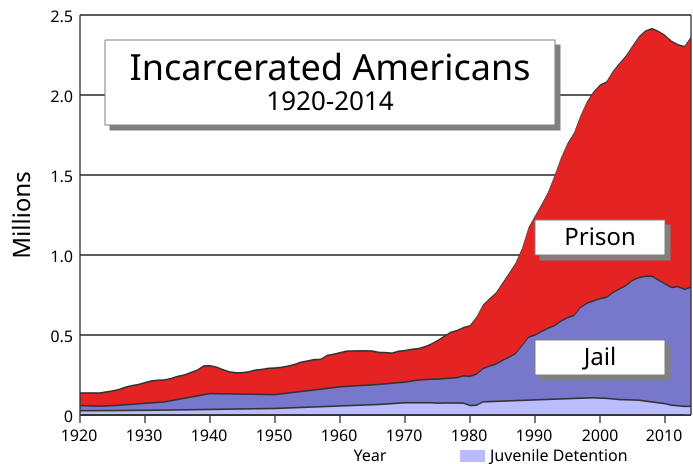
5% of the world's population, 25% of the world's prison population...

In the "land of the free" how can that be possible?  Because the U.S. is enthralled by a fucked-up right-wing authoritarian ideology.

Could you define that with measurable evidence? Your spouting a lot of stuff with virtually no statistical backup.

Here's the Wiki, or is that too liberal a source for you?

1981 was the beginning of the authoritarian age.  I was there and watched it happen in real time.

...So on this list, how does it point to authoritarianism and right wingers? Why did it increase so severely under Clinton, and not Bush Jr?

The only argument that can be made for or against authoritarianism causing such an increase would be the rapid increase of incarceration for drug offenders due to the bi-partisan war on drugs which started in the early 70's. Otherwise, I don't see what you are getting at.

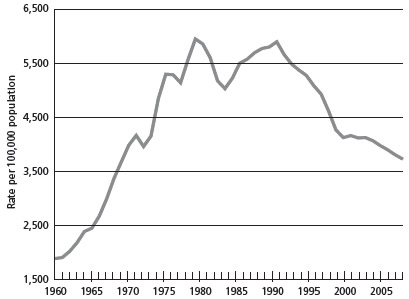
Oh, I would mention that the chart also correlates with the rapid plateau and reduction of crime in America:


Back from the dead, I'm afraid.

If you kill are rape someone then you don't deserve anything in life. If you commet petty crime like stealing,etc,then you deserve to be rehabilitated. that simple.


highwaystar101 said:
Chairman-Mao said:
Kasz216 said:
 Either way it all depends on whether you think the main purpose of prison is to punish or to rehibilitate.


I think solitary confinement would make them far more likely to kill again. I've been reading around the subject of solitary confinement today (because I'm a geek), and it causes many psychological disorders, many of them severely dangerous. Just a short extract from an article on isolation in prisons.

"Dr. Stuart Grassian, an expert on the results of living in extended isolation, has commented at length on the psychiatric harm that can come to people subjected to long-term isolation. He interviewed people who began to cut themselves just so they can "feel" something and reports panic attacks and a progressive inability to tolerate ordinary stimulation. Isolation has been documented as a cause of paranoia, problems with impulse control, extreme motor restlessness, delusions, suspiciousness, confusion, and depression. I have treated a number of ex-control unit prisoners who come out with serious symptoms of Post-Traumatic Stress."

Source

Solitary confinement clearly breeds psychological disorders in those who are subjected to it. People who have been subjected to extended solitary confinement are clearly not fit for society, significantly more so than they were before.

I think teaching someone skills is obviously a far better way of stopping them re-offending.

I guess I had better re-think my idea then. I didn't realize it could cause so many problems.

Of course I was exaggerating somewhat though. They'd still get time outside for exercise and some interaction each day. I was just thinking keep them locked up in their cell for a good part of the day in individual cells.


Double post >.<


PSN ID: KingFate_