













UN chief warns of Israeli-made humanitarian crisis in Gaza amid war on Iran
United Nations Secretary-General Antonio Guterres has called for Israel to reopen Gaza’s border crossings, which have been closed by Israel since its forces launched a war against Iran with the United States.
“It is imperative that all crossings be reopened … as soon as possible,” Guterres’s spokesman Stephane Dujarric said on Tuesday. “In recent days, our partners have been forced to ration fuel, prioritise life-saving operations, albeit in reduced capacity as our local stocks are going down.”
Dujarric said there were some stockpiles in Gaza but “when the doors are shut, we obviously stretch whatever we have to make it last longer.”
The Rafah crossing into Gaza from Egypt, the only gateway for Palestinians in Gaza to the outside world that does not pass through Israel, had reopened for the movement of people on February 2, allowing a limited number of people to leave for the first time in months and a trickle to return to the devastated enclave to reunite with family.
Thousands of Palestinians need urgent medical attention outside Gaza but have not yet been allowed to leave.
Israel shut down the crossing again on Saturday as it launched attacks on Iran, citing “security adjustments”. The crossing is considered vital for the delivery of humanitarian aid and the evacuation of critically ill patients.
Israeli authorities said late on Monday that they would reopen the Karem Abu Salem crossing, known as Kerem Shalom to Israelis, to allow for the “gradual entry of humanitarian aid” into the territory. That crossing sits at the intersection of the Gaza Strip boundary with the Israeli and Egyptian borders and was also shut on Saturday.
West Bank tensions spiral
In the meantime, Israeli forces have continued the closure of the Al-Aqsa Mosque in occupied East Jerusalem for the fourth consecutive day on Tuesday.
Palestine’s Jerusalem Governorate reported that the army prevented worshippers from entering the mosque, citing a state of emergency. The compound, the third holiest site in Islam, was sealed off on Saturday morning, hours after the Israeli-US military offensive on Iran began.
For a second consecutive day, Israeli forces raided the Askar refugee camp east of the occupied West Bank city of Nablus, shutting down its entrances and searching several homes.
Last month, the Israeli government approved a plan to claim large areas of the West Bank as “state property” if Palestinians cannot prove ownership, prompting a regional outcry and accusations of “de facto annexation”.More than 80 UN member states condemned the move and called on Israel to reverse the decision, which they said was contrary to Israel’s obligations under international law.
Israeli troops intensify push in southern Lebanon, in escalation of campaign against Hezbollah
Israeli troops are intensifying their push in southern Lebanon, the military announced Tuesday, seizing more positions on the ground as Israel escalates its offensive against the militant group Hezbollah.
The Israel Defense Forces (IDF) has held five positions in southern Lebanon for months now, using them as a means of observing the border area between the two countries. Now, as Israel intsensifies its strikes against what it sees as Hezbollah targets in Beirut and southern Lebanon, the IDF has occupied more positions, calling it an “enhanced forward defense posture.”
Defense Minister Israel Katz said he and Prime Minister Benjamin Netanyahu had “authorized the IDF to advance and take control of additional strategic positions in Lebanon in order to prevent attacks on Israeli border communities.”
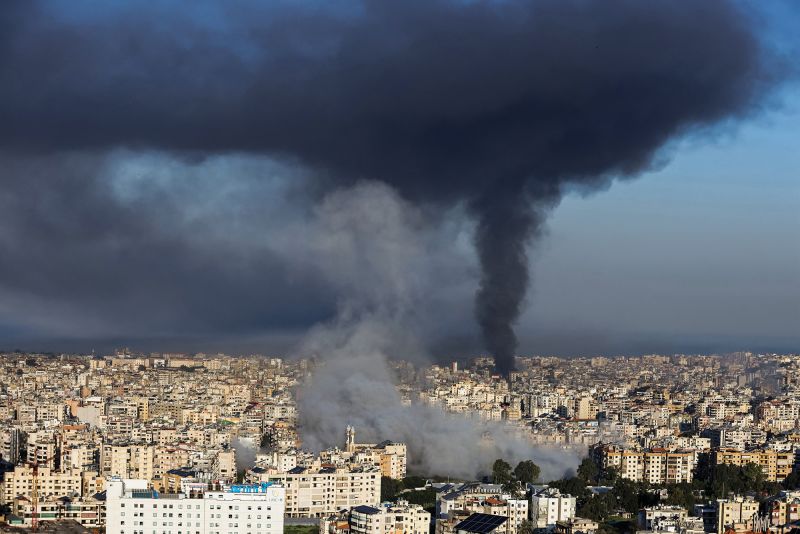
Plumes of smoke rise from the sites of Israeli airstrikes on the southern suburbs of Beirut on Tuesday.


