













Palestinian committee to govern post-war Gaza meets in Egypt: Report
The first meeting of a Palestinian technocratic committee tasked with managing the day-to-day governance of post-war Gaza has begun in Cairo, according to Egyptian media.
Al-Qahera News TV reported that the initial session of the Palestinian National Committee convened in the Egyptian capital, with discussions focused on relief efforts and post-war reconstruction plans.
Ali Shaath, a former deputy minister in the Ramallah-based Palestinian Authority, has been appointed to lead the committee.
The committee is expected to operate under the oversight of the US-proposed “Board of Peace”, which Washington has said will supervise Gaza’s post-war
transition.
Figures behind massacre of starving Gazans now shaping US Gaza plan
https://www.presstv.ir/Detail/2026/01/16/762383/US-governance-structure-Gaza-deadly-GHF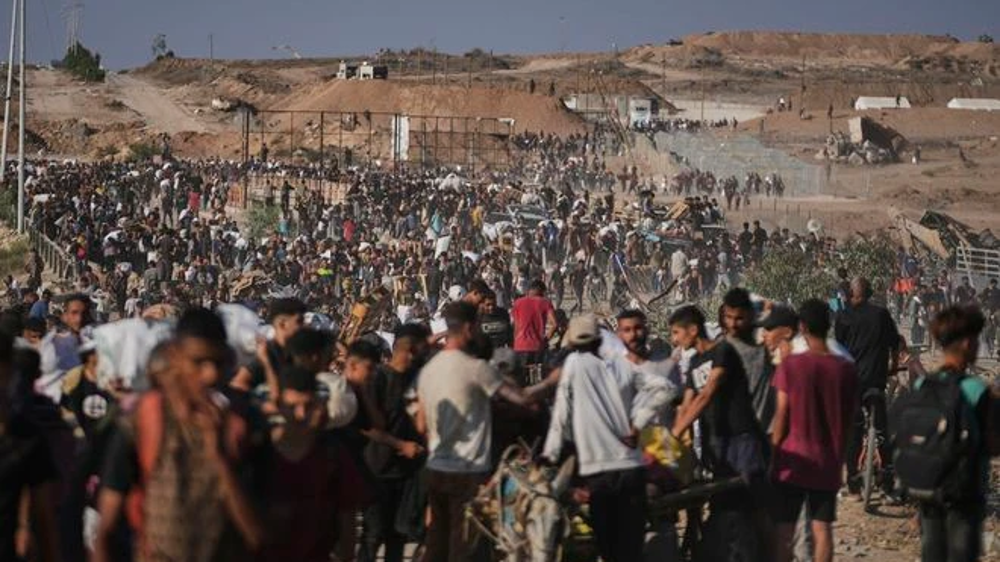
Palestinians risk their lives going to the so-called Gaza Humanitarian Foundation distribution center operated by the US-backed organization in Khan Younis, southern Gaza Strip, on June 26, 2025
Many of the figures now being elevated as key figures in Washington’s proposed postwar administration for Gaza were architects of the Gaza Humanitarian Foundation (GHF), a US-Israeli aid operation under which Palestinian civilians were repeatedly killed while attempting to access food.
According to the Financial Times, individuals shaping the new Gaza executive committee were directly involved in designing and promoting GHF, a scheme that operated for months inside Israeli-controlled areas of the strip.
GHF was presented as a humanitarian workaround after Israel restricted UN and NGO aid access. In practice, it forced starving Palestinians to travel through militarized corridors to tightly controlled distribution hubs, where limited food was handed out under the watch of Israeli troops and US contractors.
Gaza health officials reported that hundreds of Palestinians were killed along access routes to these sites, while some estimates place the death toll at close to 2,000 over six months.
Israeli authorities denied deliberate targeting and disputed casualty figures, even as repeated shootings were documented near GHF hubs.
Despite the collapse of the foundation in November, the same network behind it is now shaping Gaza’s future governance.
The planned executive committee, operating under a Trump-led “Board of Peace,” is being influenced by Roman Gofman, Israeli prime minister Benjamin Netanyahu’s chief military adviser and a nominee to head the Mossad; US-Israeli venture capitalist Michael Eisenberg; US-Israeli policymaker Aryeh Lightstone; and Israeli tech entrepreneur Liran Tancman, who has links to Israeli intelligence.
All four were involved in establishing or promoting GHF.
The executive committee is expected to include Palestinian technocrats tasked with replacing Hamas in civil administration under the second phase of a US-brokered ceasefire.
Eighteen Palestinian figures have reportedly received invitations, with former Palestinian Authority planning official Ali Shaath designated to head the body and retired intelligence officer Mohammed Nisman expected to oversee security.
....
The broader “Board of Peace,” expected to include Trump and 15 international leaders, has been delayed, reportedly due to regional tensions and Trump’s threats of military action against Iran.
The US team driving Gaza policy answers directly to Jared Kushner, with much of the planning conducted outside formal diplomatic and military coordination channels.
Meanwhile, Israeli media have reported that the army has drawn up plans for a renewed assault on Gaza aimed at seizing additional territory, even as Washington announces the start of the ceasefire’s second phase.
Hamas and other Palestinian factions, meeting in Cairo, have focused discussions on reopening crossings, ensuring aid entry, and securing Israeli withdrawal, while Israeli artillery and gunfire continue to target multiple areas across the strip.
Doubts linger over whether Israel withdraws troops under phase two
Satellite images show that the Israeli military is controlling more than 50 percent of Gaza. It has already changed the location of the yellow demarcation line multiple times, allowing Israeli forces to control more land.
As part of phase two of the ceasefire agreement, we may witness the Israeli withdrawal from these areas back to positions behind them as required under the agreement.
But we see repeatedly that the Israeli military and political officials are making a link between the Israeli withdrawal from these areas, with the full disarmament of armed factions and the return of the last Israeli body from Gaza.
To what extent the Trump administration will convince Israel to withdraw from these areas remains to be seen. There are a lot of sticking points remaining that mediators and the US will continue to work on to resolve between the conflicting parties.
But for now, people are still living under the threat of Israeli attacks. People are sceptical about the prospects of success for phase two of the agreement while violations are ongoing and inflammatory statements are being made by the Israeli side regarding the withdrawal and reconstruction of Gaza.


