











| Pemalite said: Chinese manufacturers are bringing the price down, market penetration of 4k is going to keep on growing, that's the reality, that's the facts. |
Not fast enough since the vast majority of households only replace displays every 5+ years ...
| Pemalite said:
We have no idea what AMD's implementation of full-scene RT on console is going to entail, we don't have any low-level information other than a few tidbits. |
This is AMD's plan currently ...
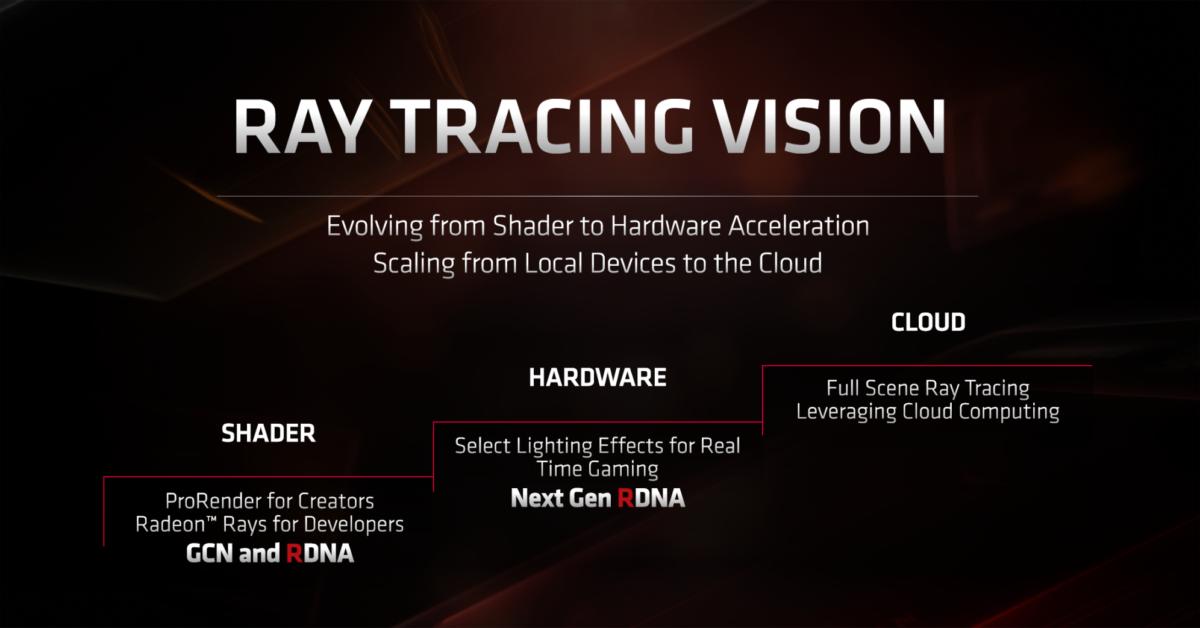
When they introduce 'hardware' for ray tracing, it'll only be done for "select lighting effects". If AMD aren't thinking about attempting "full scene ray tracing" on local devices such as consoles, there's almost zero chance console manufacturers are thinking about attempting both 4K and full scene ray tracing ...
| Pemalite said:
I am talking about demand for 4k in general, it doesn't matter if you are uploading or downloading, if you are uploading 4k content, then hopefully someone on the other end is downloading 4k content. - That is generally how these things work you know? |
If you're doing real-time 4K uploads then anyone would best be sure that they have the uplink speeds to support that ...
Demand for 4K content in general does not equate to demand for real-time 4K uploads. Just because Netflix or some other video content providers requires their content be in 4K doesn't mean that people will hold the same standards for other types of content such as real-time video streaming ...
It's easy enough to downlink 4K content but doing real-time game streaming requires good uplink speeds so why would devices like consoles need to have good support for real-time 4K streaming anyways ? I don't think you've answered this question yet ...
Is there ANY good reason why consoles must be able to do real-time 4K streaming when the much of today's uplink speeds can't support it ? Heck, is there any reason why this functionality must be integrated into the device when people can opt-in to use capture cards instead ?
| Pemalite said:
And Intel is the example that contradicts your demonstrated point. |
@Bold Not really because Intel still don't make discrete GPUs ...
At least the HTPC crowd would care if it was Vega or Navi. Every time AMD changes the display or video engines supporting different codecs, interfaces, and standards even within the same architecture. Their Raven Ridge platform which features integrated Vega GPUs have full fixed function VP9 decode while their desktop Vega counterparts do not ...
Nvidia stopped being price sensitive with Tegra since the X1 was a failure so now customers have to pay $1300 for an integrated Volta!
| Pemalite said:
Bit of a stretch to assume Navi is even remotely required. |
What if integrated Navi came with HDMI 2.1 support ?
| Pemalite said:
Then use an older GPU design. The GPU architecture isn't the intrinsic issue, it's everything else that is holding it back... Vega with 704~ shader pipes and only 38GB/s of bandwidth whilst being thermal throttled isn't doing AMD any favors. That's the reality of the situation. |
Depends on what you mean by 'mobile'. If you meant Smartphones then Intel already gave up on that and are going to auction off their modem unit. If you meant ultra-portable slim notebooks then there's a relevant enough market for it but even that's changing since ARM might become a real threat and connectivity like 5G is getting more important ...
There's arguably a stronger case for AMD to hold off on mobile even if their GPU architecture isn't the issue since Ice Lake will still likely trounce AMD's 2nd gen Zen mobile offerings. No reason for AMD to rush when their success in mobile are entirely contingent upon Intel failing over there ...
Hopefully, Intel's manufacturing group will die off soon ...


