











Hi! It's very, very likely that I won't be doing the news today. Meanwhile, if you still want something to think about, here's a couple rumors/gossip:
Unusual high failure rates for GeForce RTX 2080 Ti?
https://www.guru3d.com/news-story/unusual-high-failure-rates-for-geforce-rtx-2080-ti.html
For a couple of days now there is quite a lot of chatter on the web with GeForce RTX 2080 Ti buyers having issues, problems even running up-to the level where the card is bricked. We've monitored the chatter on the usual channels for a few days to see what is going on, and yeah the Geforce forums are flooded with reports.
The problems reported are rather diverse, some have unexpected BSODs, other cards just die and other show artifacts. All this does not seem to be related towards tweaking and overclocking. The thing with forum reports, however, is difficult, only people that have an actual issue will report it, the ones that are happy would not visit any forums, so as to what extent this is becoming a valid issue that is higher than normal RMA wise we cannot tell just yet. But something does seem to be going on.
>>The problem may be overblown, as the happy consumers don't go to the internet to say that their card works well, and also because people with failed cards may be more angrier than usual given the high price of the 2080Ti.
AMD Could Solve Memory Bottlenecks of its MCM CPUs by Disintegrating the Northbridge
https://www.techpowerup.com/249108/amd-could-solve-memory-bottlenecks-of-its-mcm-cpus-by-disintegrating-the-northbridge
AMD sprung back to competitiveness in the datacenter market with its EPYC enterprise processors, which are multi-chip modules of up to four 8-core dies. Each die has its own integrated northbridge, which controls 2-channel DDR4 memory, and a 32-lane PCI-Express gen 3.0 root complex. In applications that can not only utilize more cores, but also that are memory bandwidth intensive, this approach to non-localized memory presents design bottlenecks. The Ryzen Threadripper WX family highlights many of these bottlenecks, where video encoding benchmarks that are memory-intensive see performance drops as dies without direct access to I/O are starved of memory bandwidth. AMD's solution to this problem is by designing CPU dies with a disabled northbridge (the part of the die with memory controllers and PCIe root complex). This solution could be implemented in its upcoming 2nd generation EPYC processors, codenamed "Rome."
With its "Zen 2" generation, AMD could develop CPU dies in which the integrated northrbidge can be completely disabled (just like the "compute dies" on Threadripper WX processors, which don't have direct memory/PCIe access relying entirely on InfinityFabric). These dies talk to an external die called "System Controller" over a broader InfinityFabric interface. AMD's next-generation MCMs could see a centralized System Controller die that's surrounded by CPU dies, which could all be sitting on a silicon interposer, the same kind found on "Vega 10" and "Fiji" GPUs. An interposer is a silicon die that facilitates high-density microscopic wiring between dies in an MCM. These explosive speculative details and more were put out by Singapore-based @chiakokhua, aka The Retired Engineer, a retired VLSI engineer, who drew block diagrams himself.

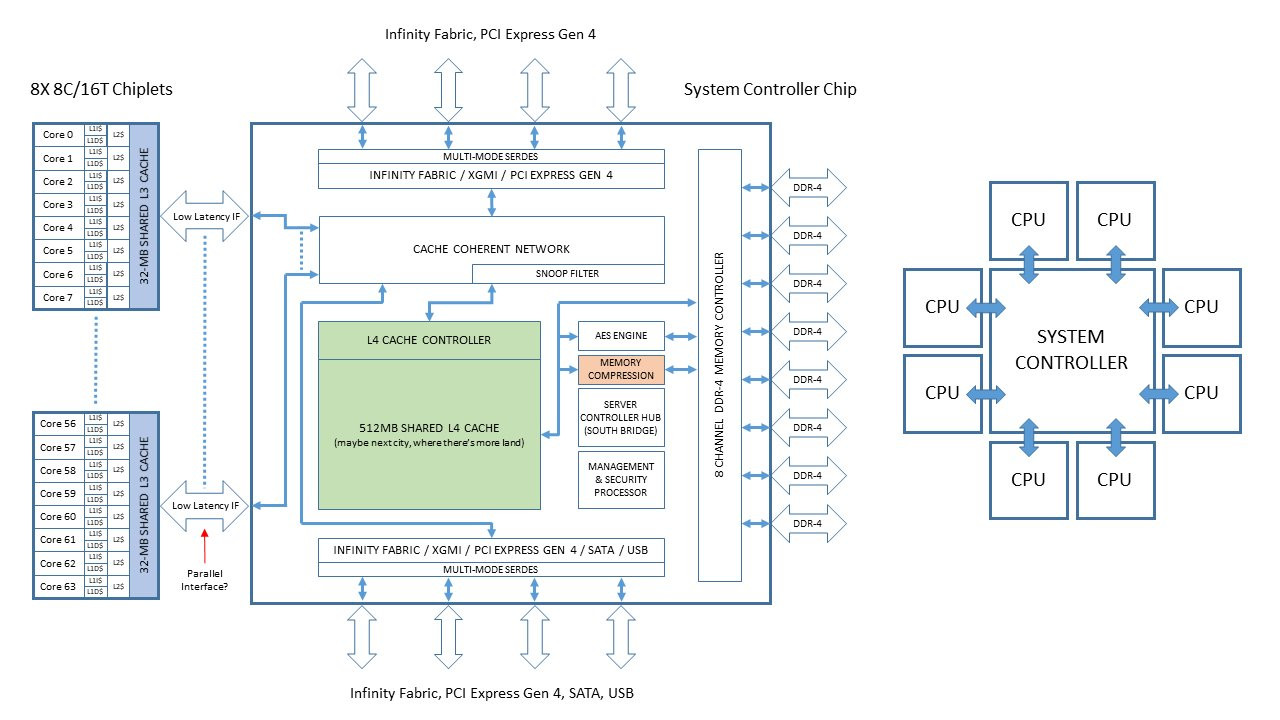

The System Controller die serves as town-square for the entire processor, and packs a monolithic 8-channel DDR4 memory controller that can address up to 2 TB of ECC memory. Unlike current-generation EPYC processors, this memory interface is truly monolithic, much like Intel's implementation. The System Controller also features a PCI-Express gen 4.0 x96 root-complex, which can drive up to six graphics cards with x16 bandwidth, or up to twelve at x8. The die also integrates the southbridge, known as Server Controller Hub, which puts out common I/O interfaces such as SATA, USB, and other legacy low-bandwidth I/O, in addition to some more PCIe lanes. There could still be external "chipset" on the platform that puts out more connectivity.
>>This is just speculation, but it maybe it could work if not for Rome, for whatever is Zen3. Oh! And each die is supposed to feature 8-cores, so we're talking about a 64-core monster.
Please excuse my bad English.
Former gaming PC: i5-4670k@stock (for now), 16Gb RAM 1600 MHz and a GTX 1070
Current gaming PC: R5-7600, 32GB RAM 6000MT/s (CL30) and a RX 9060XT 16GB
Steam / Live / NNID : jonxiquet Add me if you want, but I'm a single player gamer.


