











Those of you thinking about getting one of Nvidia's new Turing cards should take a look at this, specially if you also plan to overclock them:
NVIDIA Segregates Turing GPUs; Factory Overclocking Forbidden on the Cheaper Variant
https://www.techpowerup.com/247660/nvidia-segregates-turing-gpus-factory-overclocking-forbidden-on-the-cheaper-variant
While working on GPU-Z support for NVIDIA's RTX 20-series graphics cards, we noticed something curious. Each GPU model has not one, but two device IDs assigned to it. A device ID is a unique identification that tells Windows which specific device is installed, so it can select and load the relevant driver software. It also tells the driver, which commands to send to the chip, as they vary between generations. Last but not least, the device ID can be used to enable or lock certain features, for example in the professional space. Two device IDs per GPU is very unusual. For example, all GTX 1080 Ti cards, whether reference or custom design, are marked as 1B06. Titan Xp on the other hand, which uses the same physical GPU, is marked as 1B02. NVIDIA has always used just one ID per SKU, no matter if custom-design, reference or Founders Edition.
We reached out to industry sources and confirmed that for Turing, NVIDIA is creating two device IDs per GPU to correspond to two different ASIC codes per GPU model (for example, TU102-300 and TU102-300-A for the RTX 2080 Ti). The Turing -300 variant is designated to be used on cards targeting the MSRP price point, while the 300-A variant is for use on custom-design, overclocked cards. Both are the same physical chip, just separated by binning, and pricing, which means NVIDIA pretests all GPUs and sorts them by properties such as overclocking potential, power efficiency, etc.
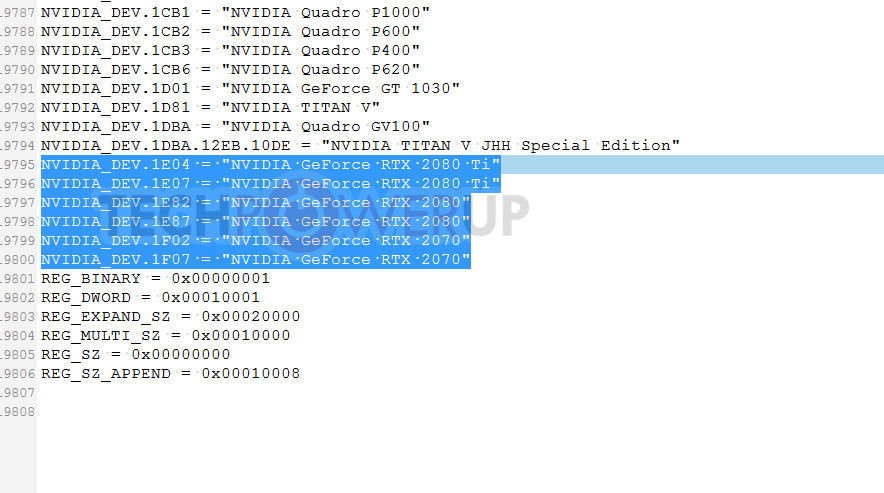
When a board partner uses a -300 Turing GPU variant, factory overclocking is forbidden. Only the more expensive -30-A variants are meant for this scenario. Both can be overclocked manually though, by the user, but it's likely that the overclocking potential on the lower bin won't be as high as on the higher rated chips. Separate device IDs could also prevent consumers from buying the cheapest card, with reference clocks, and flashing it with the BIOS from a faster factory-overclocked variant of that card (think buying an MSI Gaming card and flashing it with the BIOS of Gaming X).
All Founders Edition and custom designs that we could look at so far, use the same -300-A GPU variant, which means the device ID is not used to separate Founders Edition from custom design cards.
Please excuse my bad English.
Former gaming PC: i5-4670k@stock (for now), 16Gb RAM 1600 MHz and a GTX 1070
Current gaming PC: R5-7600, 32GB RAM 6000MT/s (CL30) and a RX 9060XT 16GB
Steam / Live / NNID : jonxiquet Add me if you want, but I'm a single player gamer.


