









| Gemmol31 said: I feel that videogame companies, should price games properly, and if they do not, we as customers should demand better and not buy those games. There are very few companies who are giving us way more than other companies for $59.99, while some take advantage and give us lowest amount of content for $59.99. I remember when the first TitanFall come out and people really argue back with me saying the price justify the content, when you paying 60 for way less content than what Call of Duty was giving, which not only gave more maps at the time, but also had a story mode, while the first Titanfall did not have a story mode, and had less maps, but still charge $59.99.......I said at that time, the game should of been $24.99 to $29.99 the most. People on every gaming website who only have a sony or xbox system, just like to get taken advantage of, as long as it have graphics they do not mind companies ripping them off, when you suppose to buy a game for gameplay. If graphics so important, just watch more Pixar films. |
There are plenty of games that take more than 200h to finish, and it isn't necessary that a lot of them do it. Also a lot games that take a long time haven't had much more dev time or cost than shorter ones, as their development can be simple for the added time.
VideoGameAccountant said:
That's a problem with budgets more than anything. These companies can make games cheaper. They can focus less on graphics which would likely save on time and money, but they refuse. The major publishers want this because it keeps competition out (since smaller firms can't make games as big and with the pretty graphics). As myself and others said, they can increase the price if they want. Also, the whole story of "games are too expensive" is a farce. Go look at their financials. They are raking in money. The whole "we need microtransactions because games are expensive" is putting lipstick on a pig. |
Could be a problem on budget, except there is a market that likes the graphic investment you seem to abhoor.
Teeqoz said:
The original post just said it was too low, which led to publishers pursuing other ways of increasing revenue. None of the companies are in it just to break even and then have some lunch money left over. You take a rather big risk every time you publish a big game, so you should expect a decent return on your money.
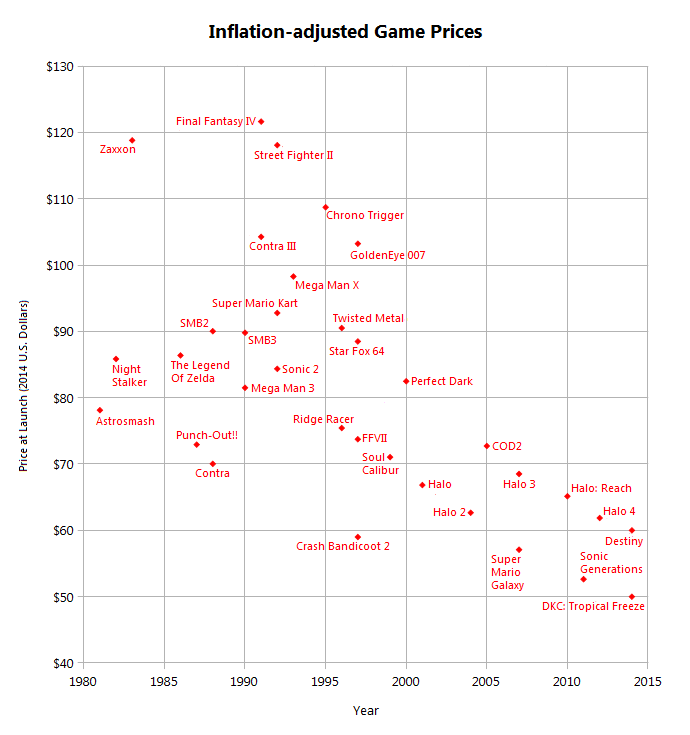
We have data on inflation adjusted game prices, do you have numbers on the added earnings for digital sales? I know they benefit the big three, as they are the platform holders, but I was under the impression that most of the added margin from moving from retail to digital didn't benefit the publishers for this exact reason. And once again, I'm not saying microtransactions are absolutely necessary. That their increased prevalence, along with other attemps to find new revenue streams, are in part caused by lower inflation adjusted game prices coupled with higher game prices though, is something I don't doubt. We both agree that it's a problem. I'm just offering a solution other than to trust the good of EA's heart. As for how you keep quoting EA's statement about Battlefront 2, consider their statement. It's not in relation to recouping the game's development budget. It's about their overall financials. Now, if we don't believe stopping microtransactions impact EA's earnings at all, then we also paradoxically think that EA make no money from microtransactions. Because that's a rather unlikely situation, this leads us to conclude that what EA actually meant was that the lost earnings from a short break in microtransactions for that single title wouldn't impact their total earnings for the entire year all that much. Do you, after all, think EA would say the same thing if laws were passed preventing EA from including microtransactions in any game? That it would have no impact on earnings? Of course it would. That's why that argument doesn't hold up to scrutiny. |
Yep, Microtransactions and lootboxes make no money, but for some reason publishers keep including it =]
Your point just show that companies can make contigency planning to keep their bottomline.
Ka-pi96 said:
Is there actually evidence to suggest that game sales overall are becoming more frontloaded? Or just physical game sales? It makes sense to me that digital sales would be less frontloaded than physical, given that physical copies will eventually stop being produced, they're much more attractive as impulse purchases, and of course there are some pretty good digital sales later on in a games life. It could perhaps be that with a greater shift to digital it appears games are more frontloaded, but that's more because later buyers are much more likely to go digital than they were previously. Besides, Gran Turismo Sport is a very recent example of a game that initally underperformed, had some price drops and then its sales picked up. |
On the front loaded... considering the day one is preloaded it's quite possible that it does make it even more frontloaded (on the profit).

duduspace11 "Well, since we are estimating costs, Pokemon Red/Blue did cost Nintendo about $50m to make back in 1996"
http://gamrconnect.vgchartz.com/post.php?id=8808363
Mr Puggsly: "Hehe, I said good profit. You said big profit. Frankly, not losing money is what I meant by good. Don't get hung up on semantics"
http://gamrconnect.vgchartz.com/post.php?id=9008994
Azzanation: "PS5 wouldn't sold out at launch without scalpers."


