









VGPolyglot said:
Thanks. So, Microsoft has other patents that has forced other operating softwares to find different means of using anti-aliasing? I don't know if Linux will ever be widely adopted, considering the brand recognition of Windows and iOS. I've never even seen Linux myself. |
We are talking about texture compression here, I am sure Microsoft has patents on AA that cause people headaches, but to my knowledge AA is not really an issue.
Personally I don't really care for AA anyway, and it is not really mission critical.
Especially when we are talking about text, for reasons I am sure I will eventually turn into its own thread.
Texture compression compatibility causes major issues when trying to, for say run Windows apps on a Linux machine.
S3TC is not a Microsoft patent, but the nature of the licensing restricts its use on Linux all the same.
Microsoft has been a big part of its success though, with the support found in / with DirectX.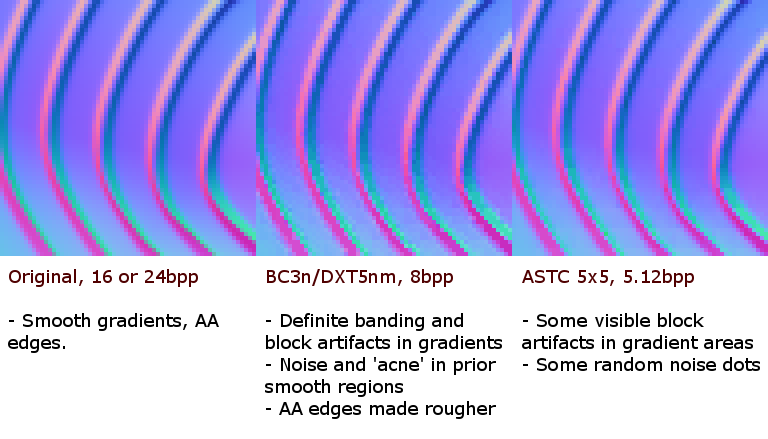
Using ASTC Texture Compression for Game Assets
Data size will be referring to VRAM usage from here on out.
bpp = bits per pixel.
There are 8 bits per byte.
I will make the assumption that a gigapixel is one billion pixels from here on out.
And from here on out I will assume (for the sake of simplicity) that one billion pixels is equal to 1GB,
eight bytes per pixel as a baseline.
The left is uncompressed data at 2 to 3 GB per gigapixel.
The middle is S3TC (Microsoft's name for it anyway) using 1 GB per gigapixel.
The right is ATSC using 0.64 GB per gigapixel.
So in short ASTC uses less data than S3TC and looks better (less artifacting when comparing the given example).
It will not always be this biased towards ASTC, and there are different quality settings that could be used.
Apologies for anything I have gotten incorrect, and / or oversimplified.


