









| sc94597 said: 1. The issue is that in the short term the diner doesn't have the extra funds to employ all of their workers at the drastically higher rate. Let's say the diner is currently making revenue of $150,000 per year. $50,000 of that goes to the owner (this is what makes it worth it for the owner to run the business, otherwise they would work for somebody else.) The rest is to be divided among capital costs: the taxes on the building, repairs to the building, food, and then to labor costs: a cook, two waitresses (assume the state requires minimum wage payments and the diner has no tips), a hostess, and a dishwasher. The cook makes $20,000 per year, the waitresses $14,000 per year each, the dishwasher $10,000 per year. That leaves $42,000 to costs of capital. Let's assume that the $42,000 is enough to maintain the building, buy food, etc for a year (it's a small diner.) Now let's say there is a 30% minimum wage increase for the following year, and capital costs are constant. That would mean ($20,000 + $28,000 + $10,000)*.3 = $17,400 is the increase. That also means the owner will have to take a pay cut of the same amount, only making $32,400. Knowing the stress of running a business would it be reasonable for the owner to keep running the business for $32,400 or could they use their skills elsewhere? What if the owner wasn't making a profit before the minimum wage hike? What if they were just getting by on $30,000? What if the owner employed many people? Would it not make more sense to just lay people off? What would happen to the quality of the service? How exactly would this affect demand for this small business owner if he or she lived in a low populated area? But heck, we don't really have to speculate. Small business owners have already recognized this reality when they had to shut down their business after wage hikes. Here is one example, but one can find plenty of other similar stories. http://www.cbsnews.com/news/feeling-burned-by-a-15-minimum-wage/ "I hadn't done the math. I penciled it out and said, 'Oh my god, that's a lot of money,'" he recalled. "'I know other stores haven't done [the math]. You try to get through the day -- you aren't thinking three years ahead." ---------------------------------------------------------------------------------------------------------------------------------------------------------------------------------------------------------------------------------------------------------------------------------- 2. Again, this is no different from the aggregate demand hypothesis. You are using an accounting term "capitalization" to describe what is essentially the economic concept of the effects of an increase in aggregate demand. Unfortunately, there is very little evidence, besides a single study in the 90's, when the labor market was at its peak in health, to show that minimum wage increases lead to increases in aggregate demand. I also don't buy that taxes will decrease. Governments, being the way they are, would just use the tax money on other pet projects. Furthermore, in places like Seattle there were actually people asking workers to reduce their hours so that they could remain on welfare, and also use more leisure time. “Astoundingly” those who advocated for the increase in Seattle are now asking their employers for fewer hours so they can keep their welfare benefits." ---------------------------------------------------------------------------------------------------------------------------------------------------------------------------------------------------------------------------------------------------------------------------------- 3. There are many factors besides labor costs which contribute to a cheaper cost of living. In the U.S: southern and rural mid-western states have lower costs of living because small population densities => lower housing prices, closer proximity to energy sources like coal and oil as well as agricultural sources => lower transportation and food costs, and fewer regulations overall increasing the cost of production. None of these have anything to do with labor costs. It is unrealistic to believe that labor costs should or would be uniform, especially in a federalist system with varying legal frameworks, as well as an overall diverse population of 315 million people. People in different regions have varying levels of productivity, and therefore the amount of money they can make for an employer varies. If wage levels were the same across the board, all this would do is push employers to places where productivity is higher, limiting the ability for persons who live in non-productive regions. The effect of this is that those with the fewest resources are stripped of any advantage they have left, and are either forced to migrate to already over-populated cities or remain in their economically stagnant position. And I already illustrated that the increase in unemployment is an economic fact. It is one of the first things you learn in a microeconomics course.
It is also supported quite a bit empirically. http://www.columbia.edu/~jm3364/Minimum_Wage_and_Space.pdf Often, minimum wage laws are decided at the state or regional level, and even when not, federal level increases are only binding in certain states. This has been used in previous literature to evaluate the effects of minimum wages on earnings and employment levels. This paper introduces a spatial equilibrium model to think about the seemingly conflicting findings of this previous literature. The model shows that the introduction of minimum wages can lead to an increase or a decrease in population depending on the local labor demand elasticity and on how unemployment benefits are financed. The paper provides empirical evidence consistent with the model. On average, increases in minimum wages lead to increases in average wages and decreases in employment. The low-skilled local labor demand elasticity is estimated to be above 1, which in the model is a necessary condition for the migration responses found in the data. Low-skilled workers, who are presumably the target of the policy, tend to leave or avoid moving to the regions that increase minimum wages.
---------------------------------------------------------------------------------------------------------------------------------------------------------------------------------------------------------------------------------------------------------------------------------- As another thing to note. We even have predatory organizations trying to take advantage of minimum wage hikes by exempting themselves. In Californian cities, labor unions have been trying to force membership by becoming exceptions in minimum wage legislation specific so that their employees don't have to work at the minimum $15/hour, and consequently business are more likely to higher them. It is quite abhorent really, especially coming from an organization that is suppose to work for higher wages. http://www.cnbc.com/2015/07/30/la-union-wants-to-be-exempt-from-15-minimum-wage.html "In May, the Los Angeles City Council voted to lift the minimum wage to $15 an hour by 2020. As the council reconvenes this week after a summer recess, the group is expected to take action on a union-backed clause in the wage bill that would exempt unionized workers." |
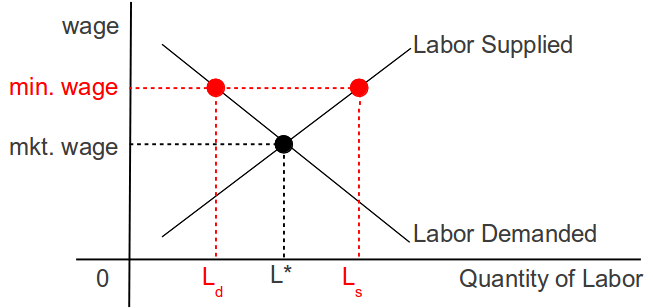
1. There is the same factor overlooked here: increased consumption, due to increased customer capitalization. If that same business was making $150,000/year and they saw a 30% increase each year, they would see an annual increase of $45,000. That would translate to an annual profit increase of $27,600. In that case the owner goes from making $50,000/year to $77,600/year. If the business was a diner, there's a fairly good chance that a sizable portion of their clientele earns minimum wage, so the increase would benefit their customers and, by extension, them.
2. You highlight a few issues here: A) A study already endorsed the economic benefits of increased minimum wages, but I think one study is too limited a sample size to realy on, B) Until the government focuses on fiscal responsibility, we should not expect increased tax revenue to lead to decreased taxation (but we should demand it), and C) If people are asking for fewer hours at the new wages to maintain benefits (from the goverment), employers will have to hire more workers (thereby increasing the number of consumers and their capitalization), which should lead to increased business revenues and decreased employment.
3. This is pretty cool and a big issue for any economic analysis: regional cost of living. It's perfectly sensible that demand for regional labor leads to increased costs for said demand, but the actual wage rate for certain labor (in theory) should be constant. If pizza men make $15/hr, then that's the pizza man standard. If a region has all the pizza men they need, the labor force shifts to the new needs or relocates to where they need pizza men. I wouldn't advocate for such an oversimplified approach to minimum wage, becuase it's haphazard and ignores the many factors you brought to light. Given that inflation has vastly outstripped the minimum wage, I think there needs to be a comprehensive evaluation of regional labor markets to ensure that workers are sufficiently capitalized to consume goods, need less government assistance, and contribute to the tax pool (I have ideas on how everyone should have a responsibility, but that's a different conversation). Without a normalization of some kind, more people will contribue less and require more. The study you linked was very interesting, and it makes me wonder how much of the effects can be attributed to nature of the American economic environment from 1985-2015 (Supply side amazingness!). There also seems to be a signficant ampunt of controversy surrounding minimum wage studies, and you'll probably appreciate this: http://journalistsresource.org/studies/economics/inequality/the-effects-of-raising-the-minimum-wage
Your note encapsulates a big factor in this discussion: dickheads ruin capitalism, every damn time. If profit margin driven (to the point of being caustic) policies didn't lead to the abuse of labor markets, we wouldn't be dealing with wage issues post mortem. Then, you have people abusing the government to take advantage of policies that are intended to correct the policies that were endorsed by the people whom they oppose. The problem is not insoluble, but people always trying to get a leg up (at the expense of others) are the problem and the exacerbators of the problem. I guess the old saying is axiomatic: "Capitalism is inherently insane."
PS: thanks for the info and constructive conversation; it's a real treat on the inernet lol.


