









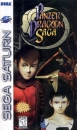

May 11th 1995 is a day that lives in gaming infamy, on that day, during the very first E3, Tom Kalinske, Sega of America's CEO at the time was showing of the Sega Saturn to the public, originally Kalinske had announced that the Saturn would be released in the US on September 2nd of that year, dubbed Saturnday, however near the end of the presentation Kalinske shocked everyone by announcing that the system was already in store shelves that very day, the Sega Saturn had its official launch in North America that day, May 11th 1995.
It's been 20 years since that day, and now that the dust has settled I want to take a little time to talk about my favorite system, this is the story of the oft-maligned, undersold and underloved console from SEGA, the 32-bit Sega Saturn.

*Details are entirely the US' launch
As already stated, the Saturn made its way onto the US on May 11th 1995, with the suggested price of $399.99 or $619.00 on today's money, every launch system came bundled with Sega's hit 3D fighting game Virtua Fighter; originally SOA shipped around 30k on launch day to satisfy demand, this however was just to some selected retailers as SOA didn't bother to tell that many people when the Saturn was coming out.
The launch of the Saturn in the US can only be described in one word, failure. The ridiculous price point, the lack of appealing software and just the surprise of the launch did not do the system any favours and pretty much set the future of the system, SOA killed off the Saturn before it had any chance to fight.
Approximately 600k units were shipped to NA between its launch and March 31st 1996, yet less than 230k were sold in the US in 1995, the system wasn't moving a drastic meassures had to be taken, less than a year after launch Sega dropped the price of the Saturn from $399.99 to $199.99 the slash in price didn't help either, the system was a dud, just a year after release.
We'll dig into more detailed sales data later on, for now onto another topic.

*From now on we'll be talking things more generally, not just US.
Near the end of 1995, once it became apparent that the Sony PlayStation was poised to seize the lead in the 32-bit console sweepstakes, Sega CEO Hayao Nakayama made a decision that would shape the course of Sega's finances for years to come. He was the man in the big chair. It was his call, and his alone. Nobody else could make this decision for him. The aging Genesis could no longer hold its own against the superior software offerings of Nintendo and its Super NES. Both Sega CD and the 32X had effectivly bombed, costing Sega millions of dollars in lost resources and revenue. Sega's handheld efforts (Game Gear, Nomad) and its educational venture (Pico) were going nowhere fast. Only the Saturn seemed to offer some hope of rescuing Sega's failing fortunes. It had done surprisingly well at launch in Japan, a market in which Sega had never taken the lead before. Saturn had floundered in the U.S. against the PlayStation, but there was still time for it to make a comeback. Most voices within the videogame industry agreed that 1996 would be the critical year in the second great console war. Sega still had an outside chance of winning, but only if it focused its resouces instead of spreading them across multiple systems. With these and many other factors in mind concerning Sega's current financial standing and flagging fortunes, Nakayama made a fateful choice that would forever shape Sega's destiny.
In October of 1995, Nakayama made the decision to put all of Sega's eggs into one basket. Sega announced that it was cancelling all of its other consumer systems and focusing exclusively on the Saturn. Sega's 32-bitter would be the company's flagship console from now on.
There is one question that has dogged Sega loyalists concerning the Saturn and its misfortunes, and it is this: did Nakayama make the right choice in backing the Saturn as Sega's sole console? The answer is not as easy as it may seem, and one must put aside the wisdom that inevitably comes with hindsight and try to see things as he saw them during that time. Sega's arcade divisions were still going strong, but its console sales were floundering against both Nintendo and Sony. That was an ever-worsening load on Sega's bank accounts that was causing the company's profit margins to begin an inexorable slide downward. Nakayama couldn't just sit around and let Sega get clobbered one piece at a time, wielding multiple systems against better financed rivals whose product lines were considerably narrower. He had to make a choice, and Saturn was the row he chose for Sega to hoe. The 32-bit market had not quite yet gained its momentum, but all the signs were there that it was coming fast. Whoever took the lead in 1996 would win the second great console war, barring none. Sega simply did not have the ready cash and company resources of a multimillion dollar international conglomerate like Sony to continue as it was doing. In order to win, it would have to focus its efforts on a minimum product base and push it for everything it was worth. Nakayama's choice was a desperate gamble, but these were desperate times, and Nakayama was a desperate man.
Nakayama's decision to cancel all other Sega consoles in favor of Saturn was the best thing that could have ever happened to Sega in its Japanese homeland. Sega had never been strong there until Saturn made its debut. All of a sudden, Sega of Japan had the number one console on the market and held a healthy lead over all competitors. Sony and its PlayStation were catching up fast; however, Sega of Japan would now be able to commit its full resources in order to attempt to stem the Sony tide. Most objective industry observers in Japan and a fair number of Western ones credit Nakayama's choice with saving the Saturn in Japan. Thanks to his decision, Saturn probably got an extra year of life in its home market that it might not have otherwise obtained. Nakayama's move ensured that Sega would retain its market lead long enough to gain a newfound measure of respect in its homeland and build a legacy in Saturn software it might not have had under other circumstances.
What of the United States, the single most profitable market in the worldwide videogame industry and the only one that really mattered in the second great console war? Almost every U.S. market expert agrees that Nakayama's decision was the wrong one for the wrong market. Sega had quite a public reputation to uphold. It enjoyed a unique relationship with older gamers that Sega of America president Tom Kalinske and his staff had been dilligently building for years. These were the ones who had grown up playing videogames and now had the resources to buy their own systems and software instead of looking to their parents for cash. These were the gamers who would form the backbone of the 32-bit console niche in the U.S. market, and it was this group that Sega of America had courted so long in an effort to win their confidence. They were ready for Sega's nextgen system, provided it was a real console and not another knock-off like the 32X. Even so, many of them had a considerable investment in their Genesis and were quite prepared to keep spending money on it until the Saturn software situation firmed up. Nakayama's choice effectively pulled the rug out from under its American customer base. They had just gone through two years of new and expensive Sega add-ons and peripherals for Genesis, and now there would be no way for them to continue supporting their favorite Sega console. Those who simply could not afford the high-priced Saturn and what few games could be found were quite willing to spend their money on new Genesis titles for another year, but now they would never get the chance. Nakayama's move forced the hand of American gamers nationwide. They wanted the best bang for their buck, but Sega seemed no longer willing to provide it. Instead, it was breaking its promises and commitments to its customer base seemingly as fast as it made them. It had said it would continue to support Genesis, but now it had changed its mind seemingly at whim, with no thought as to how the Sega faithful felt. "Those S.O.B.s at Sega!" many U.S. Sega fans began to say to themselves. "They're going to pay for being such arrogant asses." It was a growing crisis in vendor-consumer relations that would come to its head soon enough.
It should also be noted that Nakayama's choice was an unmitigated disaster for Sega's fortunes in Europe. Ever since it began its Western export operations, Europe had been Sega's for the taking. First the 8-bit Master System and then the 16-bit MegaDrive had ruled the vidoegame roost in the Old World, and Sega's legacy was as venerated among videogamers as the Amiga was among computer hackers. Nakayama's abrupt move came at the worst possible time for Sega of Europe, for Saturn had just been launched and still had not yet established its own following in Sega's traditional Western stronghold. Old-school Sega loyalists from across the continent felt like they had been stabbed in the back, and they let it be known by refusing en masse to take up the Saturn in place of their older consoles. Instead, they stuck to their MegaDrives, or in some extreme cases their hoary Master Systems, and the Saturn quickly fell of the radar in Europe. It has been estimated that only a million or so Saturns were sold in the whole of Europe from 1995 to 1998, the official lifespan of the system over there, and that was because most gamers simply refused to buy it. Instead, they went to other vendors who seemed less arrogant and pricey, and the seemingly inexpensive Sony PlayStation with its bevy of fairly affordable games was all the excuse they needed to jump ship. Sega lost the European market thanks to Nakayama's choice, and would never retake the whole of the continent again so long as Sega remained in the console business.
It must be said in all fairness that Sega's Western branches knew what was happening, could see what was coming, and did everything they could to sway Nakayama from his chosen course of action. Sega of America president Tom Kalinske was highly vocal in his objections during the increasingly frequent visits that Nakayama was now beginning to make with him. Nakayama simply overruled him time and again. Lesser Sega of America executives also found the opportunity to speak out in their opposition, such as Paul Rioux and Michael Lantham. Nakayama ignored them. Even Shinobu Toyoda, Nakayama's own hand-picked American market liason, who knew that market better than any of Sega's Japanese executives, could see what was happening and managed to work up enough nerve to question his superior's decision. His opinion was cast aside just like those of his Western colleagues, because Sega of America was no longer in control of its own destiny. The situation was practically identical over in Europe, although the names of the players were different. Sega of Japan was now in effect running the company, and it was they who were going to call the shots on anything and everything Saturn. As for the rest of Sega, it could go screw itself. The West was making Sega lose money. Only Sega of Japan, in its own eyes, had the product and vision to save the corporation from financial ruin.
Next up the complete disaster that happened in E3 1996 prompted Nakayama to get rid of Kalinske as CEO of SOA (along with plenty other people) and to switch the original Sega marketing team (the one from the Genesis days), in a desperate move to try to turn the system around in the west, however Nakayama's actions only sank the Saturn further and further, the system was now at...

As the memory of E3 1996 faded into the background and the long days of the summer season slowly ticked by, Sega found itself in the unenviable position of not being fit to do battle with either Sony or Nintendo. Many new Saturn titles were suffering production delays. Sega was losing money hand over fist due to Sony's bold moves in forcing down nextgen console prices, so much that now Sega could never hope to break even on Saturn production costs. Rumors were already starting to surface within the videogame industry that Sega was going to drop the Saturn in 1997. Industry insiders pointed to Sega's steadily shrinking profit numbers, its shallow pockets, its cranky console, and its lack of software for it. They confidently predicted that Sony was going to win the second great console war hands down. Sega's Japanese masters saw things differently, as you might expect - after all, N64 sales in Japan had all but stopped due to a dearth of software and Saturn was still outselling PlayStation. What was happening in Europe didn't matter, because the market was too small to worry about. What was happening in the United States was a mere abberation, and would be quickly corrected now that Kalinske was gone. They were taking moves to correct the situation. The Americans would come around ... in time.
Sega of Japan's arrogant confidence did not jive, however, with current company performance in the one market that mattered more than any other. By this time Sega had somehow manged to sell just over 500,000 Saturns in the U.S., which was less than half the number of PlayStations being purchased by consumers nationwide. Gamers didn't care what was happening on the higher planes - all they knew was that PlayStation was cheaper and had more of the cool games, and this was reflected in the market performance numbers. Sony was giving them more of what they wanted than Sega, which had seemingly turned its back on its glorious past and was now in the mood to alienate as many good gamers as it could with high prices, lack of good software, and broken promises. Sony's share of the videogame industry kept growing by leaps and bounds as the critical 1996 holiday shopping season inevitably approached, while Sega's continued to plummet at record speed.
Sega's chances of surviving the second great console war were now slim to none. It was no longer a question of whether or not Sega could pull off an upset. Instead, everybody except Sega was wondering just how far the former champion would fall. They would begin getting their answers soon enough.
By the end of August, Sega of America's financial situation was so bad that president Bernie Stolar ordered the company to discontinue all television advertising starting the following month. It was a move Sega could ill afford - after all, television ads had been the backbone of Sega's earlier promotions - but Stolar could read the numbers as well as anybody. Sega simply couldn't affort the kind of multimillion dollar, multimedia blowout for which it had become known in days past. Stolar was berated by both industry pundits and hardcore Sega gamers for his move, but he neither regretted his decision nor apologized for it. In all fairness, Stolar's move probably didn't hurt Sega as much as others made it to be. By this time, it was pretty obvious who was dominating the American console markets - and it wasn't Sega. Not by a long shot, and Stolar deemed it unnecessary to waste precious company resources on a battle he knew he couldn't win. He was already looking beyond the Saturn ... but few of his critics at the time realized that.
It was also about this time and during the following months that what few American gamers were left who had not yet committed to 32-bit consoles finally began to play their hand. Their choice? The Sony PlayStation. Why? "It's cheaper," they reasoned, "it has more games, and even if a lot of these are crap, there's a lot that aren't. Besides, all of the really cool titles come out on PlayStation first or exclusively. The only people buying Saturn are either losers or Sega fanatics, and most of those are losers anyway. They just don't get it - Sega isn't cool anymore. Sega is so old school ... but PlayStation is cool. Even Nintendo's looking pretty good these days, what with the N64 and all." Say what you will about the system itself, but Sony's marketing machine had done its job and done it well. PlayStation was now the "in" system, with an installed user base of some 2 million consoles and growing larger every day. Saturn was definitely "out," with just under 900,000 consoles sold and almost no good games to be had.
So how did 1996 turn out once all was said and done?
To put it bluntly, the second great console war was now effectively over. Sony had won the field of battle, sweeping away all opposition in its path and giving both of its competitors a good old-fashioned ass-whuppin'. In spite of this, Nintendo had successfully joined the nextgen wave with the N64, supplanting Sega and taking its place as the weak number two on the console market. There was no room in which a third competitor could remain profitable for long, and Sega would learn that bitter fact soon enough. On 31 March 1997, Sega submitted its annual consolidated financial reports to its stockholders. Sega had against all odds still managed to pull off a profit, but was a paltry ¥5.57 billion (US$46.4 million) - less than half of what the company had made the year before. Sega had not done this badly in the videogame market since before the days that the Genesis came on to the scene. As it would turn out, 1996 would be the last year that once-mighty Sega would post a net profit. It was as if Nakayama and his cohorts at Sega of Japan were deliberately devolving their company back into the industry whipping boy it had once been.
Sega's downward spiral would not stop here. The worst was yet to come.
Even with its poor sales, 1996 would be the system's peak year, with nearly half of its total sales being done there, by 1997 most western third parties had abandoned the system, and all but the little third parties that had carved a dedicated niche in Japan were starting to jump ship as well. And, quietly, so did Sega.
1997 isn't full of big news regarding the Saturn as Sega mostly forgot about it. By 1998 the company had officially abandoned the system and no new software was in production, Sega was already finishing details on the Saturn succesor's the Katana, which would be released in Japan later that very same year under the name Dreamcast, while they never gave an official date, SOA discontinued the system in 1998 with less than 2m units produced, while Sega in Japan also abandoned the system it managed to keep afloat with games from third parties and would go on to be supported by then up until the year 2000, when exactly was the Saturn discontinued world wide is mystery, but its likely that production of the system completely halted after the year 2000 in Japan, with less than 10m units produced.

As its common with videogame systems the Sega Saturn went through several revisions, they're most commonly reffered to as Model 1 and Model 2 and can be told apart rather easily.
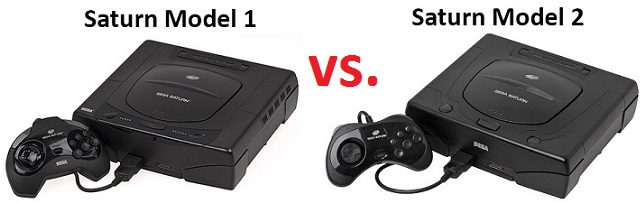 As can be seen here, the model 1 came with a different pad than the model 2, the most clear difference between the consoles, however are the buttons the model 1 has oval shapped buttons while the model 2 has more round buttons, there are some other aesthetic differences which you should be able to tell easily.Most fun is comparind the different themes and colors in which the consoles were released, here.
|
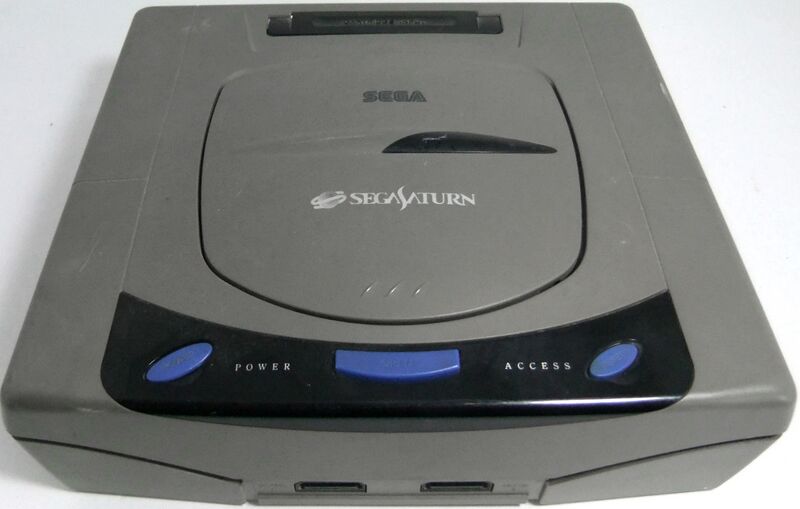
Standard Japanese Saturn (Grey) The launch Saturn is a Model 1 system as can be seen here, this one had to revisions both released in 1995 with minor differences, the Grey Saturn only comes in Model 1 |
 |
|
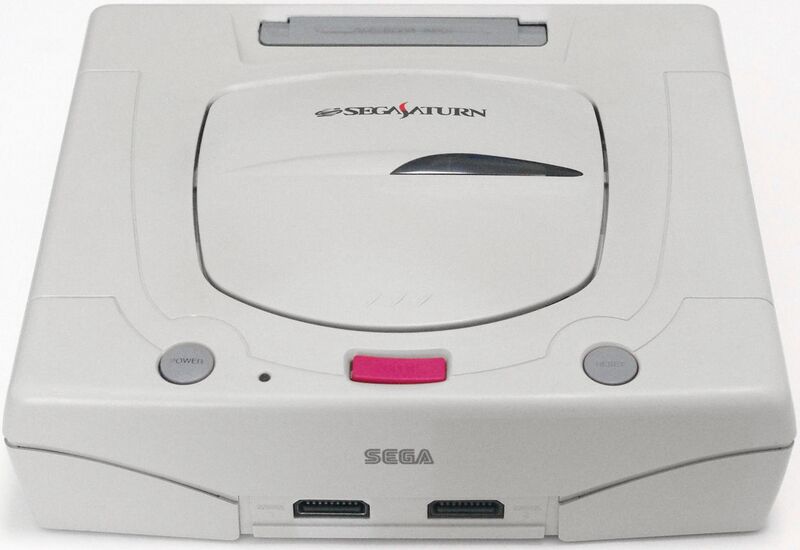
Model 2 Japanese Saturn (White) Released in 1996 the White Saturn was also a Japan only release that was only a Model 2, it had to revisions one also released in 1996 and a second released in 1997 |
 |
|
"Skeleton Saturn" The Skeleton Saturn was the last model to be released in Japan, as late as 1998 it had to revisions one in 1998 and a second in 1999, there were only Models 2 |
 |
|
Hi Saturn Hi Saturns were Saturns produced directly by Sega's partner Hitachi, this one was available as both a Model 1 and Model 2 as well as a special unique console, there were 3 revisions with 2 being released in 1995 and a last one in 1996. |
 |
|
V Saturn Like the Hi Saturn the V Saturn was produced by a Sega partner this time by JVC Victor in 1994, available on Models 1 & 2 there were 5 revisions 2 released in 1995 and 3 in 1996 |
 |
|
Black Saturn The Standard black Saturn was the only one available in the west and ironically the only one not to be released in Japan, available on Models 1 & 2 its unknown how many revisions it had. |
 |

Overly sophisticated system architecture - If you will recall, the common perception was that Saturn was the most notoriously difficult to program nextgen videogame console on the market at that time. This was not exactly true, though, and it all depended on your point-of-view. Sega gave the programmers exactly what they wanted, which was a system whose complex hardware could be directly tapped for whatever software they desired to code, along with ample documentation on every aspect possible. That was heaven itself if you were a top-notch codehead; however, it was a nightmare if you weren't - or if you were the manager of a software development team for a leading third-party software house whose superiors wanted you to finish your game ASAP. If you will recall, it was none other than Sega's own acclaimed programming genius Yu Suzuki who said, "I think that only one out of 100 programmers are good enough to [properly program] the Saturn." The third parties didn't have time to learn such a complex machine as the Saturn, and frankly their bosses didn't care - not with an easier-to-program nextgen console such as the Sony PlayStation readily available. Remember what veteran third-party programmer Steve Palmer had to say on the subject? "Video games were no longer a "niche" market, and the "big boys" had moved in. Time is money. Nobody was given the time to learn new hardware anymore." In creating an overly complex system architecture, Sega had practically guaranteed delays on Saturn software development for all parties concerned.Lack of a sufficiently good development environment early on - Chris Slate of Game Players magazine made this observation as 1995 drew to its close: "Sega struck first with an early sneak attack launch in mid-May. Unfortunately, Sega caught itself by surprise as much as the competition, and the result was a great piece of hardware left to sit on shelves with just a handful of mostly mediocre games. It would stay this way until development caught up months later with worthy titles." The reason, as we now know, was that Sega did not have practically any third-party titles ready to ship with Saturn for its abruptly early U.S. launch. The game developers were still busy wading through the manuals and learning the hardware, and many of them preferred to wait until they better understood the console. Remember, many of the best games to ever grace Sega's venerable 16-bit Genesis/MegaDrive console were by such notable third parties as Capcom, Core, Electronic Arts, GameArts, Masiya, and Namco, to name but a few. Where did almost all of them go when the 32-bit generation of consoles came along? To the system for which software development was the easiest - the Sony PlayStation. Sega was too busy doing Saturn third-party support the old-fashioned way to realize just appealing Sony had made PlayStation development with its canned software libraries. Almost every developer who has cared to publically comment on the issue has noted that the Saturn was quite capable of matching and in some cases outshining PlayStation, but it wasn't until the second-revision Saturn devkits and the Sega Graphics Library 2.0 that they felt like that had what they needed to produce good games fast. Don't forget the observation by Sega's own Yu Suzuki that only 1 in 100 programmers were capable of properly programming the Saturn, nor developer Steve Palmer's observation about the constant time pressure on third-party software development, either. They and their fellows had to make good-looking, decently-playing games yesterday per their employer's demands. For the average developer, the only system on which one could consistently do that without having to learn a lot of documentation was the PlayStation with its canned software libraries, and that remained the situation for many moons until it was practically too late for Sega to fix the problem. By the time it presented a solution to Saturn development, most of its audience had left it months earlier and were clustering around Sony's console instead.
Misreading the system's early market performance - Sega of Japan was under the mistaken impression that Saturn did far better in Japan than it actually did. As the late Isao Okawa himself noted, they were too busy counting sales to take stock of long-term market trends, and that proved to be Sega's undoing. Simply put, Saturn did as well as it did in Japan for one reason - it was the only nextgen console available that had Virtua Fighter. Once the initial glamor wore off and the PlayStation proved itself a worthy competitor - less sophisticated in its hardware perhaps but with better 3D capability and a wider software base - then many Japanese gamers proved as astute as their Western counterparts by jumping ship and joining the Sony bandwagon. It just took a lot longer in Japan than it did in the West. Sega should have been paying far more attention to Saturns sold over the counter at local retail stores than it should have out of Sega warehouses to retailers.
Pricing the system too high for its intended market - You would think that Sega would have learned from Trip Hawkins and the blunders that were made with the 3DO, but instead it almost immediately committed the very same mistake that had doomed the 3DO to failure. Sega priced the Saturn too high for its intended market. Pricing trends that had been developing in the videogame market over the past two decades indicated that the average price for a brand-new, nextgen console should be within the US$200-$350 range. 3DO had been immediately doomed to extinction with its hefty US$800 price tag - a loftily absurd figure that seems ridiculous even now. For Sega to price the Saturn at US$399 was an open invitation to disaster in the minds of many industry analysts both then and now. Of course, there was a very good reason why Sega set the price of the Saturn so high: it was operating under a steadily growing mountain of debt. Even so, Sega should have been more willing to take a hit on the price of the console and instead look for needed funds in software sales, whence the real profits lay. Steven Kent sums up this particular issue as well as anybody in his seminal work The First Quarter when he observes, "[Saturn] was too expensive for the consumer elextronics category. The $399 price point was known to be more of a high-end electronics ticket - something that people might pay for a stereo component, but not for a videogame console. Sega was making the same mistake Trip Hawkins had made with the 3DO."
Alienation of potential system supporters - Sega's once-strong relationship with third-party developers was fraying fast due to the managerial meddling from Sega of Japan. Like Nintendo before it, Sega had began to throw its weight around, dictating to its licensees what they could and could not do, how much and when, and so on. The third parties no more liked this in 1995 than they did in 1985 when Nintendo was pulling the exact same crap. Sega had by now also gained the unenviable reputation of "putting out one hardware unit after another." While Sega of Japan made it perfectly clear that Saturn was and always would be the company's future, many developers remained skeptical - especially after news of the rumored Eclipse 64-bit Saturn upgrade and the all-new Katana and Black Belt console designs leaked out in 1997. With all this confusion going on, it was no wonder that the third party community began to look elsewhere to push its products. They found it in Sony, who was very generous in its licensing terms and offered a console with simple-to-program architecture that yielded incredible results. In contrast, Sega spent a lot of its time pissing off third parties big time, so it was inevitable that they woud turn to Sony instead. It was the exact same thing that Sega had done to Nintendo and Nintendo had done to Atari years before. You would have thought that somebody at Sega saw it coming.
Lack of a system library containing good, diverse software - If there is one lesson that you, the average gamer, should have learned by now, and it is one that I cannot emphasize enough, it is that software sales are the true money train of any given vendor's system. You have can have all the fancy hardware in the world, but if you don't have enough software that properly shows it off to your intended audience, then your system is going to suffer and you right along with it. Sega should have known better than to launch the Saturn the way it did in the U.S. - advance the release date so that there was almost no software for it, let along any good software. The scant handful of titles that were available were obviously and admittedly rushed. Not a good way to get your foot in the door of consumer's homes. Furthermore, the rushed launch meant that the console sat on store shelves for months without any significant software support. By the time it arrived, the opportunity that Sega had hoped to seize with an early launch had already passed and people were now looking at PlayStation instead. Sony may not have had Sega's experience in making videogames, but it had money and lots of it, and as Game Players put it, "Baby, that can buy you all the experience you need." Add to that the simplicity of the PlayStation architecture in comparison to the mess that comprised the Saturn's internals and it was no wonder that the third party community jumped ship as fast as it did. This trend would continue throughout the lifetime of both systems, with Sony's deep pockets enabling it to afford the third-party support and system exclusives that Sega simply could no longer afford as it lost precious market share and profits right along with it. The fact that Sony was able to do such things as launch the system with the backing of the likes of Namco and Konami, wrestle Square away from Nintendo (and the Final Fantasy RPG franchise along with it), get Capcom in its corner with its best programming teams and first go-round on hot titles (do the Street Fighter 2 and Resident Evil franchises ring a bell?), and welcome a disgruntled Working Designs from the Sega fold speaks volumes. Sony had the better and more diverse software library, with few exceptions, because they could afford to pay others to develop it for them. It's that simple.
Refusing the good advice of your peers - The executives at Sega of Japan were hell-bent on making the Saturn work in a market that they knew full well was Sony's for the taking. Since their side of the company was the older and more experienced, or so the common wisdom went, then they supposedly knew what was best for Sega. Nakayama and his allies repeately ignored and overruled the advice of Sega of America president Tom Kalinske and his staff, as well as that of Shinobu Toyoda, their own U.S. market liason, on just about every critical aspect of the rapidly burgeoning 32-bit videogame market. They were going to make the American videogame market fall in love with the Saturn just as it had with the Genesis years earlier. What they forgot was that it was the American side of the business that had endeared Sega to its American fans, not its Japanese senior management. The same was true over in Europe, but Saturn had already flopped there and Sega of Japan was not about to waste any time and effort there. The U.S. was the big money market - the place where the stakes were the highest - and it was there that the Saturn should have succeeded. It did not because Nakayama and his staff were too busy refusing to listen to the good advice of Kalinske, Toyoda, and their fellows. "You're launching the system way too early," Nakayama and his staff were repeatedly warned. "It doesn't have the software base. You're wasting your efforts." Sega of Japan simply would not listen to those who best knew the intended market. It should have surprised no one what happened next.
Banking all of the company's hopes on a flawed gamble - The single most important decision insofar as Sega's future was concerned was Nakayama's 1996 gamble of banking Sega's fortunes solely on the Saturn. In all fairness, Nakayama really did not have any other choice - Genesis was beginning to fade in the West and seasoned developers were turning their backs on his beloved little 32X. The flaw in Nakayama's decision was that he made it as early as he did. It is generally agreed by most industry observers that Genesis still had enough life left in it to survive another year, which would have given Sega one more desperately needed profit stream. It is also possible, given hindsight, that more developers would have begrudged the 32X another chance. Nakayama pulled the plug on Genesis before it was really dead and axed the 32X before it even got a fighting chance because he was desperate to see Sega seize the emerging 32-bit market for its own. By putting all of his eggs in one basket, leaving nothing else on which to fall back (something that his competition over at Nintendo was not doing), Nakayama was in effect tying down the wheel and leaving Sega's ship free to drift where she would in the currents of the videogame markets. How could he have possibly known that this one decision would have directly influenced Sega's course as it did?
Poor advertising campaigns - One of the most glaring problem with the Saturn was its public image. It got a bad rap from the industry, it got a bad rap from gamers, and it wound up getting a bad rap from Sega as well. That last was due to its erratic and largely ineffectual advertising efforts in the West to promote Saturn to nextgen gamers. Sega fans in Japan got excellent advertising, including a number of spots for its games that are still fondly remembered today. Over in the West, though, Sega promptly ditched the beloved and successful "Sega Scream" and "Pirate TV" in favor of a softer, more mature image. It didn't matter which firm Sega employed - most of the advertising wound up being pretty much the same: "Here is Saturn, damnit - now take it or leave it." Most Western gamers chose to leave it and buy PlayStations instead. By the time Sega executives figured out what what happening and why, it was too late. After that, it didn't matter what they did for advertising - they had already lost the media war to their more astute rivals.
Playing your hand too early - The last thing you want to do in a high-stakes poker game is tip your hand, especially when it is a losing one. Hayao Nakayama was the first to do this by ordering the 1995 launch of the Saturn in the U.S. moved up five months despite the protests of Sega of America. In so doing, he left the Saturn high and dry as a console with virtually no software to sell, thus giving Sony the chance to blitz the media with pre-launch PlayStation hype and build up a decent launch library for the console. Surprisingly enough, Bernie Stolar would repeat Nakayama's mistake once he arrived at Sega, albeit for different reasons. In all honesty, this is the only major mistake that I can attribute to Stolar's tenure at Sega of America. Notwithstanding the now-famous personality clashes that Stolar had with various individuals working with or in conjunction with Sega, he let it be known early on that Saturn was a doomed system; furthermore, he did so publically at E3 1997. After that, it was curtains for Saturn in the West. Nobody wanted to develop for it, nobody wanted to sell it, and nobody wanted to buy it or its games because the president of Sega of America had effectively said that the Saturn was dead. It precipitated continuing negative press on Sega's "dying system" that would grow and snowball until the official announcement was made the following year, hurting sales across the board. Yes, Saturn was already a doomed system, but Stolar had no business letting the rest of the world know about it while it could still have some presence on the market. That one comment killed any chance that Saturn had of making a respectable showing that year; in other words, as was noted earlier, Stolar "... buried the Saturn alive" with his statement. Instead, most of the market share that Sega lost went to the reemerging Nintendo, with Sony gobbling up the leftovers.
In the end, it was not Sony's fault that Sega bombed with the Saturn. Almost every bad move that either directly impacted the Saturn or hurt its chances to compete within the rapidly changing videogame market of the middle to late 1990s can be traced directly back to none other Sega itself.

Due to its short lifespan and poor support the library of the Saturn is of about 600 games, with nearly 80% of those never leaving Japan, it did however had a great library albeit a limited one.
Arcade Perfect is a phrased used to describir Sega systems post Genesis, prior to Blast Processing, console ports of arcade games were very poor in quality, this was of course due to the weaker hardware. Sega planned to originally sell the Genesis with arcade ports, back then the company was an arcade giant so they would have a big library of exclusive and recognizable games in purpose Sega made their consoles "arcade friendly" so as ports would be as identical as possible to their counterparts without sacrificing gameplay, the followed this philosophy with the Saturn and the Dreamcast, both systems being well known for their great arcade ports.
As said before Sega planned to sell the Saturn with Virtua Fighter, and had titles such as Daytona USA ready to go with the system at launch, the library of great arcade ports would go on through the systems life span with titles such as SEGA Rally, Outrun, Virtua Cop 1 & 2, DODONPACHI a wealth of Street Fighter and King of Fighters games as well as Virtua Fighter 2, the system's best selling game and one of the greatest arcade ports of all time.Within the system made games, Saturn a great library of niche RPGs such a Lunar, Grandia, Panzer Dragon Saga and some other, it wouldn't be able to compete with the PlayStation and Square Soft but the system had respectable librart of them.
Sadly there was not much else, the console lacked broad appeal and lack on variety; it was the go to console for arcade ports and fighting games but there was little else. What most hurt the Saturn was the lack of a proper Sonic game, I was never a big fan of the hedgehog, but it can't be denied that it was the Sonic games that made the Genesis the blockbuster it became, and that the series was still huge in terms of selling power during the mid nineties. Now the Saturn did had a couple of Sonic games, in form of Sonic R, a terrible racing game and Sonic Jam a compilation of Sonic 1-2 and Knuckles, however it wasn't enough to save the system.

Alright finally what everyone wanted, this is a sales site so a little analisis of hardware sales of the Sega Saturn. Data officially given by SEGA thoughout the years, as can be seen easily they gave up on the Saturn on 1998 and there's not much data available, this is all what I could compile.Regarding the Americas, the Saturn sold around 1.3m of that 1.7m in the US, I'm not entirely sure though, if The Americas include Brasil, which was a huge market for Sega during the Genesis days, so its difficult to get the full picture.
From the "Everywhere else" part, the system sold 400k in the UK; back then the UK accounted for 40% of the European market, so its likely that the system sold around 1m units on Europe alone, with the remaining 450k sold in other reagions, and maybe Brasil as well.While the number for Japan ends in 1998 with 5.77m, the system is recorded to have sold between 5.9m-6m in Japan by Famitsu, so there's likely some unreported shipments.
Total shipments of the Saturn (which include numbers not listed here) are around 9.26 million units of hardware and 80 million units of software.
Regarding software, well there's not much to go around, due to its low sales it had no million sellers on NA nor EU, the only million seller recorded is in Japan, however I was able to find some data around and most of it points out that the Saturn had 2 to 3 million sellers worldwide.
Best Selling Sega Saturn Games Wordlwide
1) Virtua Fighter 2 2.20m*
2) SEGA Rally Championship 1.20m
3) Grandia 1m
*There's a debate regarding this, we know that VF2 sold 1.7m in Japan, however the rest is up int he air, some sources say that the game sold 1.7m in Japan and 0.5m everywhere else (which matches the number here) others however say that it sold at least 2.20m, with 1.7m sold in Japan and 0.5m sold in NA, so there's no real end to it.Not sure if this includes bundles either, so its very likely that some fan favorites such as the original Virtua Fighter and Daytona USA got to 1m as well, I also doubt that Grandia did 1m, its probably mixing up with the sales of the game on PlayStation. Finally, a small comparison of each the Saturn's marketshare by regions.

Its sad, but that's the true for you some time.

Throughout the years the Saturn has built a bad reputation, being outright hated by plenty of people it has gainad a bad popularity and its often considered a very poor system.Obviously it all goes down to preference, the Saturn is not for everyone that's for sure, but its far from a terrible system, it was just a mismanaged one, wrong place, wrong time and wrong people, what could've been a great system was ruined by lack of foresight, however there's no point on living on the past, today the Saturn stands a a system with an interesting library that's fun to collect.
Is it the best gaming system in the universe? Well for me, yes, but most people might disagree with that, and I guess that's ok.
Is it a bad system? Heck no!
Its been 20 years, and that makes me feel old, I remember when I got my Saturn on Xmas '95, hasn't been 20 years since that, but its crazy to think that its been so long, and that I still remember it.Hopefully within the next 20 years even more people will.


