










Metal Gear is probably the only thing that Konami makes worth giving a crap about nowadays, through over 25 years of history Hideo Kojima and his team have produced some of the most memorable videogames that exist, due to this there were be some games that fell into obscurity, this is the story of one of those, Metal Gear: Ghost Babel on the Game Boy Color.
First of course, let's do a little recap of the history of the series up to that point, starting with the seminal classic Metal Gear.
In the mid 80s action games were becoming the industry's leading genre, with several releases that started new franchises tha would live on for years, most of them were about laying on the lead until everyone who wasn't you was dead, subtly wasn't part of the players vocabulary, it was a formula that sold millions of cartridges providing little reason to change it, it would take a vissionary to break the mold.
The 23 year old Hideo Kojima joined the MSX division of Konami in 1986 with his limited knowledge of programming, he was not the most adapt employee. Kojima assisted directer Pinguin Adventure, the 1986 sequel to 1983 Antartic Adventure, he also wrote and directed an action/adventure he dubbed "Lost Warld", however as many of Kojima's early ideas Lost Warld was cancelled and never saw the light of day.

Hideo Kojima's very first game.
Kojima's last chance to save his job was a war inspired shoot 'em up for the MSX 2, however due to the limitations of the MSX 2, Kojima and his team couldn't just make an action game like Capcom's Commando or Konami's own Contra, in order to make a game to fit withing the MSX 2's limitations Kojima decided to give a more cerebral approach to action a more slow paced game that demanded a more smart approach, however Kojima's pitch was something that Konami's excecutives didn't get excited about, rather than having the players go all guns blazing, the game would encourage them to hide, it felt backwards, but Konami gambled with Kojima's vision, and released Metal Gear on July 12, 1987.
With just bare knuckles and a pack of smokes, players had to guide FOXHOUND's special soldier Solid Snake through a heavily guarded instalation called Outer Heaven, outgunned and outnumbered the players had to Snake around the base avoiding combat whenever possible, with resources limited Metal Gear was considered a stealth game, while far from being the first, it was one of the most popular during its time. Metal Gear on the MSX2 gathered glowing reviews along with a loyal following in Japan and Europe, this warm reception permitited to be adjusted for american audiences on the NES, first ported to the Famicom 5 months after the original release and the to the NES in the US in June of 88 was, however, not overseen by Kojima and as a result several revisions were made, many of them for the worst, along with a pretty poor translation, even so these had little effect on sales however as Metal Gear sold over 1 million units on the NES in the US.
Kojima's sneaky idea was a hit on both costs, but the US won the popularity contest, obviously Konami wanted a sequel after the huge success of the game, however by this point the original team had moved on, so Konami hired Ultra Games, reponsible for titles such as Skate or Die and TMNT to handle the NES exclusive sequel, as a result Snake had his revenge on 1988.
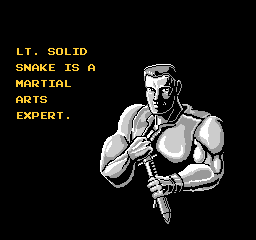
Snake as seen on Snake's Revenge
Metal Gear 2: Snake's Revenge arrived on April of that year and it takes 3 years after the events of Outer Heaven, here an unnamed nation got the plans of Metal Gear and was mass producing the weapon, Snake's mission was to destroy all traces of the secret project, unreleased in Japan the now noncannon sequel was a fair success on the US and Europe, while not a bad game by any means it was obvious that it wasn't the true successor to the 1988, the US would have to wait over 16 years to get their hands on the true succesor of the game, Japan would get it just two years later.
By the late 80s Kojima had already put Metal Gear behind him and was working on a cyberpunk adventure called Snatcher, that is until he met a developer who worked on Snake's Revenge and asked him to make a true successor to his game, that's all it took, the next day Kojima was working on the true sequel to Metal Gear, Metal Gear 2: Solid Snake.
Released on on July 1990 on the MSX2, Metal Gear 2, told the story of Snake, years after the Outer Heaven incident on how he had left FOXHOUND and retired, here he's called back into action by Roy Campbell, the new commander of Snake's former unit to stop the thread of nuclear war once again, with the now experienced Kojima, Metal Gear 2 improved on everything of the original, stealth was better than ever and the story was greatly expanded along with many new gameplay features, just like the first one MG2 was a big success in Japan, while the US and Europe would have to wait to play it when it was released as part of MGS3: Substance in 2006.
After Solid Snake, it seemed that Kojima had left Metal Gear behind once again, after the completition of said game, Kojima wrote and directed the graphic adventure Policenauts in 1994, originally released on the PC98 and was quickly ported to the 3DO, while working on the Panasonic CD console, Kojima kept hearing amazing things about Sony's new PlayStation, when he finally experienced the system's potentital by himself, he went on high alert.
In 1995 Kojima began working on a sequel to a series he hadn't touched in 5 years, the ambitious project took a longer development time than its predecesors and was essentially released as a new series rather than a new sequel, the new title wouldn't be Metal Gear 3, it would be called Metal Gear Solid, released in 1998.
Metal Gear Solid was a massive hit selling over 6 million worldwide since its released, with sales came critical acclaim, MGS has recieved several perfect scores by reviewers and its considered one of the best action games on the PlayStation.

So, with history out of the way, let's finally talk about Ghost Babel; after the huge success of Solid, Konami wanted more Metal Gear, just like the first time, originally it was requested by Konami Europe for there to be a Game Boy Color version of the PlayStation hit, however rather than doing a port, a team of Konami decided to make a brand new adventure on the system based on the original two games, the result was named Metal Gear: Ghost Babel in Japan which was retitled in the west as Metal Gear Solid despited having no relation to the first game to carry that title.
Released in 2000, Ghost Babel is a what if? scenario supposing an alternative future taking place after the first Metal Gear, directed by Shinta Nojiri who went on to the the AC!D series as well as contributing with Sons of Liberty and Snake Eater, Kojima was still credited for planning and story but his efforts were focused on Sons of Liberty's during develpment.
Seven years after Outer Heaven was destroyed Snake was once again called upon by Roy Campbell. Led by General Augustine Eguabon, the ficticional country of Gindra in Africa had gotten its hands on Metal Gear technology while enveloped in civil war, as the leader of the Gindra Liberation Front (GLF) the held up in what had been Outer Heaven 7 years prior, intreagued, Snake came out of retirement, donned a parachute and started sneaking.
His adventure led him through forests and fortresses with information being fed to him via codec from Campbell, Weasel a mercenary, Ryan McBride director of african affairs for the CIA and Mei Ling who would help saving the game. After some flirting with the codec, Snake found sargeant Christine Jeanner, the only surviving member of the delta force, sent in before Snake. Snake also saved the poorly James "Jimmy The Wizard" Harks, an imprision teenager who happened to be behind the construction of the new Metal Gear.
Along the way Snake battled more than the GLF, the gereral acquired the services of Black Chamber a US black ops group that went rougue and made their mark as the game bosses, among them were Slasher Hawk, an Australian aboriginee who threw boomerangs, the psychotic Marionette Owl attacked with two bunraku dolls, knives and darkness, forcing Snake to use night vision, Pyro Bison hunted Snake with his flamethrower, before succumbing and setting himself ablaze; their leader was Black Arts Viper a master of illusions and traps who used the GLF situation to take revenge on FOXHOUND.
Snake progressed and trampled Black Chamber member by member, culminating with the ultimate battle with Metal Gear. As the plot unraveled, friends became enemies and friends again while others died, in a final battle with Viper you discovered that McBride was actually the fifth member of Black Chamber, with the third model of Metal Gear destroyed, Snake and Christine Jenner left to a happy ending.
Ghost Babel is considered a portable masterpiece garnering accolades and perfect scores from plenty of publications, it'd managed to give a great Metal Gear experience with the limited technology of the Game Boy Color and incorporated many of the series' tropes both old and new; crawling, guided nikita missiles and the cardboard box where there as well as lenghty codec conversations.
Babel was broken into levels instead of having a consistet world, this was better suited for portable play and there were no compromises in design, it also included over 100 VR missions to test your kills with weapons and stealth, the game was quite surprisingly rated E by the ESRB despite dealing with adult themes, like alcohol, suicide and killing.
In all honestly Ghost Babel is my pick for the best third party game on the Game Boy Color, outdoing Konami's own efforts like Castlevania II: Belmont's Revemge and Dragon Quest I & II, its one of the best games on handhelds ever, however its criminal that it has not seen rereleased, while Konami already fixed some of this issues with the rereleases of the afromentioned title as well as things like Rocket Knight Adventures Zombies Ate my Neighbours, its a real shame that this game had never been revisited, its perfect for for the 3DS Virtual Console.
Due to superior portable outings such as Peace Walker and Portable Ops and more important 2D titles as the first two games, Ghost Babel has been forgotten withing the Metal Gear series and maybe righfully so, while fans of the series are constantly asking for a remake of the original games as well as Solid we should save a special place for a game like Ghost Babel as its a rare experience on the Game Boy.


