









Happy new year everyone. Its been a while since I added to my tech talk series. On this third part, I will discuss the core considerations that goes into making a console and why. At the end of this part, I hope you will at least have a better understanding on some of the nitty gritty of console design and when to realistically expect next gen hardware.
This post will be divided into 2 parts, Powe and Cost
Disclaimer: The info provided here are mostly my opinion backed on my limited experience in software Dev and general research. So as such this discussion is open to corrections and general input. Enjoy!!!
POWER
Yes. What is inside your console, will determine what it can do. This goes without saying. So let's talk about power. To start things off I will show you a picture of the PS4 APU. Being that its the most powerful of the three current home consoles. so here....
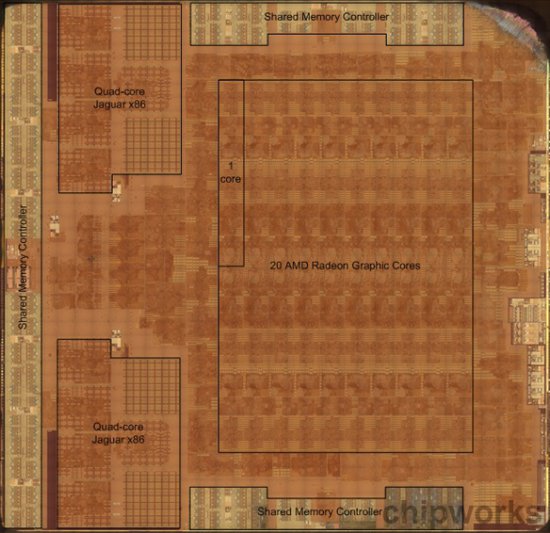
So now thats outta the way, let me start by pointing out that everything you see there fits into a ~350mm2 chip (aka die). To put things in perspective, An AMD R9 290 GPU has a footprint of 438mm2. ALL GPU!!!!
So why does this matter? Well, it just so happens to be that the size of a processor, or more importantly the fabrication process size used in making it is all that really matters when looking at not just how powerful a processor can be but also how much more powerful you can make it. Now both the PS4 and the R9 290 is both made on a 28nm fabrication process. Both processors have a near identical GPU core architecture. Only major difference is that the PS4 has just 20 of those and the 290 has 40 of them. Granted the PS4 also has 8 CPU cores on its die so it can be forgiven. There are tons of minute other differences like core clocks, memory bus width, ROP number...etc. But those aren't important in this discussion.
So here is the thing, Loosely speaking, if you can halve the fabrication process size; you can theoretically halve the size of the die or of the cores inside it. In layman terms, PS4 at 14nm fab process can put in twice the number of CPU and GPU cores (which it wouldn't) if the die size remains the same. And at 7nm, can put in 4 times the number of cores. This is assuming that nothing else changes, this is important cause typically smaller fab sizes doesn't just mean transistor doubling cause chip designers tend to add other components into a die that could benefit their architecture more than just a transistor count bump.
Note: 14nm will give a 4 times bump and 7nm a 16 times bump.
What to take from all this, is that to have a ps5 with 290 card GPU number of cores, the fabrication process has to be small enough to allow them put all those GPU cores and CPU cores on a die not much bigger than 350mm2. Bigger the die, hotter it runs and more power it uses, XB1 has a die size of around 380mm2. That's why its got a bigger fan and bigger chassis to allow for adequate cooling.
But a jump from 20 GPU cores to 40 is a joke if we are talking PS5 hardware. That's just a 2x bump in core performance. That's not even enough to run games at 4k 60fps. So we need at least a 4/5x bump. That basically, means we are looking at 14nm fabrication at worst. With 7nm, we get an 8 core CPU with at least 8-12 times the power/ or 4-8 times the transistor count and a GPU with 200-300 cores when compared to what we have in the PS4 today. All in a die size no bigger than 350mm2. Pretty impressive when you think about it. Which brings me to the most important bit.
We are a very very very long way away from a 7nm fabrication process. As it stands, Intel; the leading authority in chip fabrication tech, has just started mass producing 14nm chips. TSCM (the guys that make processors for amd, including the PS4/XB1) are about to start 20nm fabrication and are at best 18 months away from 14nm. Intel expects to start fabricating 7/10nm chips by 2017/2018. Which puts the likes of the people cheap enough to make chips that goes into consoles and GPUs behind by another 18 months. The next gen doesn't start till we hit 7nm fabrication.
There is a work around though, which unfortunately could lead to slightly more expensive consoles. Just put the CPU and GPU on seperate chips.
COST
The two most expensive components in any console are memory and the processor(s). Memory isn't too complicated, you put in what you can afford. So let's again focus on the processor. Recall that long talk we had about chip fabrication? Well it gets worse. Console manufacturers don't get first dibs on a new fabrication process. This means that even if we were to hit 7nm fabrication in 2018, Sony, Microsoft or Nintendo can't order up chips unless they are ready to pay a premium. Which is a no no cause that will mean the consoles in turn get more expensive. So GPU manufactures and apple smartphines get first dibs and everyone else waits until the process matures and yields improve before they can jump in.
This is unfortunately more straight forward than the first point cause at least that one has a work around.


