









Richard_Feynman said:
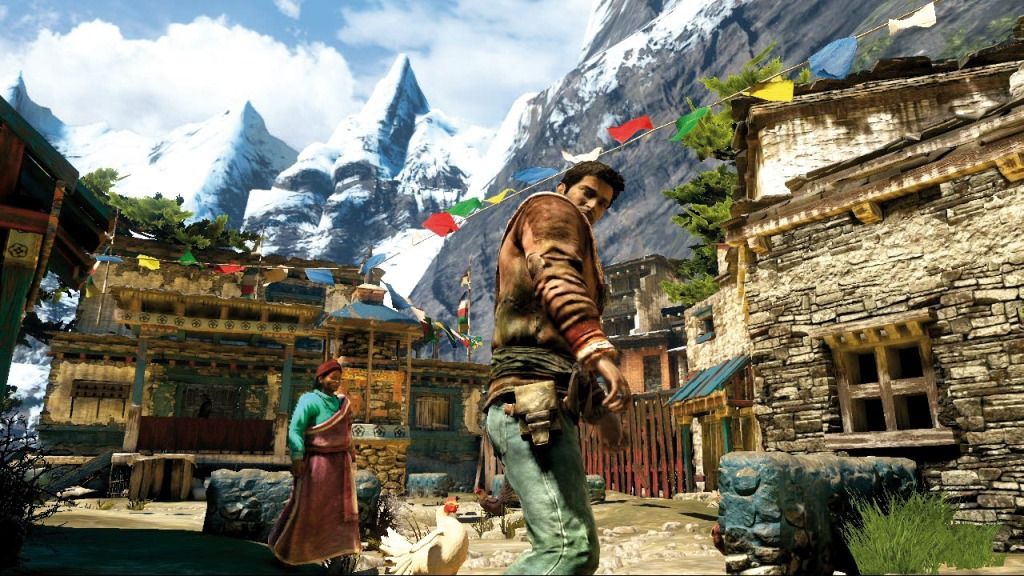
I get your argument, but for technical reasons I disagree. Why? It is very simple. Flying through the open world of GTA V in a jet enables me to reach each one of the (arbitrarily chosen) rendered cells in the city in a small enough time step to affect the quality of the rendered objects in each of these cells. Hence, Uncharted2's village in the mountain (a very small, linear playing area):
Looks better than anything in any open world game on PS3. "There is no correlation between the linearity of a game and its technical demands." I don't know why you are complicating things with strange statements and terms. Boiling down my point (and everyone else's who's arguing with you) to its absolute essense: LINEAR GAMES HAVE BETTER GRAPHICS THAN OPEN WORLD GAMES This is what everyone is arguing with you about. Nothing else. And everyon absolutely says that this is due to a difference in the technical demads of a game. Taking this statement of yours: "There is no correlation between the linearity of a game and its technical demands." We can look at it a different way. This is important, so when you have the time please answer this: If there is no correlation between the linearity of a game and its techincal demands, then for what reason were there not a plethora of open world games flooding the market after GTA III's astounding success? If there were no difference in technical demands, then surely everyone could have said, "oh yes, this is better", and simply made many more of the games open world? I offer the answer that linear games are less technically demanding in a myriad of areas: visually, ito design, system memory blah blah blah. If you could be more succinct with your statements (claims) then I'd appreciate it. Also, sources validating your claims would be appreciated. So I'm disagreeing with you, but not in bad spirits. |
In that sense, they are in a way. Since an open world game has to constainly stream assets and will have less of them kept at all time in the RAM, having to replace them all the time as the player moves to different locations, as opposed to linear games having more of the level pre-loaded at once, this aspect makes it more difficult for the hardware to handle graphical fidelity as rich as in linear games.
Linear games, by their nature, also allow more demanding features to be used, like ambiant occlusion, higher res models and textures, more complex geometry and tesselation, etc... Thus making the argument that one kind of game being more, or less demanding for the hardware relatively moot.
That being said, if an open world game had all the bells and whistles as a linear game, that game would be technically superior. But the argument in these forums are brought when talking about games that are made for closed hardware architectures. As such, a game like TLoU is not really [if at all] less demanding for the PS3 than a game like GTAV. GTAV on console is optimized to make use of the hardware the same as TLoU. As such, it can't demand [much] more than a game like TLoU (it probably does, seeing as R* games struggle much more to keep a solid framerate than ND games. But one is also first party while the other make multiplatform games, which most likely even things out.).
But yes, in essence, graphical parity for graphical parity, an open world game (on an open architecture like PC, where you can crank the performance up by improving the architecture components) is more demanding on the hardware than a linear game.


