













Zappykins said:
Thanks for the research! Is this just consumers? I know there was also a large amount of industry VHS purchaes for rentals. And they wore out so there were repurchases. Remember the ol' Blockbuster. They went through many tapes. As far as the questions about TV show being in 'SD' or stand definintion. Remember most all TV Shows since Lucy are shot in Film. And film is higher quality than DVD, so by re sampling the original they could all look better. Even 8mm can push 1080P and most TV is higher quality 35mm film. Look at the old Twilight Zones or orginal Star Treks at 1080p, they look really good. They could probably be slightly improved at 4K as well, but then the minor flaws in the background start to pop out more. |

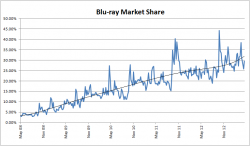
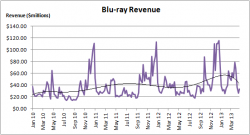
I guess that it's actual sales to consumers. I don't think it was until dvd that you could buy previously viewed movies from rental places. Before that I think it was more like a license agreement. At least that's the gist I got from my old local mom and pop rental store. They weren't happy with the transition to DVD as they now had to buy the discs up front and could only afford very few copies of each new movie. They didn't survive the transition to DVD.
It depends on the tv show, but yeah most have been shot on film until recently. 4K is still useful for 16 and 35mm, not just because 35mm can resolve between 3K and 4K in resolution, but also because blu-ray is still stuck with chroma subsampling and lossy compression. The color information on blu-ray is essentially only 1K (960x540), a quarter of the grey scale resolution. 35mm is also used anamorphically, using the full 4:3 frame to store information while Blu-ray uses black bars. From the RED user forum I see estimates for 35mm from an achievable 3.2K (3200x2400) up to a 4153 × 3112 theoretical maximum.
A 4K blu-ray played on a 1080p set will have better color definition (especially if deep color Rec. 2020 will be used) and less compression artifacts. Color and higher contrast ratio will have the biggest effect.


