


Mazty said:
Ultimately, the issue with 4k is not the price, it's the size, and that won'tchange over time.Many people won't, and can't, fit a 60+" TV in their living room.
Understand? You don't seem to understand living room size. In Japan and Europe, rooms are much smaller than in the USA. Your chart shows that it has plateaued at 46", which backs my point up.
|
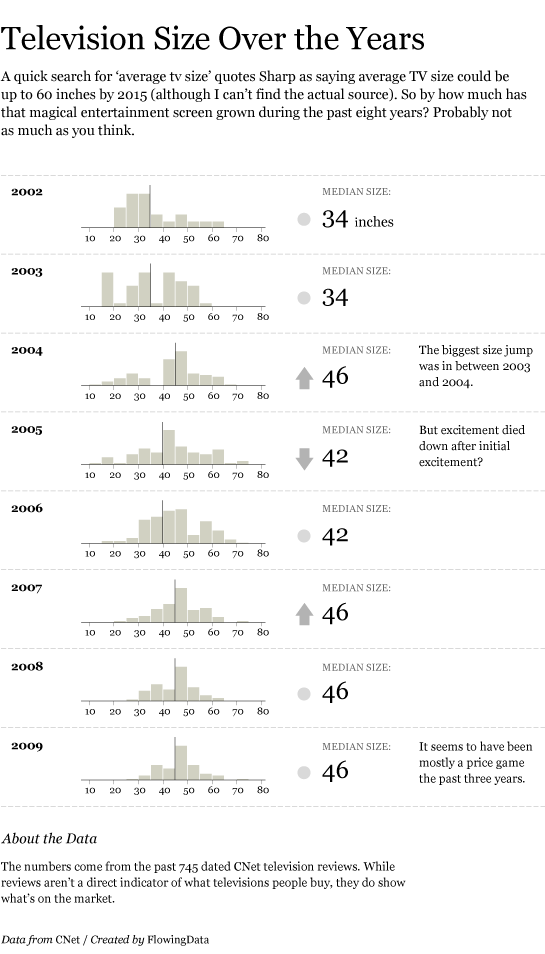
You fail to comprehend what I'm saying. There is a relation between the price and size of a tv screen. You are ill informed if you think people can't fit a 60" tv in their living room. Do you have a source to backup your claim? Any study that proves you right? How do you know rooms in Europe are much smaller? Thats just your assumption with no truth. (I live in Europe and I have enough room to fit in a +80" tv.) My chart is also from 2009. You're accepting your assumption as true without proof which again makes no sense.
Fact is that average tv sizes increase. http://www.displaysearchblog.com/2012/10/average-size-of-lcd-tv-panels-increases-by-2-inches-in-12-months/
There are several factors leading to increases in the average LCD TV panel size:
- The emergence of new sizes has led many customers to choose larger sizes, such as moving from 26W to 29W, from 37W to 39W, from 46/47 to 50 inch, and from 55 to 60 inch.
- As consumers replace older LCD TVs, they tend to choose a larger size. Many consumers in North America originally had a 32 inch LCD TV in their bedroom and a 40-50 inch set in their living room, and are upgrading to a 39 or 40 inch in their bedroom and a 50 inch or larger set for the living room.
- LCD TV brands are promoting larger sizes in order to preserve profit margins.

With the year-end, many promotions will be launched, such as the rumored 60 inch LCD TV for $999 on Black Friday. With such attractive prices on large size LCD TVs, we can expect other consumers to migrate to larger sizes, further driving increases in average screen size.
Once 60" TVs become affordable at 999 you bet your bottom $ they'll be what people buy when they're in the market for a new tv with the budget.