









| Soleron said: @BlueFalcon I like AMD and wish they were competitive. If you look 'before' you joined VGChartz you'd see threads where I recommended their CPUs. But I am a realist. And I'm not saying anything about whether you should buy it. |
The thing is AMD hasn't been competitive on the high end since at least 2006. If you were a PC gamer and cared about gaming performance and performance/watt in stock or overclocked states, there was no AMD CPU worth buying since Core 2 Duo launched. A realist would have realized once AMD went fabless, there was no way for them to ever catch up to Intel unless Intel made a mistake. What would happen if AMD's GPU division had to use 40nm HD7000 series against 28nm Kepler? They'd get smoked. The actual FX8350 design is good for MT tasks, but what fails it the most is the 32nm node. If AMD manages to improve IPC by 20-30% with Steamroller and shifts to lower nodes, they can make up a lot of lost performance. Essentially the upside for AMD is there but only if they can execute it.
Regarding APUs, I am not sure why you think they are irrelevant. The main reasons they are irrelevant now are the same reasons Vishera/Bulldozer are struggling - higher power consumption for OEMs/laptops which resulted in few AMD design wins and terrible marketing on AMD's part to the avg consumer. Most of the sales of PCs/Laptops are going to be APUs and SOCs in the next decade. It won't be $225+ i5s, FX8000 and i7s.

By far the vast majority of systems (Value and Mainstream) are buil5 with i3/A6-A8 products, with Intel obviously dominating. Less than 10% of notebooks and less than 6% of desktops sell higher end 8-core FX8300 or 4-core i5/i7 systems:
The overall market of performance PCs/laptops is tiny but PC enthusiasts tend to think it's much larger than it is.
If AMD improves the CPU performance of their APUs further and continues ramping up their GPU performance, with lower nodes they should be able to get the power consumption down to acceptable levels. Trinity APU stop-gap Richland A10-6800K and especially Kaveri expected to launch by Q4 2013 will once again make AMD's APUs superior for budget gaming builds. The problem is the average consumer doesn't understand this.

The average person is the type who'll buy a Core i3 laptop/desktop and play basic games like Minecraft or something similar, exact cases where Intel CPUs are garbage in this price point.
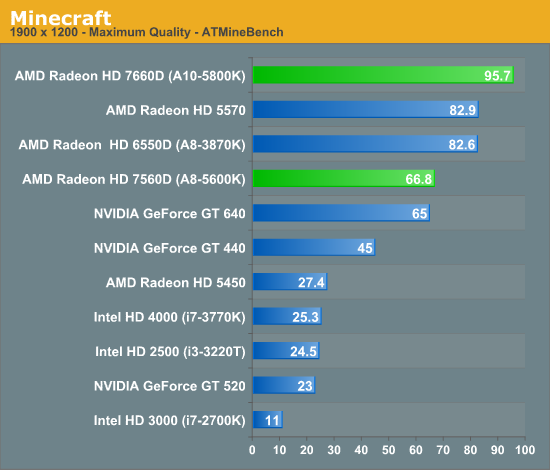
The average consumer seems to care more about 10-20% CPU speed difference than 2-3x GPU speed difference for games they are actually most likely to play on their laptops. I mean Starcraft 2 is an absolute joke on i3/i5s, which is what Intel would sell at a similar price.
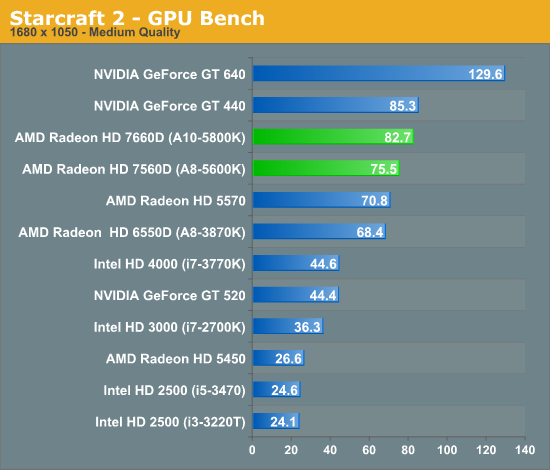
The irony is only top 10% of consumers would be better off with an Intel-based system. The average consumer would be way better off with an AMD-based system and an SSD for the same price it costs just to get an i5 with a mechanical drive. Think about it what type of tasks families might do on their PC? Recording videos of their kids at birthday parties and then encoding it, etc. Opening word documents for basic things, browsing the web with multiple tabs in the browser, viewing high resolution images from their digital camera/DSLR. In these cases a CPU with more cores and a snappy SSD would provide a superior performance to these users than an i3/i5 with a mechanical drive.
The only 2 reasons I personally keep buying Intel CPUs is because I overclock to the max where power consumption grows exponentially and I am a gamer where IPC is more important than # of cores. If I wasn't a gamer, I'd never spend extra $ on the Intel CPU since an APU+SSD, FX6300+SDD, or FX8300+SSD would be better for every day tasks 90% of the time compared to similarly priced i3/i5/i7+mechanical drive that would roughly cost the same due to Intel's pricing premium. The average consumer doesn't understand these things. They still think the CPU is the most important component in a system when it's the SSD and the GPU that will have the most impact for these 90% of users.


