









Aielyn said:
First of all, I feel I have to point out that he said income tax, not total spending. The US took in $2.3 trillion in revenue in 2011, against $3.6 trillion in expenses. So if you factor that in, it turns out that that 20% spent on the department of defense, alone, jumps up to 31.3%. Add in VA, and you get 39.1%. It's not hard to believe that another 6-7% of total expenses is spent on the various other military-related expenses. Anyway, that wasn't the reason I wanted to post in response. I just thought I'd do a bit of a comparison with spending here in Australia (Jul 2010 - Jun 2011).
Just to quickly do the conversions, assuming that numbers listed are *all* of the numbers, starting at the top and working clockwise... Community services and culture: 2.45% Definitely interesting. We spend more on social security and welfare, we spend FAR less on defence, and we actually care enough to notice how much we spend on education. The really interesting one, though, is Health. We spend less on health as a proportion of spending than you, despite having a robust public health system. But just to make sure our comparison is fair, I decided to do some conversions. Total government expenses in 2011 in the US was $3.601 trillion, so health and human services got 24% of that, or $864 billion. Per capita, that's US$2754. In Australia, we spent $56.88 billion on health. Per capita, that's AU$2480. Anyway, just an interesting comparison. I'm sure there's some factors I haven't accounted for, like the "human services" part. Anyway, notice how much (proportionally) we spend on social security, compared with you? Interesting, given that Australia now has a higher GDP, didn't go into recession due to the GFC, and has lower unemployment than America does. Oh, and we tax the rich more (top rate is 45%, and it kicks in earlier than America's top rate) and the poor pay 0% tax. We also have less public debt (30% of GDP vs 100% of GDP). Americans pay $7336 per capita in tax (includes all taxes, including corporate tax, for instance), vs Australians paying $15,258 per capita in tax. We have a lower gini coefficient (meaning less income inequality), a larger per capita labour force, a lower percentage living in poverty, a longer life expectancy - 81.2 vs America's 78.2 - which makes us 6th highest life expectancy in the world, and our country is rated as more democratic (we're 6th with 9.22, vs US in 19th with 8.11, on the democracy index). As I think I said before in this thread (or maybe it was in the "rich getting richer" thread), maybe America should be looking at Australia as a model. We seem to have it worked out relatively well. |


Wait, how does that work... your counting the income that came in and just applying it all directlty as "military" while cutting away all the excess in other spending as not military. How the heck does that make sense.
Either way... I do like the Australian model quite a bit. Australia mostly seems to only spend money it has.
The thing is... you don't seem to quite get WHY Australia succeeded where the US failed.
You spend more on social security and tax the rich higher... well so does every Europeon state that failed during the global crissis and are at worse place then the US Is now!
Everything you highlighted as to why you think Australia did better is also true in the failing europeon countries.
By the way... while your gini coefficent is lower... it's worth noting... it's grown more percentage wise due to Australias growth. (Using the incomplete less then optimal household gini coefficent, but It's all the data i can find on Australia.)
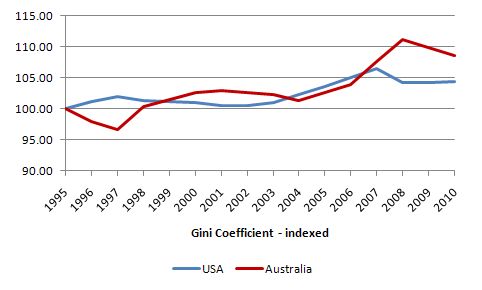
Yet you guys never had a huge crash and this was despite your higher rich people taxes and lack of mega rich. Thought steep rises were supposed to cause that.
Why did Australia avoid the 2008 recession? Well, for one. Your housing never burst...

partical due to the Australian central bank RAISING interest rates to cut off cheap capital.
Your debt level was low,
You have been increasingly more tied to Asia in trade with China as your second biggest export partner.
And plenty of more reasons. The article where I got the chart from is pretty informative.
http://www.cbsnews.com/8301-505125_162-51352693/how-australia-ducked-the-crisis/
As for Health... not really. There isn't much your overlooking. Human Services is just mostly meant to reflect the fact that they care about people as well as keeping the people healthy.
The US government just sucks at negotiating prices, because they tend to instead use it to win over lobbying groups... and have HUGE government beuracracy.
For example. Our main Medical assosiation was AGAINST the Obama healthcare reforms... until Obama agreed to stop cutbacks in what medicare and medicaid pay docotors for procedures.
Expectations for care are much different... the US tends to be "overtreated" and written perscriptions for everything.
Not to mention cultural factors which, while Australia isn't great at, the US is worse... like obesity.
Oh and the real kicker... cost to be a doctor. In the US, that's 4 years of undergraduate, 4 years of medical school, followed by AT LEAST 3 years of interning.
So you start being a doctor at like.... 30. With like 100,000-200,000 worth of student loans owed to the government who you can't deafult to.
Also, we don't count education in our spending, because while we do have a department of education... most of are education spending and funding is done directly by the state governments.
Something worth noting in all that.. our state governments do way more "non defense" spending then everywhere else.


