










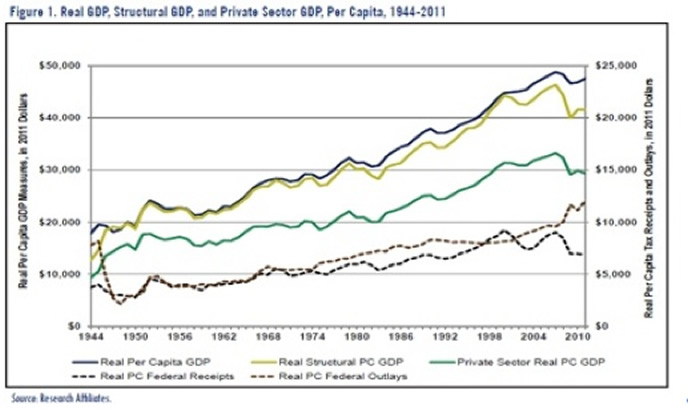
| Kasz216 said: You were right in that I misread the chart. However, you're wrong when you say government spending drives growth. Government spending drives GDP, because it's part of the equation.
As you can see... Government spending.... doesn't really match up with GDP growth. Taxes receipts do... but they stay pretty consistant with GDP growth no matter what the tax rate actually is! I forget the name of it. Laffer Curve maybe?
As for those "Big increases before the crash." Depression's are like manic depressives. There is a Boom before a Bust. |
It is the job to do unprofitable things that need to be done, because no one else can afford to do them. There is a debate over what these things are though.
The Laffer Curve has to do with there being an optimal tax rate which assures the maximum amount of tax dollars. Problem is that the economy is too complicated to find it. And, if there was an actual number, apparently politicians have little interest in finding it, because out of the GOP side, all they keep talking about is cutting taxes. Democrats will keep raising taxes. Neither one focuses on optimal, because no one can tell what it is.
This issue has a lot of gotchas in it, and really hard to nail down anything. It is ripe for ideologs to keep pushing an agenda mindlessly and get people to feel they are victims, even if they are doing really well personally.
In regards to government spending, it depends on WHAT it spends it on. If it spends it on building meaningful infrastructure, research, training and education, and so on, those can lead to an increase in GDP. If it leds to stimulus, generating temporary and meaningless activity, then it doesn't improve GDP. Government spending, like spending by any agent in an economy can have good or bad effects. Spending doesn't magically become good or evil just because the government does it. Like, whether individuals or the government gives assistance to the poor, the poor is getting assistance. In some cases, the government may do a better job than an individual, because an individual may end up getting duped by a scammer, while the government has people who are trained and/or have experience dealing with scammers. Also, collecting and distributing sufficient money via a government program, could lead to more stable funding, and a better way to tackle an issue an area. Again, it is what is done that matters far more in an economy, than who does it. Now, if anyone wants to debate whether or not the use of coersion by government to do anything is ethical or not, that is another issue, but separate from the impact on the economy.


