









On another note, the demographics of Occupy Wall Street:

It is interesting that, in a country that is 77.1% white and 12.9% black a protest in a city that is 44.6% white and 25.1% black, a protest can be made up of 81.2% white people and 1.6% black people without being called racist; especially after a much more representative Tea-Party movement was called racist because of its lack of diversity ...
(That was mostly just a "jab" at the media)
Realistically, what I'm more interested in is the education segment ... With (roughly) 90% of the population of Occupy Wallstreet being college educated, ollege educated people are significantly over-represented; and with the high level of unemployment (relative to college graduates in general) it could be argued that these people should really be angry at themselves and their colleges for getting useless degrees ...
http://www.thenation.com/article/164348/audacity-occupy-wall-street?page=full
A few years ago, Joe Therrien, a graduate of the NYC Teaching Fellows program, was working as a full-time drama teacher at a public elementary school in New York City. Frustrated by huge class sizes, sparse resources and a disorganized bureaucracy, he set off to the University of Connecticut to get an MFA in his passion—puppetry. Three years and $35,000 in student loans later, he emerged with degree in hand, and because puppeteers aren’t exactly in high demand, he went looking for work at his old school. The intervening years had been brutal to the city’s school budgets—down about 14 percent on average since 2007. A virtual hiring freeze has been in place since 2009 in most subject areas, arts included, and spending on art supplies in elementary schools crashed by 73 percent between 2006 and 2009. So even though Joe’s old principal was excited to have him back, she just couldn’t afford to hire a new full-time teacher. Instead, he’s working at his old school as a full-time “substitute”; he writes his own curriculum, holds regular classes and does everything a normal teacher does. “But sub pay is about 50 percent of a full-time salaried position,” he says, “so I’m working for half as much as I did four years ago, before grad school, and I don’t have health insurance…. It’s the best-paying job I could find.”
I don't want to be rude, but it seems that kids today are suffering because they're making very bad educational choices and are unwilling to own up to their part in this, consider the following graph:
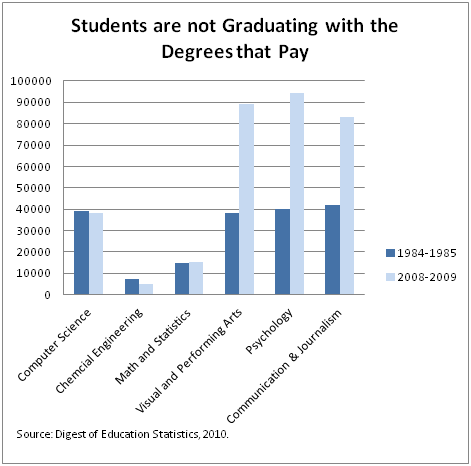
In spite of the massive growth in IT, and the amazing need for people with engineering, math, science and technology degrees, the number of graduates in in-demand fields has remaind stagnant for 30 years while there has been an explosion in "worthless" degrees.


