









Akvod said:
But the government should also spend and lower interest rates, when there is an aggregate demand shock. That is, the decrease in consumer confidence, the "animal spirit". It is rational, individually, to begin saving when times seem bad. But that's the paradox of thrift, it only makes things worse. In order to combat this self harming, the government picks up the slack and demands goods in place of the consumers, who are making the same ammount of money, but simply not spending it. Why? Because if consumers don't buy, then producers don't invest, even further depressing the economy. With lack of demand, there is a reduction in inflation rates, and eventually there will be deflation. Which will create a liquidity trap. This waiting out crap is waiting to have more oil on the edge of the hole. If the government simply picks up the slack, then the consumers will regain confidence in the economy again, and begin spending more. Then the government picks up less and less slack, GRADUALLY, and then once things are better again, it lets go. Then it begins to tax more, cut spending more, increasing rates, and worry about paying off the debt it made.
Baisically do you believe in the following things:
http://en.wikipedia.org/wiki/Consumer_confidence http://en.wikipedia.org/wiki/Sticky_wages
Then I think you'll naturally come out to become a Keynesian on your own. |
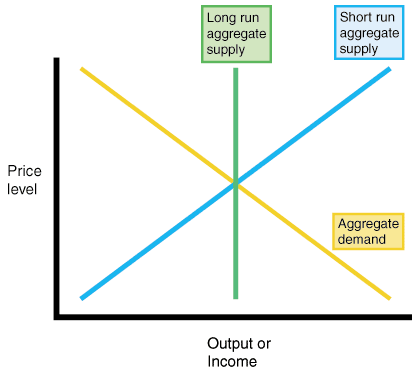

It is certainly true that saving and lost confidence go hand in hand, and it is certainly true they conspire to create economic downturns and even recessions. But Keynesianism isn't wrong because it conceptually has it wrong within the frame of a single cycle of policy, it is wrong because it fails to consider the consequences of numerous cycles.
More directly, the problem with Keynesianism has always been that it severely undervalues economic destruction. It naively advocates that the government can smooth out economic dips continually with no ill effects on the economy in the long term. The result is that in each such cycle the fat that would have been cut away by a natural dip in the economy is instead preserved. In the next cycle even more fat is left untouched by the preventative measures of government. Until eventually the weight of that fat leaves the government to choose between spending itself into oblivion to prevent the impending cycle (which is as big as ever) or allowing the occurrence of what it has naively tried to avoid for a decade or more. Only now the choice is not so easy, because either way you go at this point you will have the potential to seriously damage the economy in the long term and in some situations (like the one we find ourselves in) the potential to even destroy parts of the economy entirely if not the whole of it becomes very real. Somewhat ironically the gravity of the situation is then used to justify continued adherence to the need to avoid destruction.
In this respect Keynesianism is similar to the old philosophy of fighting fire where setting a small fire to prevent a large one was viewed as a silly idea. But we know that like the dry underbrush, the weak businesses, firms, banks, etc... cannot be protected just because we have a fear of economic downturns that might cause some strife for people in our economy. To continue the analogy, a small control fire will of course cause collateral damage to plant and wildlife as well as getting rid of that dry underbrush, but the damage is miniscule compared to the eventual disastrous fire that will come of it is not done.
This approach is appealing to many politicians because so long as the major downturn that cannot be avoided doesn't happen on their watch they are happy to pass that buck on to the next sucker. People generally don't understand the longterm effects of economic decisions and politicians often get blamed or get credit for the good and bad decisions of their predecessors or ocassionally of their predecessor's predecessor. And as most of us know all too well, politicians love to pass the back while being able to appear that they did a fantastic job.
To be fair I think Keynesian philosophy is a valid economic *theory*, I just think it's most common application in avoiding economic destruction is misguided. And to be fair not all branches of the philosophy ignore this, but unfortunately all branches that find their way into political practice do.
 |
| To Each Man, Responsibility |


