









Sigh... let's go through basic macroeconomics guys.
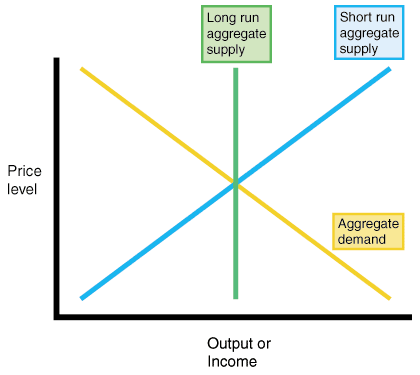
So, here we have the AD/AS model. We also acknowledge there is a LRAS, which incorporates some classical ideas.
Aggregate demand slopes downward because:
Ceteris parbus. Keeping all else the same, if you have the same wages (sticky wages), but there is inflation, you have less real purchasing power (If bottled water went from a dollar to 2, you have half the ability to purchase it), and therefore, demand less goods, at that price level.
Another one is that if inflation goes up, nominal interest rates go up, reducing investment.
Let's recap here that GDP=
GDP=Investment+Consumer consumption+Government spending+(Exports-Imports)
So, a shift in one of these things, is a shift of AD.
Consumer consumption is shifted by things like consumer confidence, and other things. Let's say that the stock market crashes. Income didn't change, you still have just as much cash to spend tomorrow, but you cut back on spending, because you feel less wealthy (or recently another asset, REAL ESTATE, lost value).
Aggregate Supply, is downward sloping, because if the cost to produce something (say 100 dollars to produce a Xbox), but aggregate price goes up (Xboxs are now 400 dollars), you make more profit, and therefore, you're willing to produce more.
So, if wages stay the same, but there's greater demand for goods, then producers will make more. If there is say, an input that becomes expensinve (OIL), then producers will be less willing to produce things at every price level.
Long run supply curve.
In short, EXPECTATION of inflation is what ties this, the long run philip's curve, NAIRU, etc together.
If, say, the government engages in inflationary policies, even when we are at the natural rate of unemployment (say, giving lots of government jobs and building bridges to nowhere), then what will result is more output, but also HIGH INFLATION.
As a result, as a worker, you will knock on Boss Joe's door and say "Hey um, everything's two times as expensive. So can I have two times my wage?", strikes, labor economics happens, and boom, eventually wages increase, they're not sticky in the long run.
Well wages, are just another input, like oil. So then if the cost to make a product is more expensive, then the supplier is willing to supply less at every price level, and the AS shifts left.
Well if AD and AS shifted, then all that happened is price level shifting upwards, but output staying the same.
So moral? You can't change the long run supply curve (unless you shift out the PPF), so promises to reduce unemployment for election, and government is bad. Discretionary is bad (Friedman).

Orange shifted right, light blue shifted left.
Orange shifted right because of increased G
Orange shifted left because wages adjusted in the long run.
But what if there is an demand shock? Say, real estate values fall (wealth effect), and consumer confidence walls (animal spirits, according to Keynes)

Well, we have DISinflation, and lowered output.
Well perfect, all we need to do is LOWER the INTEREST RATE.
Remember. GDP=G+C+Nx+I
So increase I.
But what if you did that, but interest rates are already or at (like Japan, which is a really weird case) 0?
You can't lower the interest rate beyond 0.

What do we do?
Increase G


