









Akvod said:
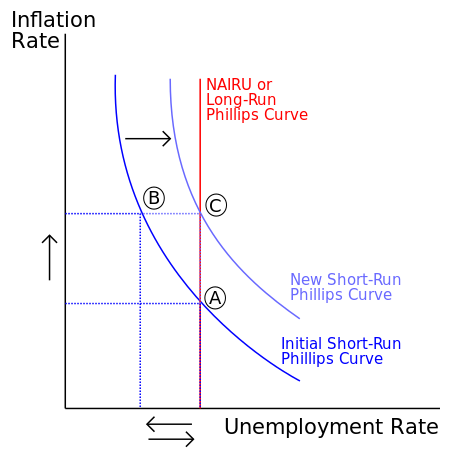
...? All three are Macroeconomic views... typo on the last sentence? Neo-Classicals try to rationalize the Classical view by saying that people are perfectly rational, and are aware of everything the government does. So any discretionary policy will backfire, because they will simply raise their expectation of inflation. ... although I asked the professor in lecture why those people didn't simply adjust their expectations to the equilibrium beforehand... but he said that a more complex explanation will be something irrational like stock markets... but it sounds pretty crappy to me. For reference.
So Neo-Classicalists are saying that if there was point A', which is A moved rightward (low inflation, and high unemployment), raising the inflation rate (moving the point back to A), will only result in a shift to C' (C, moved rightwards so that it has the same unemployment level). The question is... why didn't those oh so rational people move their expectation so that the curve will shift down, and result in lower inflation and natural unemployment rates? |
No. All 3 aren't purley Macroeconomic views. They are economic theories in general. For both Macro and Micro economics. After WW2 the Macroeconomic views were absorbed with Neoclassical views.
Largely the Macreoeconomist views of Keynsians are never widely accepted because they have no microeconomic basis.
Neo-Classical Syntehsis tried to happen to provide Keynsian economics with that base.
Additionally New Keynsian economics have tried to provide a microeconomic base actually using congruent theories.
You really need to define what kind of Keynesian you are... for what it's worth... New Keynesian's would actually disagree with you. So I hope it's not them.


