









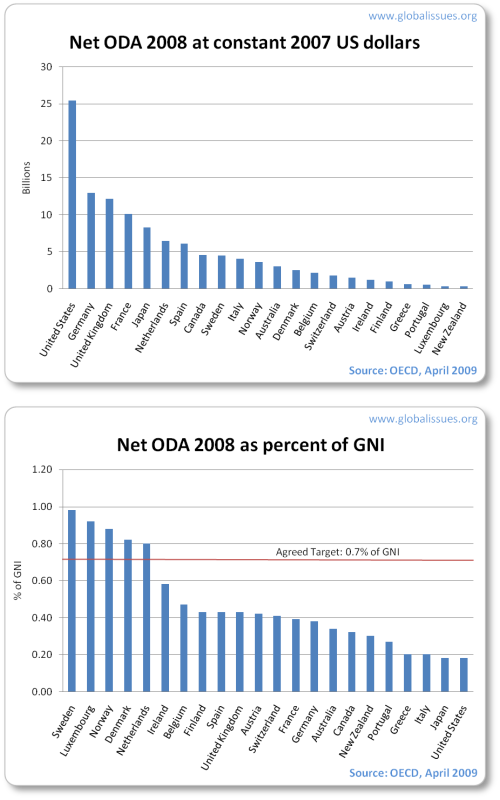
| Rath said: You're taking the history of the world wars from a very Hollywood point of view where the Americans swept in and saved the incompetent Europeans. In reality America was very late to both world wars and was there for her own interests, in WWI it was merchant shipping and in WWII it was pearl harbour. While America was undoubtably a large player in the war, I don't think Europe owes you a great deal of gratitude for your conduct. Also your aid to the world isn't fantastic actually, it's big numerically but if you look at percentages...
You're actually last in the OECD.
I can say that most Kiwis (and I think Aussies too actually) look quite fondly upon Britain despite the fact that we are now very thoroughly independent from them. Goodwill does last.
As for the Cold War, the only thing that the nuclear deterrent stopped was nuclear war. The cold war wasn't necessarily going to go to open warfare anyway, both countries had more to lose than to gain. I also disagree that chemical and biological weapons are in the same category as nuclear weapons, for two reasons. One being that none of the danger you are talking about have actually been created and the other being that no country has major stockpiles of them (so there is no mutually assured destruction). |
Your reply is to make excuses (justified or not) about why good will is not given in the examples I cite. And this doesn't just confirm what I was saying....how?
On the subject of foriegn aid its not good enough that we give double what anyone else gives? Are we really going to scoff at it because of some statistical comparison to GNI? By the way, I did love how you found a graph that holds the US's wealth against it. That's pure irony for the point I'm making, I honestly got a good chuckle at that.
On the subject of WW I and II, I didn't say Europe owes us a debt of gratitude (although some countries certainly do) but you'd think our actions would garner at least some good will no? And as you say good will goes a "very very long way" so we should still see it right? But still you try to find a reason that no good will should be given, and yet you don't see how this makes my point for me?
I have to confess a bit, I picked both of these examples because I knew they were typical points of contention for Europeans where the US has done something worthy of good will even if the amount is debateable. Your reaction on both points makes my point for me about how good will very rarely goes far at all.
The problem is that good will is by definition a currency held by one person at the whim of another. Quite literally asking someone to accept good will as payment is telling them you will give them whatever you see fit to give. That is how incredibly folly this policy truly is, it trades quite literally something of real unquestionable value for something that has value only so long as the people you bargain with allow it to.
 |
| To Each Man, Responsibility |


