









Yes, I have looked at some of the scientific data. There is some debate over whether the methodologies in the report were accurate.
But if you look at the data, the amount of rise in temperature worldwide over the last century is a little extreme to say it is just a normal deviation. Its pretty much an entire degree Farenheit in just 60 years, and an entire degree Celsius in 150 years:
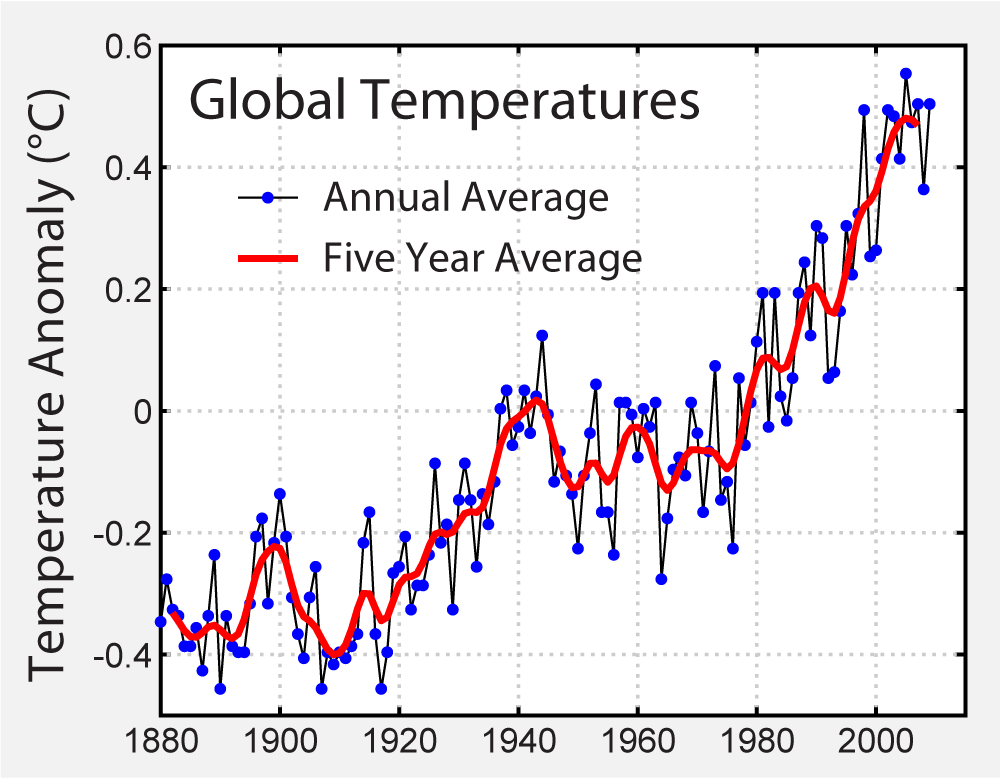
Here is a decent article about it. I have read the full report it mentions:
Scientists: Humans 'very likely' cause global warming
http://edition.cnn.com/2007/TECH/science/02/02/climate.change.report/index.html
Story Highlights
• Scientists release a 21-page report strongly linking humans to climate change
• Report scientist: Evidence of warming on the planet is unequivocal
• Scientists predict global temperature increases of 3.2-7.1 degrees F by 2100
• Sea levels could rise between 7 and 23 inches by the end of the century
(CNN) -- Global warming is here and humans are "very likely" the blame, an international group of scientists meeting in Paris, France, announced Friday.
"The evidence for warming having happened on the planet is unequivocal," said U.S. government scientist Susan Solomon, who also is a member of the Intergovernmental Panel on Climate Change.
"We can see that in rising air temperatures, we can see it in changes in snow cover in the Northern Hemisphere. We can see it in global sea rise. It's unequivocal," she said. (Watch scientist Susan Solomon deliver the grim news on global warming Video)
In a 21-page report for policymakers, the group of climate experts unanimously linked -- with "90 percent" certainty -- the increase of average global temperatures since the mid-20th century to the increase of manmade greenhouse gases in the atmosphere.
Fossil fuels like methane and carbon dioxide trap heat near the surface, a process known as the greenhouse effect. The greenhouse effect is a natural phenomenon, but human activities, like the burning of fossil fuels, can pour enormous volumes of these gases into the atmosphere, raising the planet's temperature and destabilizing the climate. (Watch what happens to our planet when manmade emissions get trapped in the atmosphere Video)
The report found it was "likely" -- "more likely than not" in some cases -- that manmade greenhouse gases have contributed to hotter days and nights, and more of them, more killer heat waves than before, heavier rainfall more often, major droughts in more regions, stronger and more frequent cyclones and "increased incidence" of extremely high sea levels.
The report noted that 11 of the last 12 years have ranked among the 12 warmest years on record with the oceans absorbing more than 80 percent of the heat added to the climate system. Add in the melt-off of glaciers and sea ice and sea levels are rising.
The IPCC predicted global temperature increases of 1.8 to 4 degrees Celsius (3.2 to 7.1 degrees Fahrenheit) by 2100 and sea levels to rise between 7 and 23 inches (18 and 58 centimeters) by the end of the century. (Watch how rising sea levels could affect San Francisco Video)
"An additional 3.9-7.8 inches (10-20 centimeters) are possible if recent, surprising melting of polar ice sheets continues," the report stated.
The group will meet again in April to discuss the socioeconomic impact of climate change.
Defining 'likely'
The IPCC was established in 1988 to study climate change information. The group doesn't do independent research but instead reviews scientific literature from around the world.
The United Nations-sanctioned group was formed by the World Meteorological Organization and U.N. Environment Program.
The group's goal is to produce "a balanced reporting of existing viewpoints" on the causes of global warming, according to its Web site.
The panel's reports are influential references for policymakers, scientists and other climate change experts.
Friday's release is the beginning of the panel's first major report since 2001. The rest of the report is due out later this year.
The 2001 report found that the 1990s were "very likely" the warmest decade on record. It also said that most of the observed warming over the last 50 years was "likely due to increases in greenhouse gas concentrations due to human activities."
The authors defined "likely" as between 66 percent to 90 percent probable, and "very likely" as a 90 to 99 percent.
Renewed concern in U.S.
Friday's report comes amid renewed debate in the United States. (Full story)
In his State of the Union address, President Bush called for the use of more environmentally friendly technologies to "confront the serious challenge of global climate change."
It was the first time he has discussed the issue in a State of the Union address.
The White House has said Bush's proposals would stop the growth of carbon dioxide emissions from cars, light trucks and sport utility vehicles within 10 years.
Leaders in the Democratic-controlled House of Representatives and Senate held hearings on climate change this week.
We had two bags of grass, seventy-five pellets of mescaline, five sheets of high-powered blotter acid, a salt shaker half full of cocaine, a whole galaxy of multi-colored uppers, downers, screamers, laughers…Also a quart of tequila, a quart of rum, a case of beer, a pint of raw ether and two dozen amyls. The only thing that really worried me was the ether. There is nothing in the world more helpless and irresponsible and depraved than a man in the depths of an ether binge. –Raoul Duke
It is hard to shed anything but crocodile tears over White House speechwriter Patrick Buchanan's tragic analysis of the Nixon debacle. "It's like Sisyphus," he said. "We rolled the rock all the way up the mountain...and it rolled right back down on us...." Neither Sisyphus nor the commander of the Light Brigade nor Pat Buchanan had the time or any real inclination to question what they were doing...a martyr, to the bitter end, to a "flawed" cause and a narrow, atavistic concept of conservative politics that has done more damage to itself and the country in less than six years than its liberal enemies could have done in two or three decades. -Hunter S. Thompson


