












Veknoid_Outcast said:
I believe the initial point that proved controversial was that mtx are necessary for AAA games to maintain profitability. Neither of us can prove or disprove that point. For every inflation argument there's a digital distribution argument. For every Activision public relations campaign insisting on the necessity of mtx there's an EA note to investors stating the opposite. For every AA studio that flew too close to the sun and fell, there's a Ninja Theory which proved the viability of the space between indie and AAA. There's just no definitive proof either way. Without crunching the numbers, we can't say that rising game budgets and static game prices have put an undue burden on publishers. So neither of us can claim victory on that point. A more fruitful discussion comes from "should they" instead of "must they." Must they? I seriously doubt it. Should they. Hell no :P |
The original post just said it was too low, which led to publishers pursuing other ways of increasing revenue. None of the companies are in it just to break even and then have some lunch money left over. You take a rather big risk every time you publish a big game, so you should expect a decent return on your money.
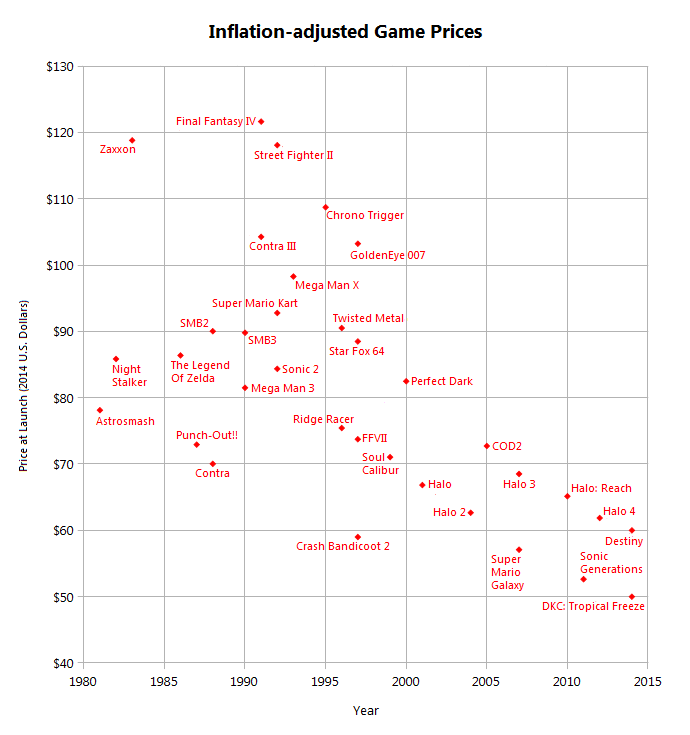
We have data on inflation adjusted game prices, do you have numbers on the added earnings for digital sales? I know they benefit the big three, as they are the platform holders, but I was under the impression that most of the added margin from moving from retail to digital didn't benefit the publishers for this exact reason.
And once again, I'm not saying microtransactions are absolutely necessary. That their increased prevalence, along with other attemps to find new revenue streams, are in part caused by lower inflation adjusted game prices coupled with higher game prices though, is something I don't doubt.
We both agree that it's a problem. I'm just offering a solution other than to trust the good of EA's heart.
As for how you keep quoting EA's statement about Battlefront 2, consider their statement. It's not in relation to recouping the game's development budget. It's about their overall financials. Now, if we don't believe stopping microtransactions impact EA's earnings at all, then we also paradoxically think that EA make no money from microtransactions. Because that's a rather unlikely situation, this leads us to conclude that what EA actually meant was that the lost earnings from a short break in microtransactions for that single title wouldn't impact their total earnings for the entire year all that much. Do you, after all, think EA would say the same thing if laws were passed preventing EA from including microtransactions in any game? That it would have no impact on earnings? Of course it would. That's why that argument doesn't hold up to scrutiny.


