By using this site, you agree to our Privacy Policy and our Terms of Use. Close

Forums - General - China will overtake the USA sometime this century....

SamuelRSmith said:
Who knows what the future may hold. Russia may even one day join the EU (there were a lot of talks about it at the start of the decade, just Google "Russia joining EU")... they already partake in the Eurovision Song Contest ;)

Does the EU allow defacto dictatorships into it's government?

I had just assumed that free elections was a required part of joining the EU.

It's one of the reasons I like the EU so much.  Though there attempts to strongarm the lisbon treaty through are disheartening.


Around the Network
Kasz216 said:
SamuelRSmith said:
Who knows what the future may hold. Russia may even one day join the EU (there were a lot of talks about it at the start of the decade, just Google "Russia joining EU")... they already partake in the Eurovision Song Contest ;)

Does the EU allow defacto dictatorships into it's government?

I had just assumed that free elections was a required part of joining the EU.

It's one of the reasons I like the EU so much.  Though there attempts to strongarm the lisbon treaty through are disheartening.

There are a couple conditions, from wiki.

Criteria and process


Population and GDP per capita of EU member states and some candidates.

Today the accession process follows a series of formal steps, from a pre-accession agreement to the ratification of the final accession treaty. These steps are primarily presided over by the European Commission (DG Enlargement), but the actual negotiations are technically conducted between the Union's Member States and the candidate country.


Conditions

Any European country could in theory apply to join the EU, at which point the Council, would consult Commission, and European Parliament on beginning accession negoatiations. The council would either accept or reject the recommendation unanimously. In order to receive a positive recommendation the country would need to meet the following criteria:[8]

  • It must be a "European State"
  • It must respect the principles of liberty, democracy, respect for human rights and fundamental freedoms, and the rule of law.

In order to gain membership it must then:

  • Meet the following Copenhagen criteria established by the European Council in 1993:
    • Stability of institutions guaranteeing democracy, the rule of law, human rights and respect for and protection of minorities.
    • The existence of a functioning market economy as well as the capacity to cope with competitive pressure and market forces within the Union.
    • The ability to take on the obligations of membership including adherence to the aims of political, economic and monetary union.

In December 1995, the Madrid European Council revised the membership criteria to include conditions for member country integration through the appropriate adjustment of its administrative structures: since it is important that European Community legislation be reflected in national legislation, it is critical that the revised national legislation be implemented effectively through appropriate administrative and judicial structures.


Process

Before a country applies for membership it typically signs an association agreement to help prepare the country for candidacy and eventual membership. Most countries do not meet the criteria to even begin negotiations before they apply, so they need many years to prepare for the process. An association agreement helps prepare for this first step.

In the case of the Western Balkans, a special process, the Stabilisation and Association Process exists to deal with the special circumstances there.

When a country formally applies for membership, the Council asks the Commission to prepare an opinion on the country's readiness to begin negotiations. The Council can then either accept or reject the Commission's opinion (The Council has only once rejected the Commission's opinion when it advised against opening negotiations with Greece[9]).

If the Council agrees to open negotiations the screening process then begins. This is a process in which the Commission and candidate country examine its laws and those of the EU and determine what differences exist. The Council will then recommend the opening of negotiations on "chapters" of law which it feels there is sufficient common ground to have constructive negotiations. Negotiations are typically a matter of the member state convincing the EU that its laws and administrative capacity are sufficient to execute European law, which can be implemented as seen fit by the member states. Often this will involve time-lines before the Acquis Communautaire (European regulations, directives & standards) has to be fully implemented.

A chapter is said to be closed when both sides have agreed it has been implemented sufficiently, however it can still be re-opened if the Commission feels that the candidate has fallen out of compliance.

In order to assess progress achieved by countries in preparing for accession to the European Union, the European Commission submits regular reports (yearly) to the European Council. These serve as the basis upon which the Council takes decisions on negotiations or their extension to other candidates.

Once the negotiations are complete a treaty of accession will be signed, which must then be ratified by all of the member states of the Union, as well as the institutions of the Union, and the candidate country. Once this has been completed it will join the Union on the date specified in the treaty.

The entire process, from application for membership to membership has typically taken about a decade, although some countries, notably Sweden, Finland, and Austria have been faster, taking only a few years. The process from application for association agreement through accession has taken far longer, as much as several decades (Turkey for example first applied for association in the 1950s and has yet to conclude accession negotiations).




Yeah... Russia would definitly not fit the criteria for joining.

I'd hope that once things get settled and they have the rules set they'll open up membership to non Europeon countries making a World Union.


^If a pro-EU movement picked up pace in Russia, then the necessary steps to joining the EU would slowly take place.

It's like Turkey, it was accepted to join years ago, but they still don't fully make out all the criteria, so they are slowly making the changes necessary to join.

I personally hope that it doesn't become a world union, otherwise it may start to lose its effect, with some countries demanding more power, we might end up with something like the UN.


SamuelRSmith said:
^If a pro-EU movement picked up pace in Russia, then the necessary steps to joining the EU would slowly take place.

It's like Turkey, it was accepted to join years ago, but they still don't fully make out all the criteria, so they are slowly making the changes necessary to join.

I personally hope that it doesn't become a world union, otherwise it may start to lose its effect, with some countries demanding more power, we might end up with something like the UN.

I disagree.

The problem with the UN isn't that there are a lot of people in it.

It's the different kinds of people into it.

Whenever there is a Veto war on policy... who is involved?

On the one hand you have the Western Democracies... and on the other you have the Non democracies.

Vetos were largely put in place in the UN for this reason.  Pardon the negative world view... but a UN without vetos would be like a prison run on a 1 person 1 vote system.


Around the Network

^Well, I don't agree with the idea of having democracies and non-democracies, I'd say that there are varying levels of democracy - I mean, look at two of the "freeist" countries in the world - the US and the UK. The US is renown for its corruption, and the UK has a Monarch and an unelected upper chamber (though there power dwindles with every decade that passes)!

You also seem to be of the view that democracy = good, dictatorship = bad. Not all dictators are evil, and not all democratically-elected leaders are good (though, of course, there is a strong correlation).

I personally think that different countries should get different veteoing powers on different matters. Some countries SE Asia may want something to happen, but a bordering country might have a negative effect from it. This issue doesn't concern any of the major powers, but some of the smaller countries might have benefited from the veto power, instead.

Anyway, that wasn't my beef with the UN, mine is that the institution is so large that it is out of touch with the real world, and it can't do anything forceful because it has to keep all members happy (like when there's a war on, instead of sending in troops to defend the good guys, they just do non-biased operations that don't have the biggest of effects).


should have allowed whats-his-face to use the nukes when he wanted to


"I like my steaks how i like my women.  Bloody and all over my face"

"Its like sex, but with a winner!"

MrBubbles Review Threads: Bill Gates, Jak II, Kingdom Hearts II, The Strangers, Sly 2, Crackdown, Zohan, Quarantine, Klungo Sssavesss Teh World, MS@E3'08, WATCHMEN(movie), Shadow of the Colossus, The Saboteur

SamuelRSmith said:
^Well, I don't agree with the idea of having democracies and non-democracies, I'd say that there are varying levels of democracy - I mean, look at two of the "freeist" countries in the world - the US and the UK. The US is renown for its corruption, and the UK has a Monarch and an unelected upper chamber (though there power dwindles with every decade that passes)!

You also seem to be of the view that democracy = good, dictatorship = bad. Not all dictators are evil, and not all democratically-elected leaders are good (though, of course, there is a strong correlation).

I personally think that different countries should get different veteoing powers on different matters. Some countries SE Asia may want something to happen, but a bordering country might have a negative effect from it. This issue doesn't concern any of the major powers, but some of the smaller countries might have benefited from the veto power, instead.

Anyway, that wasn't my beef with the UN, mine is that the institution is so large that it is out of touch with the real world, and it can't do anything forceful because it has to keep all members happy (like when there's a war on, instead of sending in troops to defend the good guys, they just do non-biased operations that don't have the biggest of effects).

The US is renown for corruption?  Does renown mean something else in the UK?

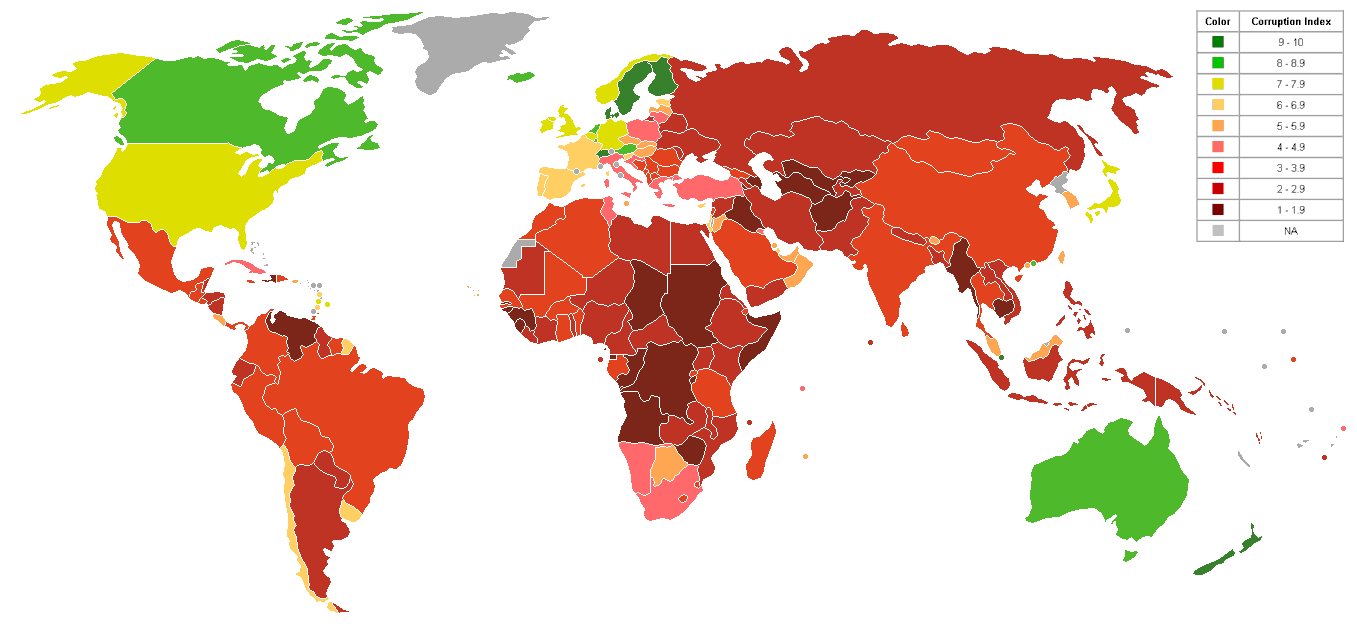
Either way as far as corruption goes.  The US is about equal corruption wise to the EU.. and in comparison to the rest of the world.....


Also... name a non "evil" dictator.

I mean look at the corruption index there. It's all pretty plain.


When I made the post, I was thinking of that German dictator before WWI, he was highly popular amongst the Germans, and Germany was highly prosperous at that time.

How the hell can a graph represent corruption? Afterall, most of it is done behind closed doors. You know, that lobbying "industry" which is worth $1.5bn a year in the states (a whole load of it comes from British firms aswell, which is funny).