


Ryuu96 on 20 February 2025
What's the song tho?










What's the song tho?


Music helps shape South of Midnight's narrative through lyrical songs, each inspired by a Southern music genre. These songs build character/creature backstories, eventually unveiling a fully realized musical piece and leading to a climactic confrontation—though not every encounter ends in a battle!
— Compulsion Games (@compulsiongames.bsky.social) 21 February 2025 at 00:24
[image or embed]
Original song then? Chads.
Ahh I love the sound of this. The songs building backstories, eventually becoming a full musical piece. Also love the sound that not every encounter ends in a battle. If they do this well, then it could make for some very great emotional storytelling, as long as people pay attention to the lyrics, Lol.
Last edited by Ryuu96 - on 20 February 2025


Ding, 53, who founded the company and is chief executive officer, has cut hundreds of jobs, closed or idled game studios and pulled back on international investment as he refocuses on a smaller portfolio of titles. He reasserted his leadership with a series of dramatic decisions over the past year, according to people familiar with the company’s inner workings who asked to not be identified.
The upheaval inside NetEase runs in stark contrast to some recent success. The company had a smash hit with Marvel Rivals in December, accruing more than $200 million revenue so far, according to an estimate by Niko Partners analyst Zeng Xiaofeng. NetEase said the game already has over 40 million registered users.
But before it was released, there were discussions about it being cancelled, one of the people said. Ding objected to paying Walt Disney Co. for the use of popular characters like Wolverine and Spider-Man, and at one point asked his artists to swap in their own hero designs. That ultimately aborted effort cost the company millions of dollars and was emblematic of the abrupt changes ushered in by the CEO. A NetEase spokesperson denied this account, saying the company has enjoyed a close partnership with Marvel since 2017.
This week, part of the Marvel Rivals creative team in the US was laid off.
Sales potential is a top priority, as he now deems any game unlikely to generate hundreds of millions of dollars per year unworthy of pursuing, the people said. NetEase doesn’t set “arbitrary blanket numbers for determining the viability of a new game,” according to the company spokesperson.
With the recent layoffs, remaining NetEase workers worry about Ding’s volatility, with some describing a CEO who changes his mind frequently, the people said. Although Ding doesn’t usually have time to play games himself, he has bragged that he can tell how a game works by watching it for a couple of seconds. Ding has asked staff in China to work until 9 p.m., including naps and meals, the people said. NetEase said there’s no mandatory time requirement and departments set their own pace.
Ding has curtailed support for about a dozen games and shut down so many projects that NetEase studios in China may not release any major titles next year. Xiaojun Hui, one of his longest-running lieutenants and president of NetEase Games, quit his management role over a year ago, the people said. He remains with the company after about 20 years of helping lay the foundation for the NetEase of today, overseeing development of its first few original gaming hits.
Among moves to shake up leadership at NetEase, Ding last year hired a small number of recent graduates from the finance sector to serve as his direct reports, the people said. Some of these 20-somethings have already been assigned key roles to lead or supervise gaming units, they added.
Outside China, NetEase has in recent months shut down or halted work at marquee studios that it opened just a few years ago, such as Japan’s Ouka, Canada’s Worlds Untold and Jar of Sparks in the US. The company is shrinking the team it has scouting overseas investment opportunities, the people said. NetEase said that fewer than 60 employees have left as a result of the shutdown of Worlds Untold and Jar of Sparks, and the adjustment at its investments team is not a “wide scale layoff.”
NetEase hasn’t made any new investments in studios or intellectual property since the start of last year. Seattle-based Simon Zhu, who has been with the company for more than a decade, remains in charge of NetEase Games investments. He declined an emailed request for comment.
Japan had been one of NetEase’s key outposts, with celebrated creator Toshihiro Nagoshi, responsible for the Yakuza franchise, a major hire to bolster the creative ranks. The decision to close Ouka was made in the midst of developing the studio’s first big game, Visions of Mana, for Square Enix Holdings Co. Ding overruled executives who had greenlit the project as he decided there’s no need for a team working for outside publishers, the people said.
Outside Ouka, NetEase-funded Japanese creators — Nagoshi among them — have been given time to wrap up ongoing projects. The message from headquarters in Hangzhou has been that there’ll be no additional funding or time, the people said. There’s no plan to spend on marketing or promoting the games currently in production in Japan.
That’s even though some of NetEase’s Western studios engaged in discussions with potential new game publishers, according to one of the people. Jackalope Games, NetEase’s first studio in the US, has been working on what’s known in the industry as a massively muliplayer online role-playing game tied to the Warhammer game franchise. At a recent trade show it received a positive reception from potential partners.
NetEase’s Billionaire CEO Ding Slashes Jobs, Games in Profit Push - Bloomberg
This guy sounds absolute garbage, Lol. They're going to backstab our boy Nagoshi.
So many veterans left to join with NetEase as well.


He's insane, like half the reason Marvel Rivals is so damn popular is BECAUSE OF THE IP AND ALL THE MARVEL CHARACTERS 
The stuff about the Japanese studios is awful, Suda and Nagoshi are going to be screwed.
Come back to RGG, Nagoshi.
Dude's basically done a "Finish your game and then fuck off" to the Japanese studios.
There’s no plan to spend on marketing or promoting the games currently in production in Japan.
Put a bullet in all their Western studios and specifically singling out Japanese titles as not deserving any marketing or promotion is SHITTY.
Last edited by Ryuu96 - on 21 February 2025


Also "Fuck license IP, I hate them" and "Cancel all our original IP"
NetEase is the Chinese Embracer Group, at least Lars actually played games though, LOL.




Fairly sizeable list of fixes here!
Envoys! Patch 1.2.3 is now available! This update includes important fixes, so be sure to update your game when you see it!https://t.co/p7GLT26ivX pic.twitter.com/A4k2cWmjVG
— Avowed (@AvowedtheGame) February 21, 2025
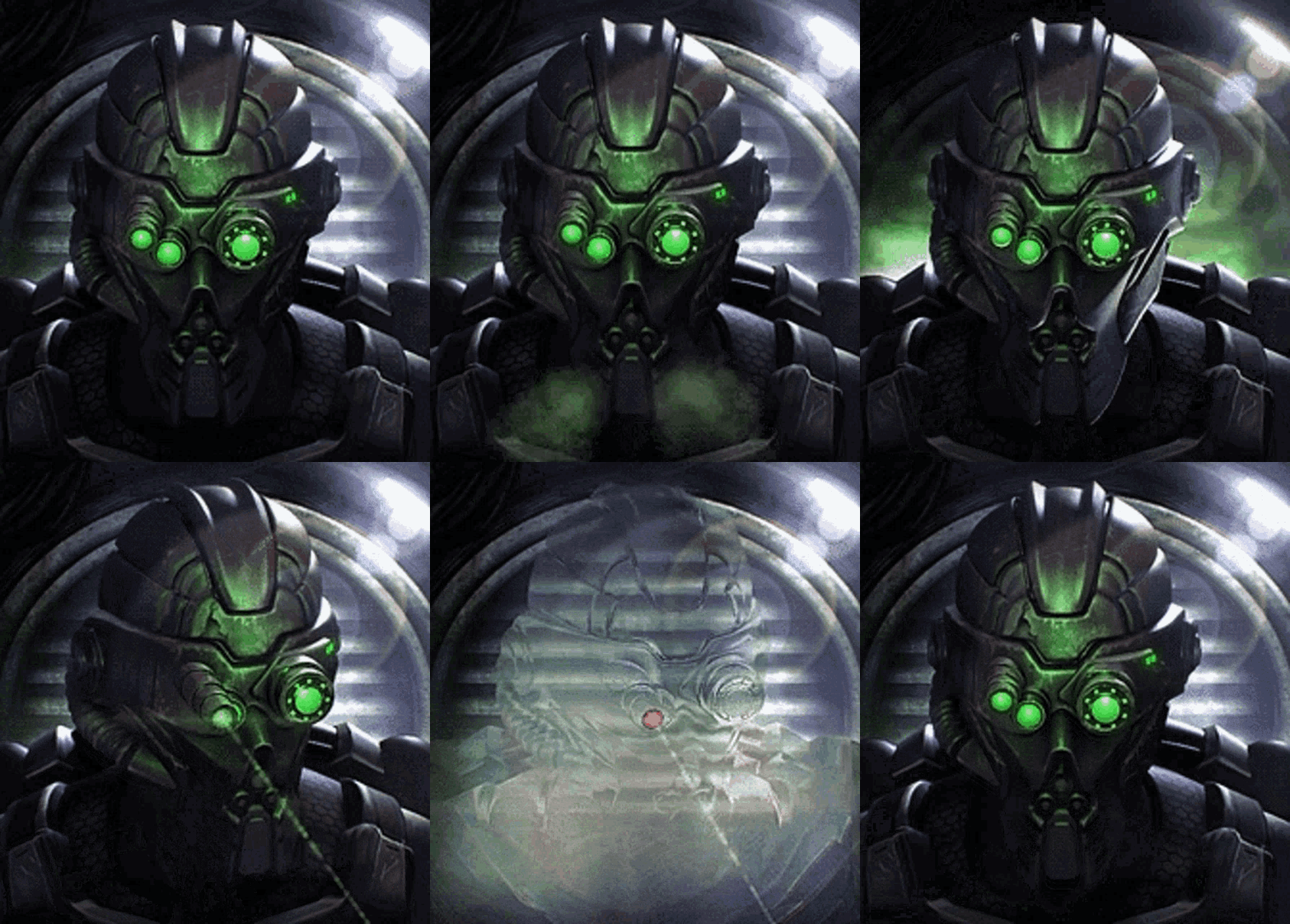
You called down the thunder, now reap the whirlwind


Yeah, I went to play, then got sad to see a 2Gb patch.


Avowed, the lovely new game from Obsidian, took 6 years, 3 vertical slices, and 2 reboots.
I spoke to director Carrie Patel about the long road to completion, her inauspicious start on the project, and what's next. This week's column: www.bloomberg.com/news/newslet...
— Jason Schreier (@jasonschreier.bsky.social) 21 February 2025 at 18:02
[image or embed]
About four years ago, employees of the Irvine, California-based video-game developer Obsidian Entertainment were set to gather on a video call to discuss some unpleasant news. Avowed, the ambitious role-playing game that they had been developing for more than two years, was going to be rebooted.
Carrie Patel, who would take over as director on the new version, already had a lot of reasons to be anxious as she waited for the all-hands meeting to start. During her time at Obsidian — her first video-game company — she had been a writer, a lead narrative designer and the director of an expansion. But she had never led development on a game this large, and she knew that the news would result in upheaval and a big hit to the team’s morale.
It was an inauspicious start to Patel’s stewardship of Avowed. But four years later, the end result is impressive. Avowed came out this week to generally positive reviews and strong buzz. It’s a sharp, focused RPG with solid combat and stellar exploration.
Behind the scenes, the creation of the game was anything but straightforward, with multiple false starts and a lot of stress.
“I feel like I’ve learned so much over the past four years that I wish I’d known at the start of this process,” Patel said. “It’s definitely been a job where the highs are really high and the lows are really low.”
Development of Avowed began in 2018, as Obsidian executives were gearing up to sell the company after 15 years of independence. The studio had become beloved for complex role-playing games like Fallout: New Vegas and Pillars of Eternity, but staying solvent was always a challenge. Obsidian presented prospective buyers with a pitch for Avowed, which the company hoped would be its magnum opus: a cross between Destiny and Skyrim that allowed players to adventure together in a massive fantasy world.
Later that year, Microsoft Corp.’s Xbox purchased Obsidian. The new owners announced the game in the summer of 2020. But despite a glossy teaser trailer, Avowed was floundering. The development team had gone through two different vertical slices — chunks of the game designed to demonstrate how it would all function — and cut the multiplayer component. Even so, it was still failing to coalesce. By January, the studio had decided to replace the project’s leadership team and reboot the game.
This came as a shock to the Avowed team, which consisted of 80 people who were preparing to enter production. Now they would have to develop a third vertical slice and essentially start over from scratch.
“Normally if you’re stepping back and reevaluating your creative direction, putting together a new vertical slice and revised production plans, you would do that with a very small team,” Patel said. “We did not have a very small team at that point.”
In the weeks and months that followed, Patel had to simultaneously figure out a new vision for the game, refill key leadership positions and ensure that dozens of writers, designers, programmers and artists had work to do as Avowed found its footing. It was like “building the tracks while the train is moving forward,” Patel said.
“A lot of lessons we learned as we were building this game, ideally we would’ve learned on a small scale with a true preproduction,” she added.
Under Patel, the game made two major pivots. One was to double down on the story and lore from the Pillars of Eternity franchise, which Obsidian had been incubating for more than a decade. The other was to replace the open world with “open zones,” like the company’s 2019 hit The Outer Worlds, which would allow the development team to create distinct, dense spaces.
They’d have to sacrifice the ambitions of building a Skyrim-style map where players could walk for hours and still not see everything. But for both technological and logistical reasons, that was proving to be an impossible quest.
The Avowed crew stayed quiet for the next few years as Patel worked to rebuild her leadership team, steer everyone in the same direction and learn how to direct a major project for the first time.
Because games are so complex, with countless variables ranging from big (how many companions there are) to small (the main character’s walking speed), even something as seemingly simple as clearly communicating decisions can prove to be a big obstacle — and a big lesson for Patel.
“As an individual contributor, you’re always saying, ‘Well if I were in charge, I’d be doing this, and obviously this would be the right call,’” she said. “Then you get there and you’re like: ‘This is harder than I thought it would be.’”
Faced with the pressure of delivering on one of Obsidian’s biggest bets, Patel spent a lot of time getting to know unfamiliar disciplines, like engineering, while making tough calls about what to prioritize.
Avowed was re-revealed in 2023 and initially set for a fall 2024 release before it slipped to Feb. 2025. It wasn’t until late in development that it all coalesced.
“There’s this interesting thing I’ve seen on every project I’ve worked on or seen during my time at the studio — things are messy, messy, messy, then they start coming together,” Patel said. “How can we find that point a little earlier? Or at least find the things we need to reinforce for ourselves? Yes we will get there, we’re on track. A lot of it is iterative. There’s a lot of work to get there.”
But ultimately it was worth the wait. Players have raved about the game, and the company said it is happy with sales so far.
Obsidian isn’t saying what’s next for the team, but Patel said she wants to keep directing games. The idea of something new is appealing, she said, but it seems more likely she’ll be building on Avowed’s foundation for expansions or sequels.
“Now that we’ve built this wonderful world, and also built this team strength and muscle memory around the content and gameplay in this world, I’d love to see us do more with it,” she said.


All of the above makes Carrie's first attempt even more impressive, I would love to see her establish herself as a repeat Obsidian director! Love to hear she seems like she wants to build on Avowed. I'm loving the game, it has a few issues but I think it's great with a really strong foundation to build upon and as for Carrie herself, this is an impressive directorial debut and all the experience and knowledge can be applied to the sequel for an even stronger game. Right now Avowed is about an 85-86 for me and building upon it could elevate it to a high 80s-90 title.
Love to see Obsidian elevating so many of their employees to directorial positions and giving them a chance, they have so fucking many, Lol.
Take the Avowed team straight into Avowed 2
If Obsidian wants to make Fallout then they can use The Outer Worlds team, Lol.
Last edited by Ryuu96 - on 21 February 2025
About Us |
Terms of Use |
Privacy Policy |
Advertise |
Staff |
Contact
Display As Desktop
Display As Mobile
© 2006-2026 VGChartz Ltd. All rights reserved.


