Yep thats it
Review
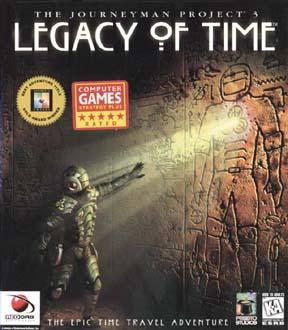
If your gaming equipment is fairly recent, you'll probably really enjoy The Journeyman Project 3: Legacy of Time, the just-released next installment in the game series from Presto Studios, following 1994's The Journeyman Project Turbo and 1995's Buried in Time. This time around, the game designers chucked the old slideshow-style Director interface for a new "spherical virtual reality" engine that allows you to look in all directions from each location. We last saw this impressive interface in the poorly-designed Atlantis: The Lost Tales from Cryo Interactive, and we're happy to say that JP3 suffers from none of the shortcomings of Atlantis. Under Windows 95, there are a few video problems in JP3, and the occasional sudden crash, but these do not seriously detract from enjoyment of this excellent game.
JP3 starts out with an extensive introduction, providing full story background for those who haven't played the previous games in the series, and there is a nice tie-in to the final silo sequence from BIT. Much of the live-action talent from the previous games has returned, but the starkly-staring actor portraying your alter-ego Gage Blackwood is new. Generally, the actors (at least the adult ones) are satisfactory, and succeed in furthering a well-written story involving various game quests. An interesting feature that gets you rapidly immersed in the plot is the initial set of three "mini-quests" (all on the first CD-ROM) that serve to familiarize you with the concepts of time travel and introduce you to the main locations of the game. After these mini-quests have been completed, the game becomes quite multi-threaded as you try to complete three independent quests (each on its own CD-ROM) for hidden artifacts. Most of the puzzles of the game are fairly easy ones involving inventory manipulation, but several quests require transferring items between different timezones, as in BIT. For better or worse, there is no spear room puzzle in JP3. One of the improvements in JP3 over its predecessors is the ability to transfer between timezones without losing your location. As you might expect from one of Presto's well-designed games, JP3 can be started up with any of its CD-ROM's loaded (or even none at all). Video sequences are skippable. Due to frequent "one-way" gameplay segments, it's a good idea to save your game often and to look around first before interacting with anything. Saved games are file-based, unlimited and an overwrite warning is provided, but names are listed alphabetically rather than in the reverse-chronological order we would have preferred.
Graphics in JP3 are fairly impressive, particularly when experienced through the spherical VR. Most backgrounds are rendered, but close-ups in a few scenes would have benefited from a few more graphic elements; for example, the polygonal coils of rope on the Atlantis dock crane and the blocky coastline in the first Atlantis mini-quest. All in all, however, JP3 is visually striking and quickly gives you the feeling that you're really there. As in its predecessors, all game action in JP3 takes place within a partial-screen display representing a helmet "viewport". Other areas of the screen are reserved for inventory control, appearance selection and your wisecracking AI sidekick, Arthur. Instead of the "biochips" in the previous games, JP3 uses a "chameleon" jumpsuit that allows you to take on the appearance of anyone you meet in the game. As a result, JP3 emphasizes character interaction and dialog, leading to more involvement in the game.
Other features adding to immersion in the gameplay are JP3's excellent sound effects, particularly the footsteps that simply have to be the best found anywhere. New textural variations have been added that alter the sounds depending on the surface being travelled. A notable example is the realistic crunching sound when moving over snow-covered paths. Background music is appropriate and unintrusive, but not as notable as in BIT. There were a few sound playback problems, but nothing serious.
Innocuous, but extremely well-done little animation sprites (flowing water, smoke, flames, etc.) are found throughout JP3. Small motion pauses and the occasional grunt make it easy to believe you're actually wearing a TSA suit. Unlike in BIT, your character cannot die in JP3. On the other hand, we rather liked the hand-painted death scenes in BIT, even if it did mean we had to restore a previous saved game.
If JP3 has a weakness, it must be in its troublesome live-video sequences. There was frequent sprinkling of pixels in video frames, along with general jerkiness and bad lip sync. From a design point of view, we would have preferred aliens created via makeup effects rather than the much less realistic, crudely-animated cyberpuppets that were mixed with live actors in many scenes at TSA headquarters. However, none of these problems prevented enjoyment or involvement in the game, and there was always Arthur to add a little levity to the situation.
Here's hoping Presto Studios won't wait so long to make the next Journeyman Project game!