You misunderstood, and failed to comprehend the poll results multiple times.
You also left out this part from your link "Before we dig into the results, it’s important to note that this was an open survey, with nothing to stop the respondents from lying or taking it multiple times to skew the results. It’s possible some respondents answered in bad faith"
If anybody answered in bad faith it was in order to paint piracy in a favorable light. In fact it's much more likely that people responding to this survey accidentally misremembered how many pirated games they paid for. When people are asked how charitable they are or how many times they brush their teeth, they often overestimate in their own favor. It's likely that the same thing is happening here, in favor of pirates buying games. The funny thing is, the poll was set up in a way to hide the actual rate of piracy on PC, but we'll get to that later.
1. so out of 100% of PC gamers, 35% of them have pirated a game, with 50% of that 35% then going on to buy said game. Thats a lot less then the massive 90% number you where screaming about all along.
Ugh no, that's not what the available responses to the poll were. The question was "How often would you say you've purchased a PC game after pirating it?" The available respones to the question at hand were "Never", "Rarely", "Over 50% of the Time", and "Always". That means that 50% of the respondents went on to buy the game 51% of the time or greater. It also means that 7% of the respondents Always went on to buy the game. If I were to pirate PC games, and if I were to only pay for PC games 55% of the time that I pirated them, that means I would be able to be part of your 50%. You misunderstood the poll results, and confused 50% of the people going on to buy said game with 50% of the people buying the games they pirate 50% of the time or greater. The poll was set up in a way to make it easy to respond with "I pay for my pirated games", by leaving out options for "I pay 40% of the time", or "I pay 30% of the time". The poll also neglected to give an option to admit to having bought the game on sale at a much later date, but we'll get to that in a minute. Even with the poll being set up in such a friendly way we still get a 44% chunk openly admitting to not paying for the games they pirate.
You also leave out this "Some highlights from the piracy breakdown per country: Serbia and Romania had the highest piracy rates among our respondents at close to 75 percent. Lithuania and Argentina were both over 60 percent. Russia, often cited as a country where pirating runs rampant, was right at the 50 percent mark."
And also this "
In our report on the state of PC piracy we spoke to a pirate who lives in Bulgaria, who explained a new game on release day costs almost a third of a minimum wage earner's monthly income (imagine new games costing $400 in the US)."
So out of that 35% the largest precentage of them come from country's where lets face it gaming is very expensive, some games are never released, some people are just too poor to buy them. I wonder how many of them same gamers would pirate console games?, i wonder how many of them do pirate console games?. You can bet that number would be very high too. But then its nothing new for you to leave out the data that doesnt paint your image of PC how you want it to be seen.
The majority of respondents to the poll were from developed countries such as U.S, U.K., Germany, Australia, etc. You can see this here.
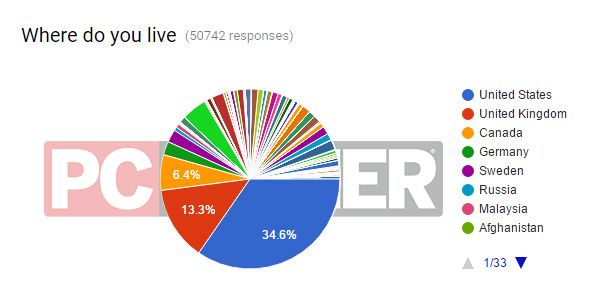
It's hard to tell from the pie chart, but if you add up all the developed countries together I'm pretty sure we'd wind up with over 75% of the respondents being from developed countries. Your theory that most of the pirates are from developing or underprivilidged countries doesn't reflect the data.
If respondents from your listed countries were weighting the average we would see a much lower rate of piracy than 35% in developed countries. But as we can see below we don't see that. The U.S., U.K., and Canada still sit around the 30% mark for piracy. Countries such as France, Spain, and Italy sit at 40% to 50% piracy rates. Also, do you see those little numbers at the top of the bars? Those are the number of respondents per country. With a little math it's not hard to get a fairly accurate number of the percentage of respondents per country. Expect an edit of this thread in the next day or so showing the results of that math.
Edit: I did the math. 39,506 or 79% of the respondents were from the developed world. 6,795 or 13.5% were from developing countries. That leaves a little under 7% of the respondents being from countries with fewer than 250 responders. 2134 or 4% were from the countries you listed with high piracy rates. So, again your theory that countries with high piracy rates are skewing the results, doesn't reflect the data shown.

Chazore has explained how this has no effect on Persona 5 to you very well. Unless Atlus ports Persona 5 to PC they have no lost sales. Its pretty much that simple, unless you believe that them pirates who cant afford a PC game are going to be able to afford a console+the price of the game.. You pushing this has giving me a good laugh i will admit. Many many research has shown that once a person gets enough income they go on to start buying games, the once who dont never would of in the first place. But trust me when Atlus ports Persona 5 to PC (We all really know thats what this is all about), then we can judge its sales on PC, as im sure many PC gamer will be more then happy to buy it for the first time or in my case double dip and buy the pc version to send it to the top spot on steam charts, Atlus knows this.
Your response here is a red herring. It's not about how many people might eventually buy the game if it comes to steam. It's about how many of the people who emulate the game bought the disc.
I'll further elaborate on why the number of pirates who purchased Persona 5 is likely to be much lower than the number of pirates who purchased a game on steam. It's well documented that when paying is optional, and the price is high, payments go down. When the price is low and paying is optional payments go up.Let's say I'm selling donuts in an office building. I don't have time to run a cash register so I leave a box of donuts, and a lockbox on the table in the break room, with a note saying to please put money in the lockbox, and a list of donut prices. Now let's say that early in the morning I price the donuts quite high because they are fresh and in demand. Naturally more people will take a donut and not pay for it, since the price is too high. Later in the afternoon when the donuts are stale I lower my prices to a third of what they were in the morning. At this point I haven't checked how many of my donuts are left, nor have I checked how much money is in the lockbox. Now all the people that took a donut without paying in the morning will rush to put money in the box at the new price. The percentage of people who paid for my donuts either initially, or later in the day winds up being 70%. Pretty good right? Now let's say I get a competitor named Phil. Phil sets his prices high in the morning like me, but *doesn't* lower them in the afternoon. Phil winds up with a much lower percentage of people that paid for his donuts at only 30%.
In this analogy the sale and payment rate of my donuts reflects that of a game on steam. The sale and payment rate of Phil's donuts reflects Persona 5. It's important to note that just because most of my customers paid in the afternoon that doesn't clear them of theivery. They still stole a donut when the price was high, and wound up paying later when the price was lower. They still failed to pay the price that was asked of them at the time.
3. Please do point out once again how all PC gamers are pirates as thats what you are saying by "People actually want free icecream" that PC gamers want atlus to port the game to pc so they can pirate it for free. I know you know better since your own link up above shows you that only a small number of PC gamers pirate, and many of them are willing to go on to buy the game.
No, that's not what I was saying at all. Chazore was saying that it's bad to go for what a company wants instead of for what people want. I responded with "People actually want free icecream." as an example showing that what people want is not always the best option. People can already pirate the game for free on PC, so your interpretation of my comment makes no sense. Why would I imply that people want Persona 5 ported to PC so they can pirate the game for free, when they can already do so? At this point I've already shown that you misunderstood the data in the article multiple times.
Show me where PC gamers trew a tantrum over BOTW?, or wait you seen it on the interwebs right?. Thats like me saying "PS4 gamers trew a tantrum over BOTW not coming to PS4, i know cos i seen it on some other forums".
Hacking the game so that it will run on PC = throwing a tantrum. Going out and paying developers to create a tool that allows you to pirate a game that is on store shelves, just because you can't play it on PC is childish behaviour.
No one paid to "Hack" BOTW. People "Are" paying to support an emulator for a system thats now discontinued. A system that funny enough has been hacked and can play pirate games, hell a person could pick up a hacked WiiU for like €150 loaded with a bunch of games including BOTW that will play perfect right now today. Them people thats supporting the emu are doing so for its future progress and being able to play their games in a much higher res and detail then the WiiU originals.
Cemu was released in October 2015, not even three years after the Wii U launched. There's only around 15 good games for the Wii U and four of them came out around that date or later. Switch was far off on the horizon at this point. Contrast this with the 2012 release date of the PS3 emulator, when 90% of the PS3's good games had already been delivered. So, no they weren't paying for an emulator of a discontinued system. They were paying for a way to pirate Nintendo games on a PC. They still are paying for that, since BotW is a Switch game. Keep in mind that Cemu donations blew up once BotW released. So it's not a case of funding an emulator for a defunct system in order to "save those games", it's clearly a case of wanting to be able to pirate Nintendo games on a PC.