By using this site, you agree to our Privacy Policy and our Terms of Use. Close

Forums - Gaming - How would you put a price on a videogame?

This question is way too complicated, for it to have one simple answer. Personally, would love for games to be cheap, but at the same time, I want the developers to make their money back as soon as possible, so they might make a sequel and/or not go bankrupt like many have.
I guess the amount we pay nowadays is fair for the moment.(would like to see triple A games going for 40 at the most though)


Around the Network
fatslob-:O said:
If I were a publisher I would price it so I can try to break even or make a profit ...

If I was a gamer I'd let the market determine it's price ...

If it were me personally, I would like to be as cheap as possible ...

There are many facets to your question ...

Yeah, I know there are, that's why I found interesting to know which one would prioritize people, and so far the answers were fairly diverse, so I'm happy :P.


I'd always price games less than what they're actually worth, that way more people get more of an incentive to buy and it looks good on your part.


I'm now filled with determination.

I'm fine with paying $40 for 3DS games and $50-60 for Wii U games (though a bit pricey)... However, is the not the case anymore so I'm basically not really getting any games day 1 anymore


NintenDomination [May 2015 - July 2017]
 

  - Official  VGChartz Tutorial Thread - 

NintenDomination [2015/05/19 - 2017/07/02]


Here lies the hidden threads. 

 | |

Nintendo Metascore | Official NintenDomination | VGC Tutorial Thread

| Best and Worst of Miiverse | Manga Discussion Thead |
[3DS] Winter Playtimes [Wii U]

Shadow1980 said:

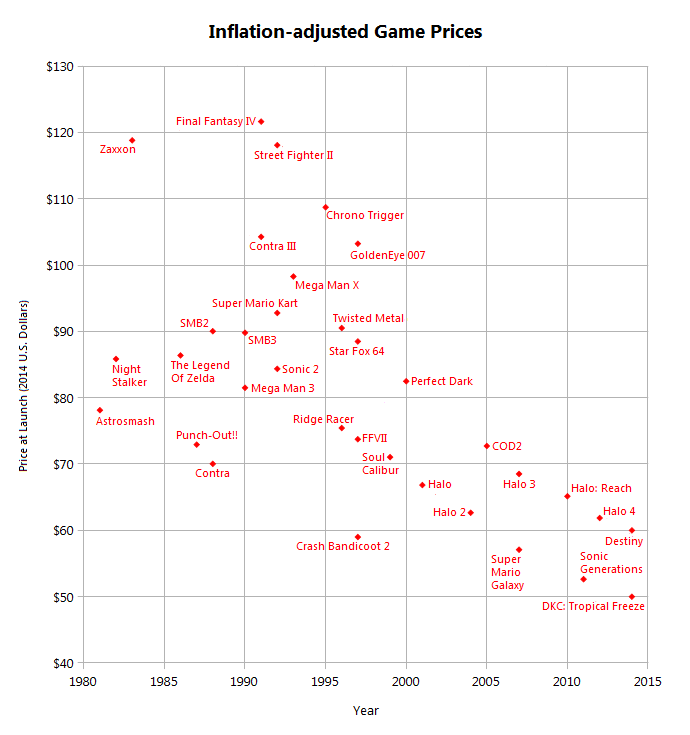
The games industry did used to be more flexible with pricing. New NES games usually ran from $35 to $50 (and older ones tended to be towards the cheaper end of that range than ones later in the generation). New SNES, Genesis, and N64 games ran from $50 to $70, while PS1 games ran from $40 to $60 (though most $60 PS1 games were early titles, and $50 was the normal upper tier price starting around 1997). But after the turn of the century pricing became far more standardized. Most new titles in the sixth generation ran for $50, and $60 has been the standard for most new titles for the last decade. There are some budget titles that go for $50, and $50 was also the standard for the Wii, but those are the exceptions to the rule.

Of course, those prices are not adjusted for inflation:

But should the industry go back to more flexible pricing for new AAA titles? It's hard to say, really. Without knowing the exact reasons for past flexibility, we may never know for sure. Factors with a large degree of subjectivity like how long the game takes to complete will likely never be part of the equation (and FWIW most games in the 8-bit & 16-bit eras were very, very short by today's standards despite costing considerably more on average at retail than today's games and costing only a tiny fraction of today's budgets tomake). Most AAA games are rather big-budgeted, but there is some flexibility in those budgets and thus budgets could be a metric. There's a lot of other factors at play. Advertising budgets, sales expectations. It's certainly something worth considering. In terms of relative proportion, the NES price range of $35-50 is about the same as the SNES/Genesis/N64 range of $50-70. Considering $60 is the average today, a $50-70 range could work. I also wouldn't mind lower-budget "double-A" games becoming a thing. In terms of budget they could fit between low-end AAA games and high-end indies, and they could cost $40 per copy.

Of course, there's a big difference between "should" and "will," and the industry doesn't really have much incentive or practical reason to change the status quo.

Sony tried experimenting last gen with $40 Sly Cooper, $30 Ratchet and Clank: Into the Nexus, and $40 Puppeteer.  They are also listing the new Ratchet and Clank as $40.  So hopefully they get rewarded for this model as Sly and Puppeteer were unfortunately bombas despite being fantastic games.


I am Iron Man

Around the Network
Shadow1980 said:
archer9234 said:

Why not? The people who build the game, give the Q&A team logs. Then you average out the time. That's how people do it now. You just then make a universal pricing scheme. Like when they give the games rating. For hitting certain things. It acutally help people. The game shows up as 50$. Oh it's 10 hours. I have that time to kill.

There's just too many variables to take into account. Will average playthrough times determined during internal testing be representative of that of the general public?

If that's not the case now. Then why are they in reviews? People see a review of someone beating it. Lists how long. And then accept the time. We already do it.

If a game has multiple difficulty levels, do they use the average playthrough time for Easy, Normal, or Hard?  

Normal means the normal choice. If the other two didn't exsist. You'd use just that. Or are you saying no game has a default.

Does the game's genre come into play? After all, sports and racings games don't really have a story mode. As another example, for fighting games would completion time be determined by time to beat the story mode with all characters or just a single character?

I already answered that with being determined on the amount of content in those games. Roster size (fighters), comparible items that are normal to the series (Sims).  As for fighters, racers etc. Your primary goal is to unlock the cars/parts, or characters. I'd count that as the games time. 

What about MMOs and other games with no fixed ending?   

They have an ending. When the scripted story elements ends. The released length of the game determins. Not the future DLC.

Then there's open-world games, which offer but don't usually make mandatory a bunch of sidequests and the like.

You mean like Minecraft? Or GTA? They still have endings. You have a end goal. Same with Sim City. Or The Sims. It be harder to judge sure. But there is still a end point of the games. And these games cost $60 anyway. Minus Minecraft. Since it was a indie game. And would have to be based on what it had at public launch. Not now.

Speaking of which, do completion times include 100% completion or just simply reaching the end of the game or somewhere inbetween, and what about speedrunners who try to sequence-break?

I said ignoring sidequests. So that means no 100% completion. And speedruns are made up by people. Because then you'd count collecting 700 Pokemon, over beating the Pokemon League, as the real goal. Or Gltiching threw the floor, in Metroid.

How does multiplayer fit into the mix? People can invest dozens, hundreds, or even thousands of hours into playing online. Do we charge more for MP, and if so does it rate on number of maps, number of game modes, or some other metric?  

We don't any more or less account MP now anyway. Or COD would be worth $10,000. And if you want to talk about MP only games. Your goal is still to unlock everything, in the game. That would be the time.

Then there's replay value. Some people may play a shorter game more regularly than a much longer game because of the lower time investment, but others may simply may prefer to play a longer game over and over. Finally, there's often a massive disparity in completion times. Some single-player games can be beaten in 8-10 hours, while some offer many tens of hours of gameplay including sidequests and other extras.  

Again, I said not counting sidequests. The main story only. And persons personal replayablity isn't counted. Just like a person speed running a game wouldn't be. It's a PERSONAL choice to do these things. If a person wants to hunt down glitches. That adds hundreds of hours of playtime. It's their choice. Not the developers.

If we meter them at, say, $2/hour, a game like New Super Mario Bros. U might go for only $15-20, while a game like Skyrim would go for well over $100. Developers would be encouraged to pad the length of certain kinds of games to keep them from nearly being a giveaway while cutting material from others so the game could be released at a viable price point for the average gamer.

They do that now, anyway. Your point? It still doesn't invalidate a preset universal pricing scheme, based on time. People freely bitch that this game wastes your time, in certain places. And is really not this long. Bayonetta, as an example. Intentionally put in certain shit checkpoints, to pad out the ending. While the beginning and middle don't have this problem. 


Those that think a games lenght should influence the price should take a look at the howlongtobeat site: http://howlongtobeat.com/stats_more.php?s=Longest_Games


Those that think a games (map) size should influence the price should take a look at the this site: 
http://www.giantbomb.com/profile/aperturesilence/blog/a-relative-size-comparison-of-game-world-maps-fasc/49712/


Those that think a games budget should influence the price should take a look at the this site:

 https://en.m.wikipedia.org/wiki/List_of_most_expensive_video_games_to_develop


baloofarsan said:

Those that think a games lenght should influence the price should take a look at the howlongtobeat site: http://howlongtobeat.com/stats_more.php?s=Longest_Games


Those that think a games (map) size should influence the price should take a look at the this site: 
http://www.giantbomb.com/profile/aperturesilence/blog/a-relative-size-comparison-of-game-world-maps-fasc/49712/


Those that think a games budget should influence the price should take a look at the this site:

 https://en.m.wikipedia.org/wiki/List_of_most_expensive_video_games_to_develop

So, what do you think?


I won't pay any more than $20 for a digital copy of a game, but for the same game, i'd pay up to $60 for it, for a disc based copy. Remasters, my cutoff is $30. There are very few new release game that i'll buy day 1, and pay full price for, since games go down in price so quickly anymore, and also since i don't have the time to play most games when they release.


naruball said:
baloofarsan said:

So, what do you think?

I have to be boring and say the obvious: supply <-> demand decides price, not how much effort or money or resources that are invested in the game.