

Dustforce sales figures
When we first started working on Dustforce, it was frustrating to not be able to find much data about whether indie game development is a realistic thing to do with your life. The closest thing out there were unofficial sources, like VGChartz, that gathered retail information, but lacked in digital sales data. Fortunately, independent developers don't have the same financial obligations that publishers do. There was a series of helpful articles [parts 1, 2, 3] by David Galindo that talked about the financial details of his game, The Oil Blue. It was just one data point, but a valuable one. Now that we've finished our own first project, we'd like to contribute our own data about Dustforce to the growing trend of transparency in indie game development.
Beginnings
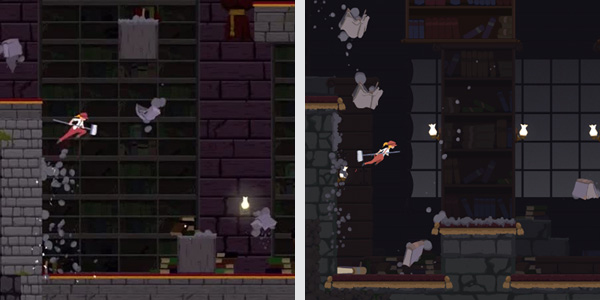
Right: Dustforce as it is today, built in our own engine.
Dustforce started out as the project of the first half of Hitbox Team, Lexie and Woodley. They built the Dustforce prototype during the summer of 2010, motivated by the deadline of a game contest. For four months, they worked in an outdoor shed, living on cheap frozen foods and bulk soft drinks. Lexie worked at a second job during the day, and joined Woodley at night to build their prototype. They finished the game by August, in time for the contest deadline.
In the few days after the prototype was posted online, anarticle on IndieGames.com drew some positive attention. Woodley and Lexie received an email from Valve, inviting them to put Dustforce onto Steam. This was the motivation they needed to work on Dustforce full time, to turn it from a prototype into a full game. It wouldn't be an easy task – the prototype was far from the final vision, and would take more than just two people to finish the game.
It would take at least a year to do it, and of course it costs money to live during that time. Where would that money come from? Working a second job would cost precious time and energy, and borrowing money from a publisher or investor comes with obligations that can be creatively detrimental to the project. Fortunately, the answer came easily: the Dustforce prototype won the competition, and along with it, a $100,000 grand prize.
The cost of development
$100,000 USD is a significant amount of money, but is it enough? Well, let's look at a detailed list of all the costs critical to developing an indie game:
- Food
- Water
- Shelter
- Internet
All you really need to make a game is a computer and basic living expenses. Time is money, as they say, and we needed roughly a year and a half to finish Dustforce. How much does a year cost? We were all living in different areas of the world at the time (Brisbane, Tokyo, New York, and Cincinnati) – on average, it would cost us around $20k per person per year to live frugally. A lot of the prize money went to paying existing bills, debts, and traveling expenses. Between three people (the fourth lived off his own savings), the remaining money would last about one and a half years.
This was just enough time to finish the game, but it was cutting it a bit close - you don't want to finish the project with zero dollars in the bank. It can take up to 90 days to receive the first payment from sales, and of course it's possible that the game might not sell well at all, so it would be ideal to leave a few months of money in reserve.
People often ask: how much does it cost to make a game? Well, the answer is straightforward:
Bear in mind that we had no formal business structure, no salaries or benefits. We were just four kids who really wanted to make Dustforce, and were lucky enough to have enough cash to not worry about anything else for a year. Also, it's important to note that money is not sufficient to finish a game – there are intangible resources, like motivation and patience, which are just as consumable as cash.
Expectations and results
A year and a half has passed since development began. It is now January of 2012. How is progress on Dustforce going? A few months prior, we gave ourselves a hard deadline of January 17th. It would be too financially risky to work much longer past that date. In addition, motivation and patience are running low, after fifteen long months of hard work. Now, by some miracle, the game is ready to launch on Steam. With a nervous click of the mouse, we upload the final build and await the launch.
We had no idea what to expect. We could only speculate, using sparse data points and ballpark figures. Was the past year and a half worth it? Of course it was – we worked the hardest any of us have ever worked, and we created something we were truly proud of. Yet, there was a lingering uncertainty of financial expectations. Our goal was to just make enough money to be able to do it again. If we could work on our next project independently and without being restricted by a financial cut-off date, then we'd consider Dustforce a financial success.
So if it cost us almost $100k to work for a year and a half, we'd have to make around $67k for every year until we release our next game. However, it would be nice to live a less frugal lifestyle than before, so ideally that figure would be around twice as much. With a rough estimate of three years for our next project, plus a bit of a buffer, we were looking at around $300-400k USD as our final goal. Was that realistic? We had no idea.
After a few hours of mashing the refresh button on the sales page, we were able to sleep knowing that sales were doing just fine: on the first day, we sold 4,796 copies - a revenue of $44,141. It was hard to extrapolate this into the long term – obviously we wouldn't be selling this many copies every day, but how long would the initial surge last? After around two months, the trajectory of sales took shape:
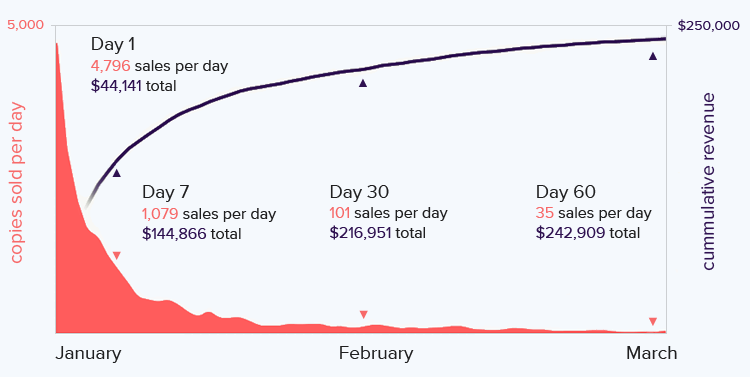
As expected, the sales declined steadily after the launch. The first three days of sales accounted for half of our cumulative revenue for the first three months of sales. By the end of the second month, we were selling around 30-50 copies per day. Our running total by then was around $243k. Remember, this is just the revenue. After deducting withholding taxes, Valve's cut, returns and fees, we're left with around 63% of that, so that figure is closer to $153k. With that taken into account, Dustforce was profitable (in that it made over the $100k put into it) by January 25, or 9 days after its launch. If you take into account personal income taxes (between 28-36%), then we were personally profitable by around a month after launch.
By the end of April, sales have tapered off into a trickle of a dozen or two sales a day. However, Dustforce was slated to be on a Steam Midweek Madness promotion, at 50% off for the first 3 days of May. At the same time, we finished porting the game to Mac, and also added in the custom level editor and server. Here's what happened:
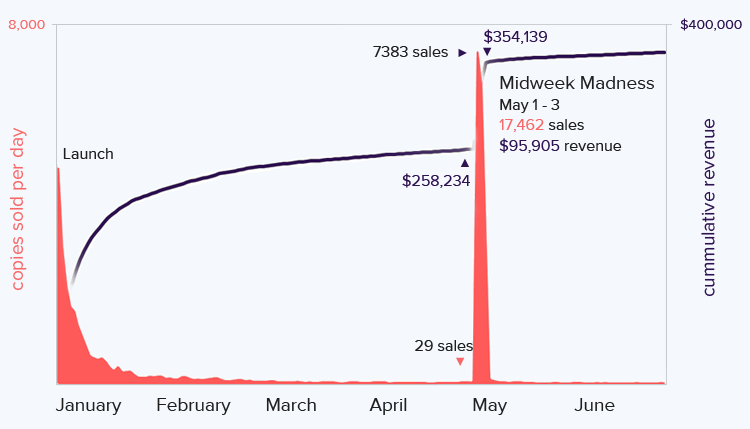
Over the 3 days of the promotion, we sold 17,462 copies of the game, more than the amount we sold during the first 3 days of the January launch. Of course, at 50% off, the revenue was a bit less, but it was still an instant 37% boost in lifetime revenue. We were thrilled: it looked like we'd hit our financial goal pretty soon. As a side note, we thought that the huge increase in the player-base would help the long tail with more word-of-mouth sales, but it seemed to taper off back to their original rate within just a few days.
Humble Bundle
Soon after our January launch, we were contacted by the fine folks from the Humble Bundle. They were interested in putting Dustforce on a future bundle, as well as helping us port the game over to Linux. In mid September, the Humble Indie Bundle 6 was released, along with some other great games. Here's what happened:
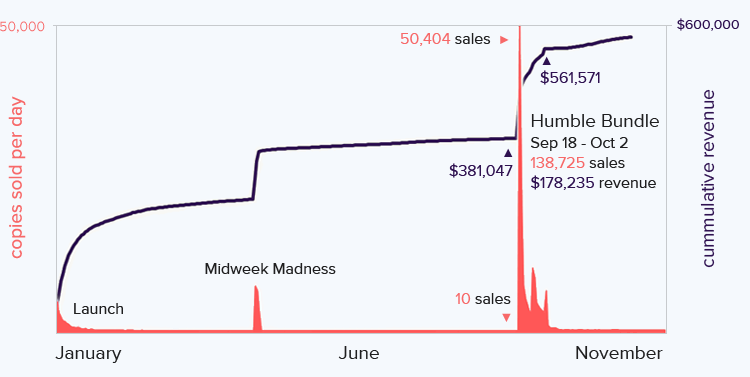
(Note that for the number of Humble Bundle units sold, we just included the number of copies of Dustforce that were activated on Steam.) The Humble Bundle was a great success: we made roughly $153,915, and unlike the last promotion, we did notice an increase in Steam sales afterwards. With such a huge boost in the number of people playing Dustforce, the amount of daily sales jumped up from under a dozen to around 50 or 60 copies per day.
After the Humble Bundle, we also had three other promotions to end the year on: 50% off during the Thanksgiving sale, a daily deal, and the holiday sale. Although none of them were as dramatic as the previous events, they cumulatively had a big impact, netting $76k in the 45 days between the beginning of the Thanksgiving sale in November, to the end of the Christmas sale in January. This was over three times as much as the revenue in the 45 days prior to that.
Final numbers
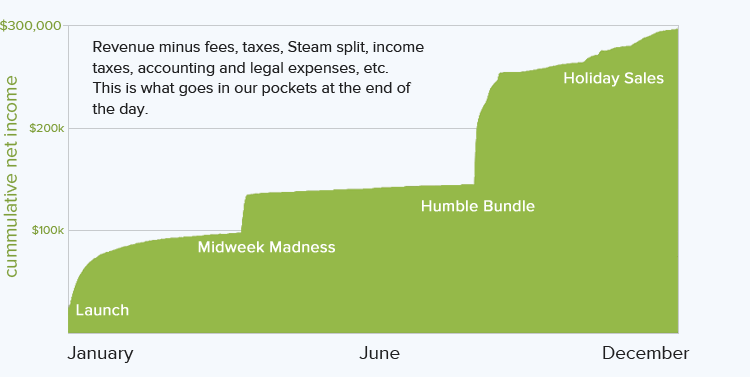
The final figure for our income after exactly one year of sales is $489,404 USD (from a total of $668,490 in revenue). Of course, there are also costs to running the business: legal and accounting fees, software licenses, server costs, and some travelling expenses have added up over the past year to take a good $36k or so out of our total income. When you take that into account, along with personal income taxes, we are left with around $295k. In the end, this means that for every $10 copy of Dustforce sold, $4.41 of it ended up in our pockets. We then split this between the four of us.
Dustforce was our first finished game, and we went into it without much experience, especially in the business side of things. Through this project, we learned firsthand that time is money, and that sacrifices have to be made when resources are limited. We were also surprised by how critical promotions were for revenue. We are really grateful to have a strong start, and are very happy with how the game turned out.
We're putting all our earnings back into making our next game, Spire. By being able to remain financially independent, we can continue to develop the game as artists and not as businessmen. Like it was with Dustforce, it is of utmost importance that we make design decisions based solely on making the game better, not on making it sell more.
We are all humbled and elated by how well Dustforce has been received. The joy from our players is enough to keep us making games – the financial success is just an incidental blessing.
http://hitboxteam.com/dustforce-sales-figures

 @TheVoxelman on twitter