






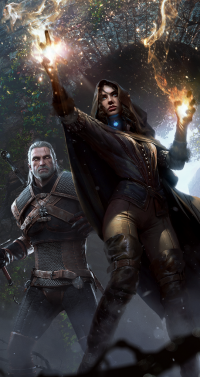


The story behind The Witcher 2 is almost as epic as the plot of the hugely successful RPG itself - a tale of how an independent Polish studio created one of the most technologically advanced PC games in existence and then somehow converted it across to the Xbox 360, retaining and indeed adding to the original gameplay and bringing across the vast majority of the game's phenomenal visuals.
However, the tale really begins during the development of game's predecessor - CD Projekt RED's debut outing for super-powered monster-slayer Geralt of Rivia. In producing this new RPG, the studio turned to an existing engine to provide the technological underpinnings - BioWare's Aurora - but as development continued, it became clear that while accomplished enough in its own right, the bought-in platform wasn't entirely the right fit for the team.
"The team are hugely modest about the scale of its achievement in the creation of the REDengine, but in the current era of games development, the notion of an independent developer producing a state-of-the-art technology that compares favourably against industry heavyweights like Unreal Engine, id Tech and CryEngine 3 is simply astonishing. From a visual arts perspective, CD Projekt RED had hit a home run with its first time at bat."
"But the decision was made early on that this beefed-up version of the game would be exclusive to the Xbox 360, with Sony's PlayStation 3 architecture not being a good match for The Witcher 2's underlying tech. Executive producer John Mamais explains why:
"Simply put, our engine architecture was more suited to an Xbox 360 adaptation. Preparing two versions at the same time would result in dividing the programming team, and most likely would have doubled the time it took to deliver the 360 version at the quality we achieved. We simply didn't have the manpower to achieve this in the given time," he says."
""Actually, we had to rewrite most of our shaders and materials and redo the whole post-process pipeline. When the adaptation work started, we had about 5FPS in most locations, meaning that the scene was rendering in 200ms instead of the desired 30ms," says senior programmer Bartek Wroński, revealing that the resultant work achieved more than just mere optimisation, but also some better-looking effects.
"Fortunately, Xbox 360 is closed architecture, and we had quite a lot of time for the adaptation/porting process, so we could find most bottlenecks and fix them. Some of the effects had to be totally redesigned to work in, for example, half resolution, like particles and transparencies or SSAO (for which we used a totally new, lower-quality but very cheap algorithm). Some post-process shaders were just rewritten to be optimised without sacrificing quality, sometimes even enhancing it.""
"Xbox 360 has its own specific output colour/gamma curve, different from PCs, and TV sets have totally different colour rendering from monitors designed for gamers and office work. We had lots of issues like overexposure, ugly colour-banding in shadows, strange colours and wrong gamma."
To overcome the issues, the programming team stepped in to assist the artists with some much needed modifications.
"We helped artists and implemented colour pre-scale that helps to fight banding, changed the tone-mapping process to work differently with a more intuitive set of parameters, and designed a special filmic-like colour curve that looked just fine on most TVs," Wroński continues, pointing out that the decision helped immeasurably with the final presentation of the Xbox 360 game.
"Yes, we used NVIDIA's FXAA. It is very simple to implement at any development stage, very cheap and worked just fine," confirms Wroński.
"On Xbox 360 we deliberately lowered its effect to avoid over-blurriness, already associated with lower texture quality and lower screen resolution."
Another challenge facing the team was the relative weakness of the Xbox 360's Xenon CPU. It's a tri-core processor that runs at 3.2GHz, each core featuring two hardware threads. It sounds a lot more powerful than it actually is - a Microsoft GameFest presentation by Bruce Dawson (now at Valve) reveals just how hard it is to eke out maximum performance from the PowerPC derived technology, to the point where for all its high-end clock-speed, the 360 typically requires five processor cycles to run just one instruction.
"We had some difficulties with the CPU side. There were a few functions in the code that were particularly inefficient on the Xbox 360 because of load-hit-store problems and L2 cache misses," confirms lead engine programmer, Tomek Cybulski.
"We had no problem with these on the PC because of different architectures. We had to go through each and every such function and re-factor them to utilise the CPU better. This is especially important for some functions that are called hundreds of times in a frame."
"REDengine is technology meant for developing great RPGs, and it's good at that. It supports the creation of immersive, mature, non-linear stories; dynamic gameplay; realistic, vast game worlds and everything that makes The Witcher 2 one of the greatest RPGs I've ever played - in my personal opinion," says Balázs Török.
The company does plan to branch out though. The age of the PC exclusive - for CD Projekt RED at least - is over, with executive producer John Mamais confirming that "we're going multi-platform and will support DX11".
While the company obviously won't go on the record about any kind of next-gen console spec, we were curious about what they would want to see from new hardware.
"Generally speaking, our games always have a lot of content and detail, so we always need more of everything - more CPU and GPU power and more memory," shares lead engine programmer Tomek Cybulski.
"More specifically, the thing that constrained us the most was the disc access speed; since the Xbox 360 doesn't guarantee a built-in HDD we can't rely on installing the game, so we hope to see better access speeds or at least a lot of memory."
Community Action
In the meantime, CD Projekt RED continues to support The Witcher 2 and strives to satisfy its ever-expanding community. The company's approach to free game updates and DRM anti-piracy measures has provided it with a wealth of goodwill from PC gamers.
"We create and deliver DLC as a way to retain our loyal fan base and don't want to alienate them by nickel-and-diming them every time we release something new," explains executive producer John Mamais.
"Hopefully we can also pick up some new fans along the way with such a philosophy. The community is very important to the continuing success of a game development studio, and we always try to listen to our fan feedback."
Mamais also hopes that the studio's noted dislike of DRM helps reduce the impact of piracy.
"I think we've gained lots of respect in the gaming community because of it and hopefully that's mitigating some of the piracy," he says.
"When W2 pirates openly converse on forums they are often lambasted by other would-be pirates because of our policy - look at the comments on 4chan, where pirates were getting trolled for trying to download our game. To some extent, that's evidence that our way is not only right, but actually makes an impact. We need folks to buy the game so we can earn enough cash to make the next one - but customers should feel that they want to buy it. That's why we put so much care into our community."
Full article http://www.eurogamer.net/articles/digitalfoundry-the-making-of-the-witcher-2

 @TheVoxelman on twitter


