By using this site, you agree to our Privacy Policy and our Terms of Use. Close

Forums - General - Athens or Sparta?

Kasz216 said:
Yeah, City States. They still recognized that they were all infact Greek.

Something which they did not see the Macedonians as.

Also, the vision of Alexander wasn't to unite the greek tribes under macedonian and build an empire.

It was his vision to build one world empire. Macedonian, Persian, Indian, Greek. It was all the same to him.

Race did not matter to Alexander. As can be seen by his heavy handed attempts to encourage interacial marriages.

Also, i'll say it again. You can't drive people out of "All of greece" if they lived in greece.

No they (we) didn't. As I said, just a sense of unison and common culture.

Around the Network
AkiraGr said:
Thats bad translation man.......the man you translates the book you have has no idea of the political system on Greece at that time that why you are so confused.

And yes Alexander had the idea to unite all the know world at the time BUT how would do it if he did not unite all greeks under him.
And again if Macedonians did not seem them selfs as Greeks why the hell did they pick up Greece to unite and not join with the Persians in the first wars and fought against them with all Greeks???

Man this translation hurts Historical Facts to your head with the wrong speed.

I know perfectly the political system of the time, and if the translation is bad, why don't you translate said page for me?

Why did he have to unite the rest of the world first? You have to start somewhere.

Also he was known as a Phillhellene wasn't he? Which unless i'm translating this wrong is "One who admires the greeks."

Would you call someone who was greek one who admires the greeks?  Sometimes this was the case, when one upheld the culture, but Alexander promoted a one world ideal.


Can you please give me a copy of the book you have so i can read what the fuck the guy wrote(translate) in that please. There is no sense to what Plutarch in your book say with the original manuscripts.


Alexander the Great

From Wikipedia, the free encyclopedia

Jump to: navigation, search
Alexander III, the Great
Basileus of Macedon, Hegemon of the Hellenic League, Shah of Persia, Pharaoh of Egypt
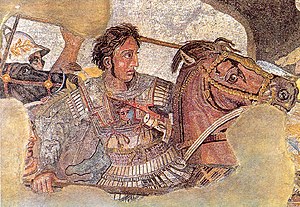
Alexander fighting Persian king Darius III. From Alexander Mosaic, from Pompeii, Naples, Museo Archeologico Nazionale.
Reign 356-323 BC
Born July 20, 356 BC

Pella, Macedon
Died June 10, 323 BC
  Babylon
Predecessor Philip II
Successor Alexander IV
Consort Roxana of Bactria
Stateira of Persia
Issue Alexander IV
Father Philip II of Macedon
Mother Olympias of Epirus

Alexander the Great (Greek: Αλέξανδρος ο Μέγας or Μέγας Aλέξανδρος,[1][2] Megas Alexandros; July 20, 356 BCJune 10, 323 BC),[3][4][5] also known as Alexander III, was an ancient Greek[6][7][8] king (basileus) of Macedon (336323 BC). He was one of the most successful military commanders in history, and was undefeated in battle. By the time of his death, he had conquered most of the world known to the ancient Greeks.

Following the unification of the multiple city-states of ancient Greece under the rule of his father, Philip II of Macedon (a labour Alexander had to repeat because the southern Greeks rebelled after Philip's death), Alexander conquered the Achaemenid Persian Empire, including Anatolia, Syria, Phoenicia, Judea, Gaza, Egypt, Bactria, and Mesopotamia, and extended the boundaries of his own empire as far as Punjab, India.

Prior to his death, Alexander had already made plans for military and mercantile expansions into to the Arabian peninsula, after which he was to turn his armies to the west and (Carthage, Rome, and the Iberian Peninsula). His original vision had been to the east, though, to the ends of the world and the Great Outer Sea, as described by his boyhood tutor Aristotle.

Alexander integrated many foreigners into his army, leading some scholars to credit him with a "policy of fusion." He also encouraged marriages between his soldiers and foreigners; he himself went on to marry two foreign princesses.

Alexander died after twelve years of constant military campaigning, possibly as a result of malaria, poisoning, typhoid fever, viral encephalitis or the consequences of alcoholism.[9][10] His legacy and conquests lived on long after him, and ushered in centuries of Greek settlement and cultural influence over distant areas. This period is known as the Hellenistic Age, and featured a combination of Greek, Middle Eastern and Indian culture. Alexander himself was featured prominently in the history and myth of both Greek and non-Greek cultures. His exploits inspired a literary tradition in which he appeared as a legendary hero in the tradition of Achilles.


Alexander united the several city-states not conquer them. Notice the words "unification" and "conquered". He though of the rest of "Greece" as a nation very close to his own, they felt "Greek".

 
Proof that Alexander and his father's empire was Greek (again as a nation, NOT a country)


AkiraGr said:
Can you please give me a copy of the book you have so i can read what the fuck the guy wrote(translate) in that please. There is no sense to what Plutarch in your book say with the original manuscripts.

http://www.amazon.com/Age-Alexander-Greek-Penguin-Classics/dp/0140442863/ref=sr_11_1?ie=UTF8&qid=1200120413&sr=11-1


Around the Network

Sweet. Wikipedia. Cause, that's not something that could be eaisly changed considering there are some strange land disputes that are around now... depending apparently on the heritage of people long dead.


Athens!


On the Malice of Herodotus

In On the Malice of Herodotus Plutarch criticizes the historian Herodotus for all manners of prejudice and misrepresentation. It has been called the “first instance in literature of the slashing review.”[10] The 19th century English historian George Grote considered this essay a serious attack upon the works of Herodotus, and speaks of the "honourable frankness which Plutarch calls his malignity."[11] Plutarch makes some palpable hits, catching Herodotus out in various errors, but it is also probable that it was merely a rhetorical exercise, in which Plutarch plays devil's advocate to see what could be said against so favourite and well-known a writer.[3] According to Plutarch scholar R. H. Barrow, Herodotus’ real failing in Plutarch’s eyes was to advance any criticism at all of those states that saved Greece from Persia. “Plutarch,” he concluded, “is fanatically biased in favor of the Greek cities; they can do no wrong.”[12]


From wikipedia the source of all the data collected on Alexander was from Herodotus and Plutarch is also live in the Roman Empire that has become Greece after the invasion of the romans. So i have sourches and proof from Herodotus prior to Plutarch that say that Macedonian are Greek, which is of course what Plutarch also say in his manuscrips but even if we take your book as it says why would Herodotus say the excact opposite from Plutarch which Plutarch took from Herodotus any information from his work to write about Alexander???

To many question, no real answear with scientific proof......except your bad transalted book you have.  


Ok thanks i order it. I will read it and then if you can find someone to translate greek to you read this.

http://www.perizitito.gr/authors.php?authorid=21958


Kasz216 said:
Sweet. Wikipedia. Cause, that's not something that could be eaisly changed considering there are some strange land disputes that are around now... depending apparently on the heritage of people long dead.

At least I offered some evidence, if not completely reliable, to the table. And just so we know, if the Macedonians weren't in fact Greek what were they?