By using this site, you agree to our Privacy Policy and our Terms of Use. Close

Forums - Politics - The effect of income equality on societies...

This video goes into the effect of income inequality in societies.  Whether or not the income inequality is caused by the problems, or the income inequality causes the problems, is subject to debate.  This video argues societies are worse off overall if income inequality is larger (it is from TED):


Around the Network

As with all things, there's diminishing return as you accumulate whateverthingamajig it is.
Money becomes unimportant and it no longer give you the same kind of satisfaction.


I'd suggest reading the first chapter of "The Consequences of Peace."

You can download it for free at Project Guttenburg.

http://www.gutenberg.org/ebooks/15776


all he said is common sense


Or to go into further detail now that i have time. To argue that income inequality overall is "Bad" is a naive approach.

All one needs to do is imagine a society in which the gini coefficent is 0.

Where does someone go for a loan? How much money is actually invested, versus being used for common gain? How does medical research get funded?

Wealth distribution in general is a matter of Consumption vs Investment. The more equality you have, the more consumption you have and less investment in future products. The more inequality you have, less money is used for consumption, and more is used for investment in the future, either through research, infrasturcuture or the creation of new investments and companies.

Go to far in either direction and you either end up with stagnation or excess poverty, but the truth is, you generally NEED some level of inequality in society and not just for "motivation" reasons.

In general, gini coefficent arguements tend to fall down a bit because there are a some nations run by people who rob their poor countries, and use all that money for their own consumption and don't reinvest much because unlike us, they don't really have an excess of wealth even when concentrated at the top.


Around the Network

The debate on inequality is (often) formed incorrectly in order to promote the redistribution of wealth, when the real question about inequality is whether there are structural discrimination preventing people from making decisions that will lead to them earning more money. If there is no structural discrimination than the redistribution of wealth is punishing a successful individual for making good decisions that lead to their success to reward other individuals who made poor decisions that led to their failure; in contrast, if there is structural discrimination why wouldn't you address that rather than simply trying to gloss over the problem through the redistribution of wealth?


HappySqurriel said:
The debate on inequality is (often) formed incorrectly in order to promote the redistribution of wealth, when the real question about inequality is whether there are structural discrimination preventing people from making decisions that will lead to them earning more money. If there is no structural discrimination than the redistribution of wealth is punishing a successful individual for making good decisions that lead to their success to reward other individuals who made poor decisions that led to their failure; in contrast, if there is structural discrimination why wouldn't you address that rather than simply trying to gloss over the problem through the redistribution of wealth?

In order to discuss the issue, and have meaningful action be determined to address it, it has to be recognized as both existing and a problem.  It is true that an action to address an issue can be merely treating symptoms, rather than causes.

As it is now there is both debates over whether or not it exists at all, and is a problem.  Consider talk by Mitt Romney for example, who calls it merely envy:

http://money.cnn.com/2012/01/12/news/economy/romney_envy/index.htm?hpt=hp_t2


The thing people have to understand about the monetary system is that it is a ZERO-SUM GAME.
That is a FACT.

They call it inflation when more money is made. Inflation means money loses its value, loses its worth.
If everybody had decent dollars, then money would have no point.
It is a system that DEPENDS on INEQUALITY.
In the monetary system, for someone to be rich someone else has to be poor.
The more money a few people have, the poorer more people become.
It is INHERENT in the system to be that way.

Warped humanity in their backwards thinking believe that RARITY of a resource means WEALTH.
REALITY shows ABUNDANCE of a resource is WEALTH. When things become common, when they become commodities.

Think of that hierarchy of needs that Maslow guy detailed.
You can't go hardly a minute without breathing. Air is the most important thing a human being needs first & foremost. But air is ABUNDANT, isn't it? Not rare. It's everywhere & the powers that be haven't quite figured out a way to charge for it yet.

You can't go hardly a week without drinking water. Water is SECOND most important thing a human being needs. But drinkable water is ABUNDANT, correct? Not rare. It's so common that schools, stores, & all types of facilities offer it for FREE in the form of indoor water fountains.

You can't go hardly a couple of weeks without eating food. Food is the THIRD most important thing a human being needs. But food is ABUNDANT, don'cha know? Not rare.
Sure, they charge for food but in comparison to its 'essentiality' to the human design, it's fairly cheap. Besides, a single town throws more food away in a single day to feed a small nation probably for a week. And get this, for those who can't afford the food prices, there are food pantries & soup kitchens who feed them for FREE!

Value is NOT based on Rarity. It is based on function. I need fresh air to breathe. I need clean water to drink. I need nourishing food to eat. Whether there's a little or a lot, these are the 1st 3 essential things a human needs to EXIST. Essentials by function. Say I'm in a desert & I haven't eaten or drunk water in days. Hungry & thirsty, I run across a real oasis with coconut trees and a pool of water. Within this oasis I see a treasure chest full of gold. Which has more value to me in this situation? Simple answer. I can't eat or drink gold.

Money is a bad game started by corrupt players & the world suffers for it. Human beings will never fix the money system because it is designed to pit humanity against itself in the name of greed.
All money is fiat. Imagined value. The gold standard is just as flimsy as the federal reserve note. Both non-essential things we pretend have essential value. It's all make-believe like the stuff in Mister Rogers' Neighborhood.

The inequality ends once we realize we are our brother's (& sister's) keeper. Once we nip our inherent greed in the bud & learn to share. Until then all remedies to address this problem are merely Band-Aids on a gushing bone-deep wound.
John Lucas


Words from the Official VGChartz Idiot

WE ARE THE NATION...OF DOMINATION!


johnlucas said:
The thing people have to understand about the monetary system is that it is a ZERO-SUM GAME.
That is a FACT.

Er... no it isn't... and even the most(I'd actually say all, but who knows there might be like 2 people with economics degress out there who disagree) leftwing economists would disagree with you.


Additionally, water actually isn't abundant... and I'd argue you don't really know what your talking about when it comes to Maslow's hierarchy of needs.

For example, Water and Air weren't ranked, and were in the same level.

Additionally, in a desert Oasis, you'd take the food.

In modern society, you'd take the gold, then buy food, and a bunch of otherstuff....


All your arguement did was highlight exactly why rarity is an important factor to price controls.

If I tried to trade you a bottle of air right now... would you trade me a piece of gold for it right now?  Or some money? 

Can't breathe money afterall.


richardhutnik said:
HappySqurriel said:
The debate on inequality is (often) formed incorrectly in order to promote the redistribution of wealth, when the real question about inequality is whether there are structural discrimination preventing people from making decisions that will lead to them earning more money. If there is no structural discrimination than the redistribution of wealth is punishing a successful individual for making good decisions that lead to their success to reward other individuals who made poor decisions that led to their failure; in contrast, if there is structural discrimination why wouldn't you address that rather than simply trying to gloss over the problem through the redistribution of wealth?

In order to discuss the issue, and have meaningful action be determined to address it, it has to be recognized as both existing and a problem.  It is true that an action to address an issue can be merely treating symptoms, rather than causes.

As it is now there is both debates over whether or not it exists at all, and is a problem.  Consider talk by Mitt Romney for example, who calls it merely envy:

http://money.cnn.com/2012/01/12/news/economy/romney_envy/index.htm?hpt=hp_t2

I'd think the first step to solving a problem would be to actually suggest it is a problem.

Nothing in the video actually establishes it as a problem, because it's all generally anyone who's ever taken a class in research methods could tear down pretty eaisly... not even in a "causation vs correlation" way.  (Though it also fails in that regard.)

Really, i'm not sure what's happened to you the last few months...  you used to better then buying into overtly obvious propganda.


Though if you want to figure out how to address icnome inequality.  There isn't really a good way, since in general the gini coefficent gap in the US has been caused by the growth in Dual income familys, women gaining equality and single parent families... Rich individuals haven't been getting richer.

.
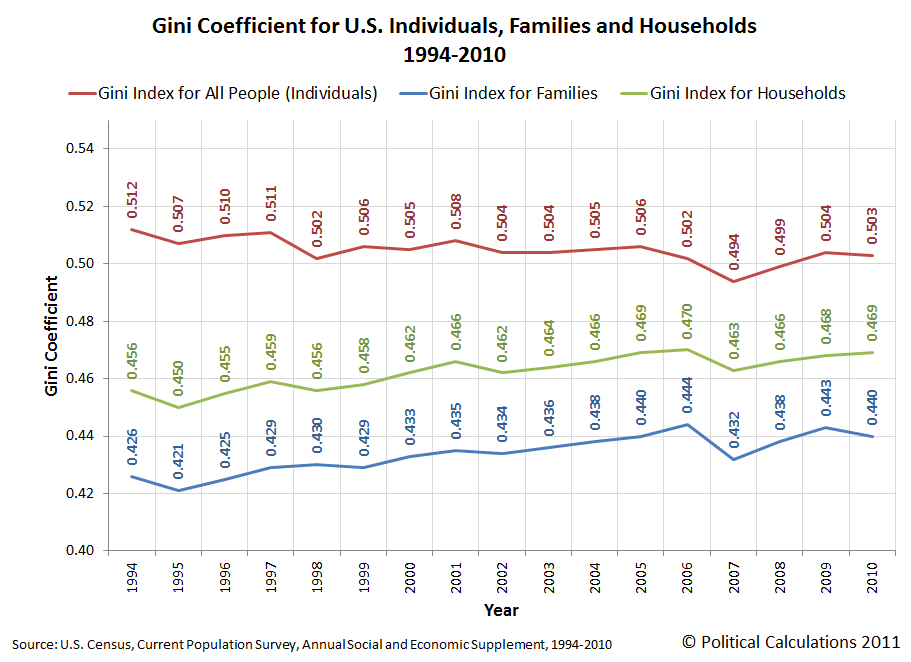
 

In general what happened was, women started making more money, which meant that when a Man and Woman got married and people started marrying more "Within there class."

This is espiecally true when you consider the fact that most men would STILL be upset if their wife made more then them.  Meaning that woman making $50,000 a year is far more likely to marry a man making 50K + then the man who would of had that job 10 years ago would have.

Clearly nobody actually wants women to be treated as unfairly as they used to be in the workplace anymore.  Furthermore, this SHOULD be a self correcting problem.  It will rise more as women continue to make more money.  (Some studies suggest that women under 30 actually do BETTER on average then their male counterparts at this point.)

However, eventually men will stop being douchebags and not care if their wives are the breadwinners marrying SHOULD become more like it was in 1994, and everything should fall back down to slightly above 1994 levels.

It still staying somewhat over it, likely do to single parents.