richardhutnik said:
mrstickball said:
Tax cuts won't create jobs when the government is doing all it can do to discourage private investment. Remove regulations and reform those that must remain to ensure that businesses have every incentive possible to hire, and compete against businesses overseas.
Furthermore, you assume that Republicans are innocent in regards to regulations - they are not. The Republicans passed things like the Patriot Act (which meant that transferring significant amounts of monies were required to be reviewed by specific agencies) and Medicare Part D. Both sides are implicit in this, although Obama's administration has done far more it seems.
|
How exactly did a lack of regulations cause the housing bubble and the dotcom bubbles of the last decade? There is an entire derivates market has been completely unregulated and engaged in credit default swaps and chopped up housing loans into tiny pieces and mixed good with bad and then sold those as assets that were badly rated by private rating agencies, because of flaws in their mathematical models. If you bring in the Fed being a big problem with its easy money policies, I wouldn't argue against that. Nor, would I argue against you saying that a large amount of problems are caused by what the government does. However, I will argue if you lay every single problem at the foot of government, and say that, somehow, if government got out of the way, we would have some sort of paradise, or, oh well freedom does cost lives, but what do you expect?
If you were to argue the case of investment being something that actually produces goods and services in the nation that offers the tax cut, it is fine. But what I see today is what is called investments is a ton of money flowing into derivates and paper, which doesn't produce jobs. Or investors feel that they get a better return in corrupt places like China, because they growth rate is larger, and also they wages are lower and polution standards are non-existent. So, to make things more competitive in America, get rid of minimum wage, allow people to be paid pennies per hour, and also get rid of all polution standards. In other words, race to the bottom.
|
First off, the dot-com bubble and housing bubble are not the same.
Secondly, the housing bubble started well before the derivatives market was even established in the context of the housing bubble. Home ownership began to spike in 1994 thanks to acts initiated by Bill Clinton and Executive Order 12898 among other things. The bubble was firstly initiated by a government that wanted to artificially inflate housing demand, thus creating market growth. Once established, we then know that loans were incentivized due to meddling by the Federal Reserve's historically low interest rates (again to create growth) which helped spur on the sub-prime mortgage schemas, and the derivatives market to cover up the bad deals that were being made.
Having said that, I do not fault the government for 100% of the problem. Obviously, businesses took advantage of government policies that sought to enable them to take on high-risk clientelle and socialize their defaults (remember, the government pays back the banks that foreclose, thus creating a huge incentive for them to simply write off the losses and get the monies back in taxes, then sell the house at a later date and make money). Finally, you have an idiotic population that bought into the idea that home ownership is a must-have, which got people to purchase these houses they couldn't afford with money they did not have.
Its my view, however, that government 'primed the pumps'. They were the ones that incentivized the activities with adjusting interest rates, promoting minority home ownership against market policies, and generally pursued a strategy of incentivizing bad markets. Without government being there as the sugar daddy of bad policies, I do not believe the banks would have taken on such bad loans, and if they did, it would have been to a much lesser degree. Additionally, those that would have taken on bad loans would have went bankrupt, and the market would have corrected quicker.
Richard, its not about 'racing to the bottom'. Its about making our industry globally competitive. You argue minimum wages would cause our workers to be paid pennies on the dollar, but I can't think of a single manufacturing job that pays minimum wage. Better yet, I don't think I can name more than 5 or 10% of jobs that even pay minimum wage right now. If minimum wage were abolished, it wouldn't effect current jobs, but would create new ones for markets that are ultra-low skilled that cannot exist under current wage floors.
In regards to regulations, we're cutting our throats by enacting legislation that discourages jobs in the name of insane requirements. For example, America has the most stringent requirements for diesel in the world. So stringent, that we cannot produce many types of vehicles here such as Ford's new 68MPG vehicle which is being sold in Europe right now. I am not saying that we must care about the environment as much as China does, but we can be far more reasonable and business friendly (after all, why do you think these jobs went overseas? Its not just wages, its regulations that have driven many jobs away because the government decided that it would take more and more capital to meet requirements to build factories here).
America has the capability to be a producer of high-tech goods, far greater than anywhere else in the world due to our unique access to resources, massive amounts of capital, and a decently educated labor force. The issue, however, is that these capital-intensive projects (such as......a Space-X or Tesla car plant) need lesser regulations in ensure these jobs stay here, forever. Remember: Our jobs aren't just going overseas to China, they are also going to Europe, Japan, and other OECD countries that have lowered their tax rates, regulations and such while we've either remained stagnant or increased regulatory requirements.
I'll leave a few charts here for you:

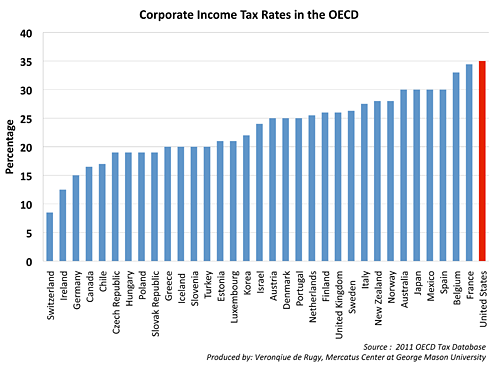

Just a few things to think about.